Industrial blower manufacturer is a search that usually shows up at one of two very different moments either someone is trying to understand what an industrial blower actually is, or someone is already deep into sourcing one and trying to figure out who to trust with the order. This guide is built to answer both, properly, in one place. Whether you’re a plant engineer specifying your first blower, a purchase manager comparing quotes, or a business owner trying to understand why your current blower isn’t performing, you’ll find a complete, practical answer here including types, real applications, pricing ranges, and exactly what separates a dependable industrial blower manufacturer from one that will cost you more in the long run than it saved you upfront.
Let’s go through this systematically, the way a good manufacturer should walk you through it before you ever place an order.
What Is an Industrial Blower and Why Does Nearly Every Industry Need One?
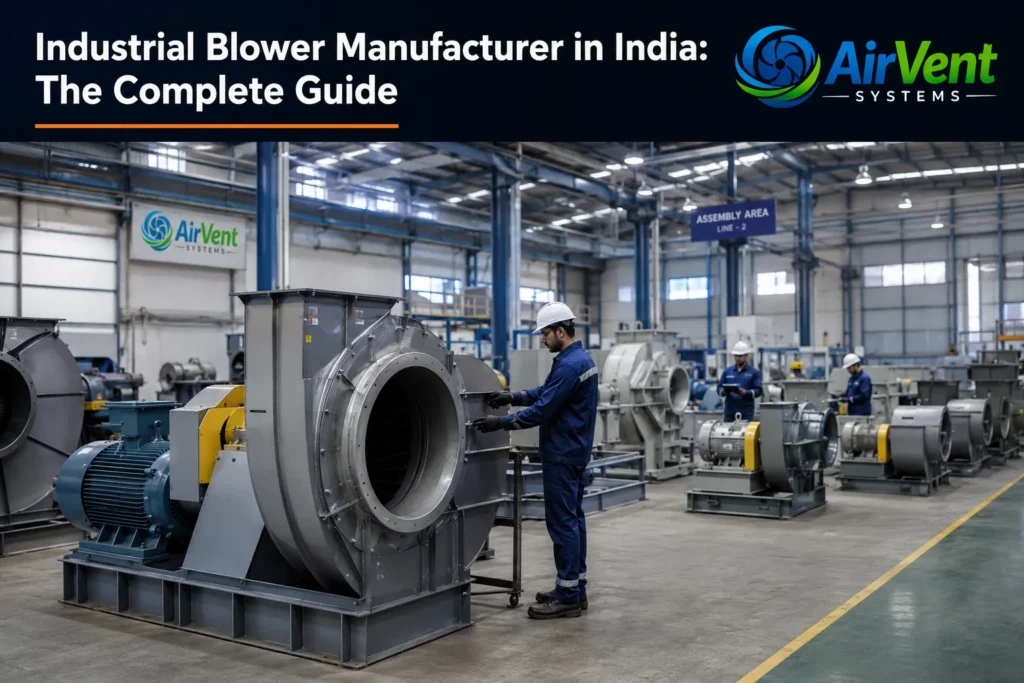
An industrial blower is a mechanical device that moves large volumes of air or gas through a system using a rotating impeller, and it forms the backbone of ventilation, cooling, drying, conveying, and pollution-control processes across virtually every manufacturing sector. Unlike a household fan, an industrial blower is engineered to move air against real resistance filters, ducting, process equipment while running continuously, often in hot, dusty, or corrosive environments.
Consequently, industrial blowers show up almost everywhere:
- Ventilating factory floors and removing heat or fumes
- Supplying combustion air to boilers and furnaces
- Conveying powder, grain, or granular material through pipelines
- Cooling process equipment and machinery
- Feeding air into dust collectors, scrubbers, and pollution-control systems
- Drying, aerating, and material handling in food, pharma, and chemical processes
Given how broad these applications are, it’s no surprise that choosing the right type and the right industrial blower manufacturer genuinely changes how well your process runs.
Types of Industrial Blowers Explained
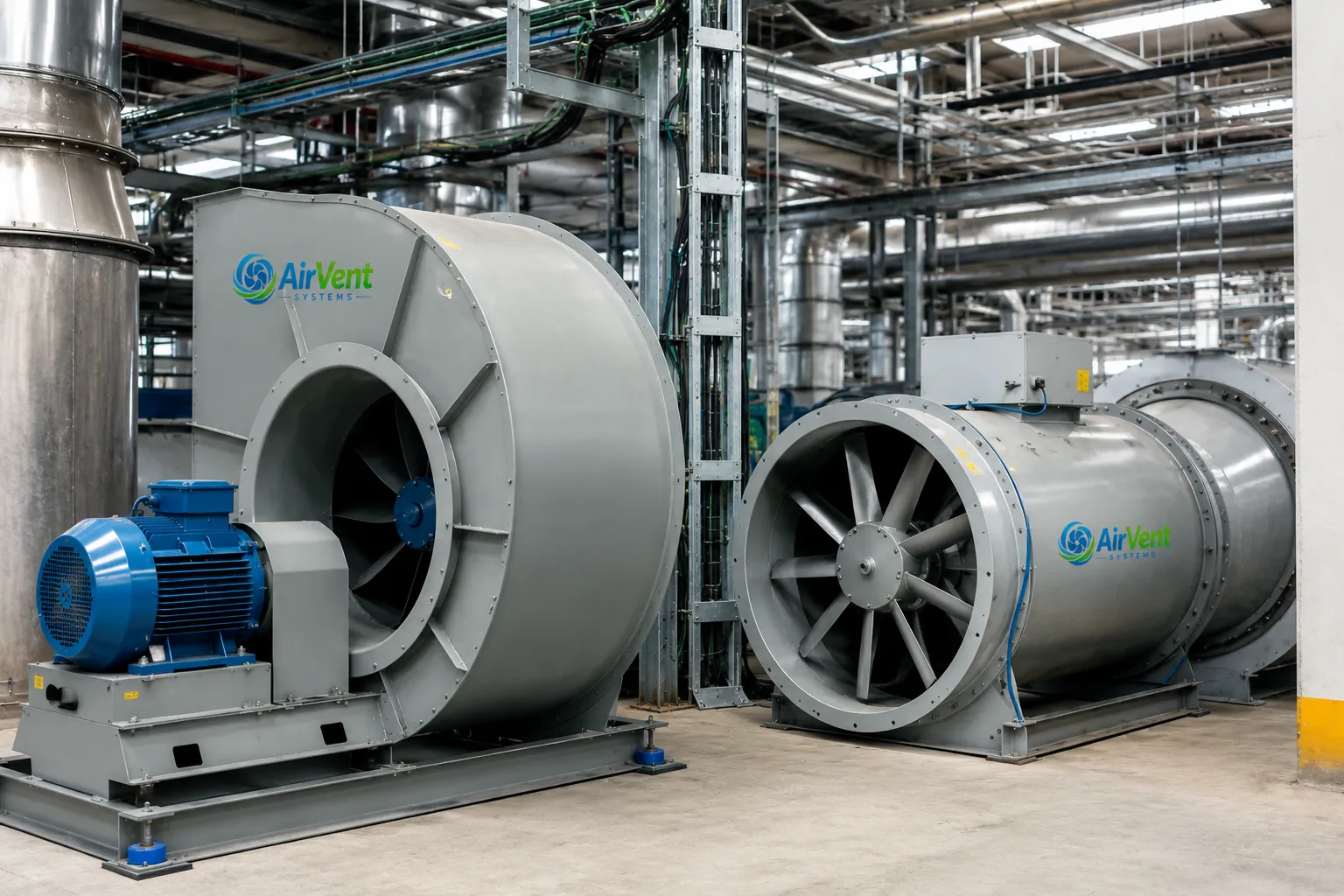
Every reliable industrial blower manufacturer will tell you the same thing: choosing the correct type matters more than choosing the biggest one. Here are the main categories you’ll come across.
Centrifugal Blowers
Centrifugal blowers use a rotating impeller to fling air outward at a 90-degree angle, building up high static pressure before discharging air through a single outlet. This makes them the go-to choice whenever air has to travel through resistance long ducting, filters, or dense process equipment.
Best for: Dust collection systems, combustion air supply, pneumatic conveying, and any application requiring high static pressure.
Axial Blowers (Axial Fans)
Axial blowers move air in a straight line, parallel to the shaft, much like a propeller. They deliver high air volume but relatively low pressure, and they’re compact enough to mount directly in-line on ducting.
Best for: General ventilation, cooling towers, and open, low-resistance airflow needs. For a deeper comparison, see our detailed breakdown in Centrifugal Blower vs Axial Fan: Which One Does Your Process Need?
Positive Displacement (Roots) Blowers
Roots blowers use meshing rotors to trap and push a fixed volume of air with each rotation, delivering a constant flow regardless of system pressure changes. This makes them ideal where flow consistency matters more than raw efficiency.
Best for: Pneumatic conveying of powders and granules, wastewater aeration, and vacuum applications.
Regenerative Blowers
Regenerative blowers recirculate air through a series of impeller blades multiple times before discharge, building moderate pressure with very quiet, efficient operation.
Best for: Food processing, pharmaceutical packaging, and clean, low-noise environments.
Heavy Duty Industrial Air Blowers
This is less a distinct technology and more a build classification heavy duty industrial air blowers are constructed with reinforced casings, higher-grade bearings, and upgraded motors to handle continuous duty, higher temperatures, or abrasive dust loading. If your process runs 24/7 or handles harsh material, this is the classification you should be asking your industrial blower manufacturer about specifically, rather than a standard-duty unit.
Industrial Blower Types Compared
| Type | Pressure | Airflow Volume | Noise | Typical Use |
| Centrifugal blower | High | Moderate | Low to moderate | Dust collection, combustion air |
| Axial blower | Low to moderate | High | Can be higher | General ventilation, cooling |
| Roots (PD) blower | Very high | Constant regardless of pressure | Moderate to high | Pneumatic conveying, aeration |
| Regenerative blower | Moderate | Moderate | Very low | Food, pharma, packaging |
| Heavy duty air blower | Application-dependent | Application-dependent | Application-dependent | Continuous duty, harsh conditions |
Industrial Blower Applications Across Industries
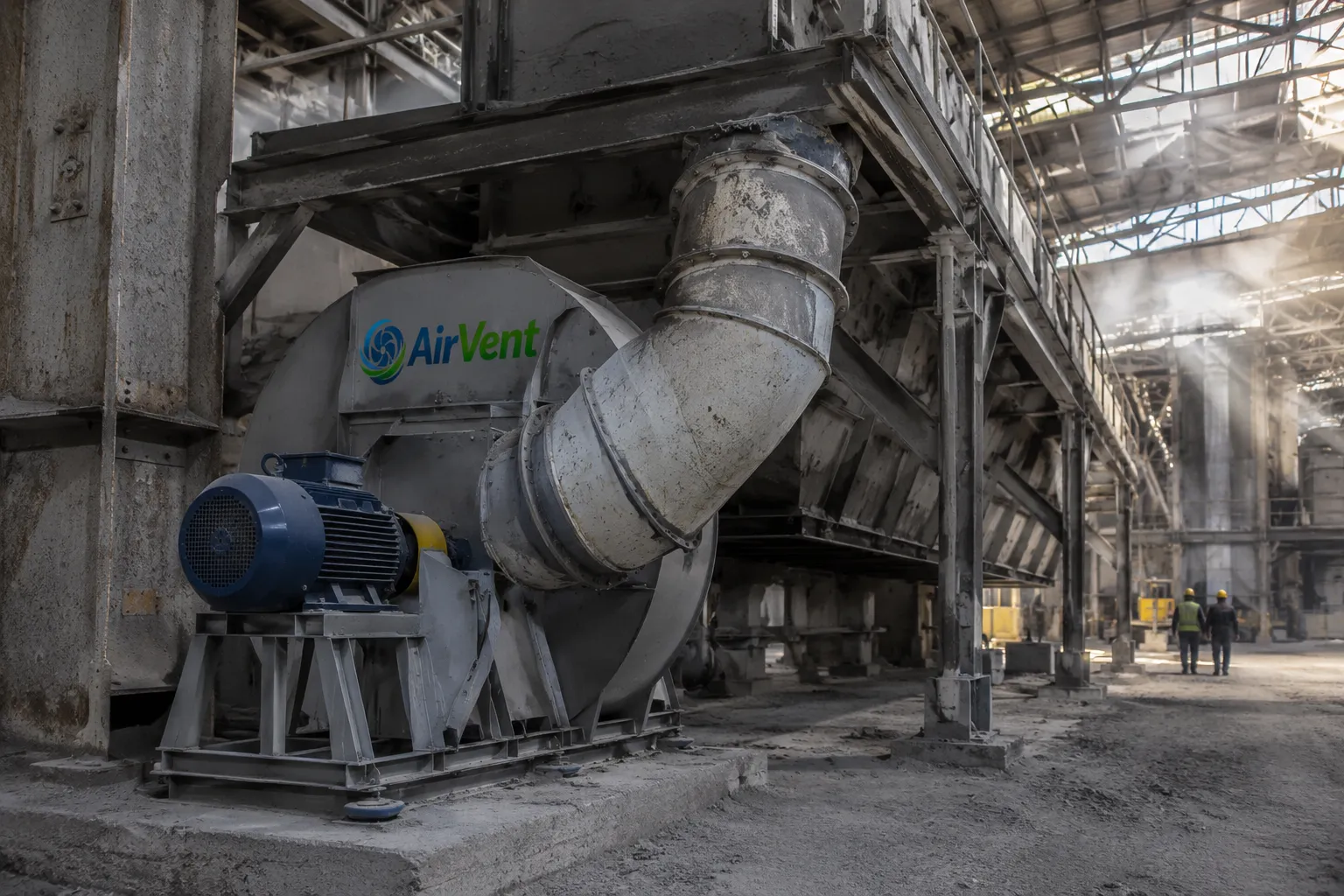
An experienced industrial blower manufacturer designs differently depending on the industry it’s serving. Here’s how the same core technology gets applied differently:
- Cement and steel plants: combustion air supply, dust collection feed, high-temperature exhaust
- Chemical and pharmaceutical units: corrosion-resistant blowers for fume extraction and process air
- Food processing: hygienic, low-noise regenerative blowers for drying and packaging lines
- Foundries: heavy duty blowers for fume extraction and dust-laden air handling
- Textile mills: ventilation and material conveying blowers for lint and fiber handling
- Wastewater treatment: roots blowers for aeration basins
- Automotive and fabrication: industrial blower for cleaning components, drying paint lines, and general fume extraction
Industrial Blower for Cleaning: A Specific Use Case Worth Knowing
One search we see often is industrial blower for cleaning, and it’s worth addressing on its own because the requirement is genuinely different from a standard process blower. Cleaning applications blowing away debris, drying surfaces, clearing conveyor lines typically need high-velocity, moderate-pressure airflow in a compact, often portable format, rather than the continuous high-static-pressure output a boiler or dust collector needs. If cleaning is your primary use case, tell your industrial blower manufacturer this upfront, since sizing for cleaning duty is a different calculation than sizing for continuous process duty.
How Much Does an Industrial Blower Cost in India?
This is, understandably, one of the most common questions we get, and honestly, there’s no single number that answers it honestly pricing depends heavily on type, capacity, and build quality. That said, here’s a realistic range to help you budget:
| Blower Type/Size | Approximate Price Range (INR)* |
| Small industrial blower fan (up to 1 HP) | ₹8,000 – ₹25,000 |
| Centrifugal blower (2–10 HP) | ₹25,000 – ₹1,50,000 |
| Centrifugal blower (10–50 HP) | ₹1,50,000 – ₹6,00,000 |
| Heavy duty / high pressure blower | ₹3,00,000 and above |
| Roots (PD) blower | ₹1,50,000 – ₹8,00,000 |
| Regenerative blower | ₹15,000 – ₹1,00,000 |
*These are indicative ranges only; actual pricing depends on material of construction, motor rating, static pressure requirement, and customization. Always get an application-specific quote rather than relying on a catalogue price.
A quick note on the “cost of 1 HP blower” question specifically: a basic 1 HP industrial blower typically falls in the ₹8,000–₹18,000 range for standard-duty units, though corrosion-resistant or specialized-motor variants can cost more.
What Makes a Reliable Industrial Blower Manufacturer?

“Which brand blower is best” is a question we get asked constantly, and honestly, the honest answer isn’t a single brand name it’s a set of criteria that separates a dependable industrial blower manufacturer from a risky one. Before you commit to a supplier, check for:
- Application-specific sizing, not a generic catalogue recommendation based on horsepower alone
- Material of construction options (MS, SS, FRP) matched to your process corrosive or high-temperature applications need this addressed upfront
- Testing and balancing standards, ideally referencing recognised specifications rather than an unspecified in-house benchmark
- After-sales support and spare parts availability, since downtime cost almost always exceeds the original purchase price
- Manufacturing experience across your specific industry, not just blowers in general
- Transparent quoting that breaks down motor rating, static pressure, and material grade rather than a single lump-sum figure
A manufacturer who asks detailed questions about your process before quoting is, in our experience, a far stronger signal of reliability than a manufacturer who quotes instantly off a standard size chart.
Custom-Built vs Standard Catalogue Blowers: Which Should You Choose?
This is a decision every industrial blower manufacturer will eventually walk you through, and it’s worth understanding before you get a quote. A standard catalogue blower is manufactured to a fixed set of specifications a specific horsepower, casing size, and material and it’s typically faster and cheaper to procure. A custom-built blower, on the other hand, is engineered around your exact static pressure, temperature, dust loading, and duty cycle.
- Choose a standard catalogue blower when: your application is straightforward, your operating conditions are close to typical (moderate temperature, low dust load, standard duty cycle), and lead time matters more than fine-tuned efficiency.
- Choose a custom-built blower when: you’re running continuous, 24/7 duty, handling corrosive or abrasive material, operating at elevated temperatures, or replacing a unit that has repeatedly underperformed.
In our experience, plants that skip this conversation and default to a standard catalogue size simply because it’s available faster often end up replacing that blower well before its expected working life, which ultimately costs more than the short-term time saved.
Energy Efficiency and Running Cost Considerations
Purchase price is only part of the real cost of an industrial blower running cost, driven largely by motor efficiency and correct sizing, adds up significantly over years of continuous operation. A blower that’s oversized for its actual duty runs inefficiently and wastes power every single hour it operates, while an undersized blower works harder than it should, shortening motor and bearing life.
A few practical points worth checking with your industrial blower manufacturer:
- Ask for the blower’s efficiency curve at your actual operating point, not just its maximum rated efficiency
- Consider IE2 or IE3 rated motors for continuous-duty applications, since the incremental cost is typically recovered within a couple of years of operation
- Where load varies significantly through the day, ask whether a variable frequency drive (VFD) makes sense it can meaningfully reduce power consumption compared to running a fixed-speed blower with a damper
- Factor in maintenance accessibility; a blower that’s difficult to service tends to get neglected, which increases both energy waste and failure risk over time
Therefore, when comparing quotes from different manufacturers, it’s worth asking each one to estimate annual running cost at your actual load, not just comparing the upfront invoice value.
How to Get an Accurate Quote from an Industrial Blower Manufacturer
To avoid the common mismatch problems covered above, share the following details with any industrial blower manufacturer before expecting an accurate quote:
- Required airflow (CFM or m³/hr)
- Required static pressure (mmWG)
- Operating temperature range
- Nature of the material being handled (clean air, dusty, corrosive, abrasive)
- Duty cycle (intermittent vs continuous, hours per day)
- Available installation space and orientation
- Applicable electrical supply (voltage, phase)
A manufacturer that asks for this information before quoting is, generally speaking, far more likely to deliver a blower that performs reliably than one that quotes based on horsepower alone.
Choosing an Industrial Blower Manufacturer in Pune and Maharashtra
Pune’s industrial belt spanning Bhosari, Chakan, Talegaon, and Pimpri-Chinchwad hosts a dense mix of automotive, pharma, foundry, and process manufacturing units, and each of these industries places very different demands on an industrial blower manufacturer. An automotive fabrication unit typically needs blowers for cleaning, drying, and fume extraction; a pharma unit needs hygienic, corrosion-resistant blowers for cleanroom-adjacent processes; a foundry needs heavy duty blowers built for continuous, high-temperature duty.
If you’re sourcing locally, working with an industrial blower manufacturer based in or near Pune has a genuine practical advantage: faster site visits for sizing, quicker turnaround on spares, and a better understanding of the specific MIDC industrial environment your blower will operate in.
Common Mistakes When Buying an Industrial Blower
I’ll be direct here, because these mistakes are avoidable and costly:
- Choosing based on horsepower alone, without confirming actual static pressure requirement
- Ignoring the material of construction question for corrosive or abrasive applications
- Buying the lowest quote without checking testing standards or after-sales support
- Underestimating duty cycle buying a standard-duty blower for a continuous, 24/7 application
- Skipping a site visit or process discussion before finalizing the order
Every one of these mistakes shows up repeatedly across the plants we work with, and every one of them is preventable with a proper pre-purchase conversation.
Maintenance Tips to Extend Industrial Blower Life
- Inspect and clean air inlets regularly to prevent dust buildup and imbalance
- Monitor bearing temperature and vibration on a scheduled basis
- Lubricate components according to the manufacturer’s recommended interval, not a reactive schedule
- Check motor current periodically to catch developing electrical faults early
- Keep ducting and dampers clear of obstruction, since restricted airflow increases load on the entire system
If you’re dealing with a blower that’s already showing signs of strain, our related guide on Common Causes of ID Fan Failure and How to Prevent Them covers many of the same failure patterns that affect centrifugal blowers under continuous duty.
How This Connects to Your Broader Air System
An industrial blower rarely works in isolation it’s almost always paired with downstream equipment. If your blower is feeding a dust collection system, our guide on Types of Industrial Dust Collectors: Cyclone, Baghouse and Cartridge Systems Compared will help you match the two correctly. And if you’re specifically evaluating combustion-side fans alongside your blower selection, our article on FD Fan vs ID Fan: Understanding the Difference is worth reading as well.
According to sector data compiled by the India Brand Equity Foundation (IBEF), India’s manufacturing sector continues to expand steadily, which directly drives rising demand for reliable industrial air-handling equipment across new and expanding facilities.
Frequently Asked Questions
What is an industrial blower?
An industrial blower is a mechanical device that moves large volumes of air or gas through a system using a rotating impeller, commonly used for ventilation, cooling, drying, conveying, and pollution control.
Which brand blower is best?
There isn’t a single “best” brand for every situation the right choice depends on whether the manufacturer sizes the blower to your actual application, offers the correct material of construction, and provides reliable after-sales support, rather than selling a generic catalogue size.
What are the types of blowers?
The main types of industrial blowers are centrifugal blowers, axial blowers, positive displacement (roots) blowers, regenerative blowers, and heavy duty industrial air blowers, each suited to different pressure, volume, and duty requirements.
What is the cost of a 1 HP blower?
A standard-duty 1 HP industrial blower typically costs between ₹8,000 and ₹18,000 in India, though price varies based on material of construction and motor specification.
How do I choose the right industrial blower manufacturer?
Look for a manufacturer that sizes blowers based on your actual static pressure and airflow requirement, offers suitable material of construction for your process, follows recognised testing standards, and provides dependable after-sales and spares support.
Final Thoughts
Choosing the right industrial blower manufacturer isn’t about finding the cheapest quote or the biggest horsepower number on the spec sheet it’s about finding a partner who takes the time to understand your actual process before recommending equipment. We’ve seen plants save significant money and downtime simply by switching to a correctly sized blower, and we’ve seen the opposite too, where an undersized or mismatched unit kept failing long before it should have.
At Airvent Systems, we manufacture centrifugal blowers, high-pressure blowers, and heavy duty industrial air blowers engineered around your actual application not a generic catalogue size. You can explore our full Industrial Blowers range, or reach out and share your requirement with our engineering team directly.
Not sure which blower fits your process? Get a Free Sizing Recommendation from Airvent Systems →