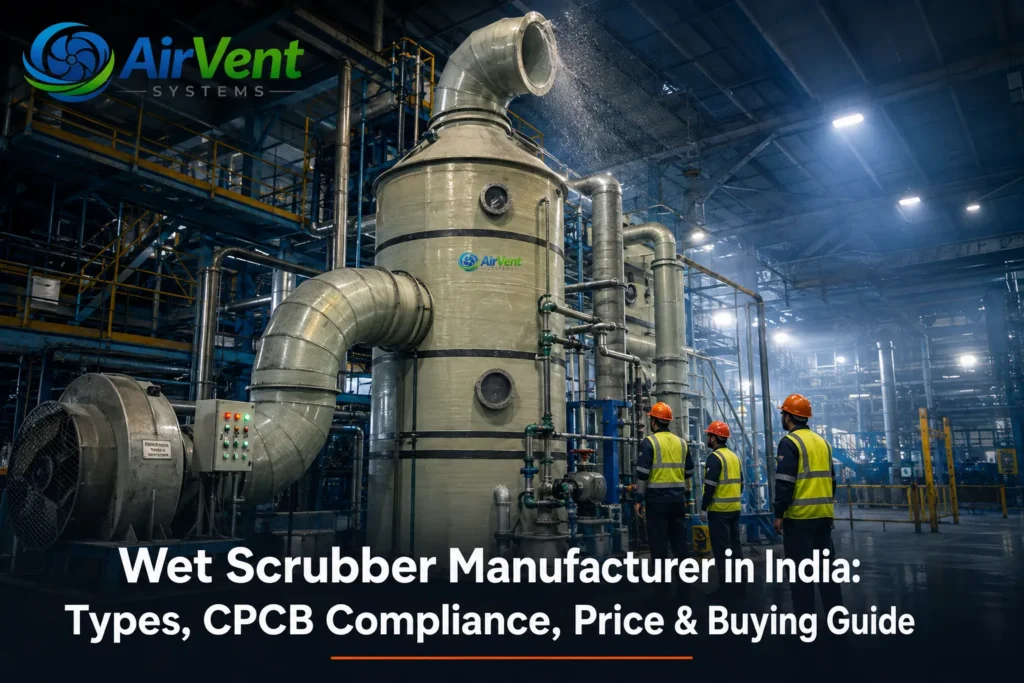
Wet scrubber manufacturer is a search that almost always comes from one of two very specific situations either a plant is already failing an emission check and needs a solution urgently, or an engineer is specifying pollution control equipment for a new project and trying to understand what they’re actually buying before they commit. This guide is built for both. After reviewing every major wet scrubber manufacturer currently ranking for this keyword Drizgas, Envigaurd, GTS Enviro, Parboiler, Cleantek, and Intensiv Filter Himenviro I can tell you what no wet scrubber manufacturer blog covers properly: real pricing with rupee figures, a genuine CPCB compliance guide specific to Maharashtra and India, an honest wet scrubber vs bag filter comparison, and the specific questions you should ask any wet scrubber manufacturer before placing an order. We cover all of that here, drawing from real manufacturing and field experience at our facility in Pune, Maharashtra.
If you’re looking for a wet scrubber manufacturer in Pune, Mumbai, or anywhere across India or simply trying to understand which type of scrubber your process actually needs this is the complete answer.
What Is a Wet Scrubber and How Does It Work?
A wet scrubber is an air pollution control device that removes harmful pollutants dust, acidic gases, chemical vapours, and particulate matter from industrial exhaust streams by bringing the contaminated gas into direct contact with a scrubbing liquid, typically water or a chemical solution. The pollutants are captured in liquid droplets through inertial impaction (for particles) and absorption (for soluble gases), then drained away as a slurry or liquid waste stream.
This direct gas-liquid contact is precisely what makes wet scrubbers uniquely suited to applications where both particulate matter and gaseous contaminants must be removed simultaneously something a dry bag filter dust collector simply cannot do. For a detailed comparison of when each system is the better choice, our article on Types of Industrial Dust Collectors covers the full selection logic.
Types of Wet Scrubbers: Which One Does Your Process Need?
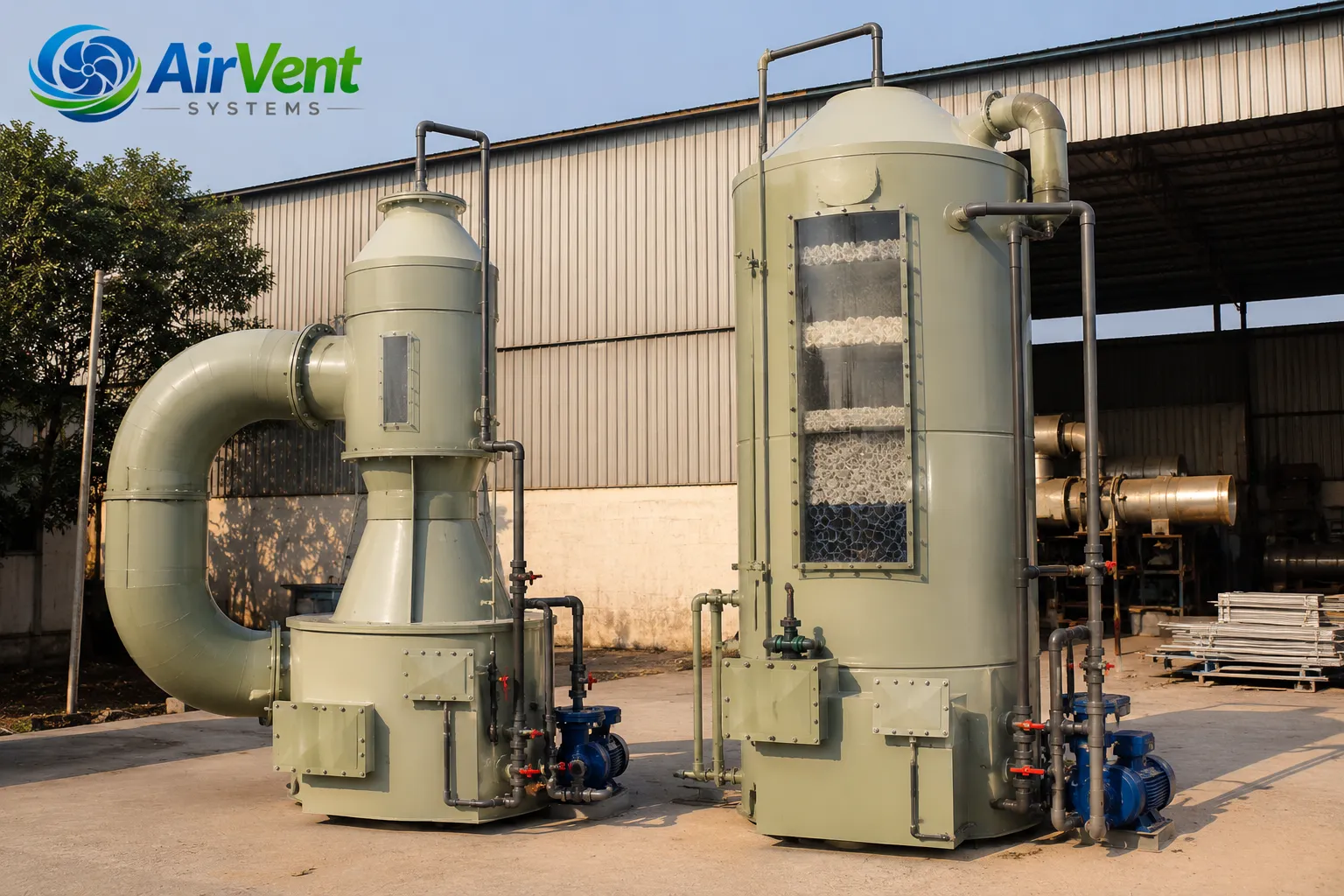
This is the most important decision in wet scrubber selection, and most wet scrubber manufacturer guides reduce it to a brief list. We’re going to go deeper, because the wrong scrubber type for your pollutant even from a well-built wet scrubber manufacturer will consistently underperform regardless of how well it’s constructed. Every experienced wet scrubber manufacturer will tell you the same thing: scrubber type selection must be driven by your specific pollutant, not by what’s cheapest or fastest to supply.
Venturi Scrubber
A venturi scrubber accelerates contaminated gas through a narrow venturi throat, where it collides at high velocity with a scrubbing liquid injected into the throat. This collision captures fine particles and soluble gases simultaneously with very high efficiency.
Removal efficiency: Up to 99% for fine particulate and soluble acid gases Best for: Fine dust, acid gas streams, hot and humid exhaust, applications with simultaneous particulate and gas removal requirements Common industries: Chemical plants, foundries, boiler flue gas, DG set exhaust, metal finishing
Honest limitation: Venturi scrubbers have higher pressure drop than other types, meaning they consume more energy to operate. If your pollutant is primarily coarse dust with no gaseous component, a bag filter may be more cost-effective. However, if your exhaust contains acid gases, soluble vapours, or sticky particles that would blind a fabric filter, a venturi wet scrubber is genuinely the right call.
Packed Bed Scrubber (Packed Tower Scrubber)
A packed bed scrubber passes contaminated gas upward through a tower filled with structured packing media, while scrubbing liquid flows downward over the packing surface. This counter-current flow creates a large gas-liquid contact area, making it extremely effective at absorbing soluble gases.
Removal efficiency: 95–99%+ for soluble gases (HCl, HF, SO2, NH3, H2S) Best for: Gaseous pollutants acid fumes, alkaline fumes, solvent vapours, odour control Common industries: Chemical and pharmaceutical plants, electroplating, pickling lines, fertiliser units, laboratory exhaust
Honest limitation: Packed bed scrubbers are not effective for heavy dust or sticky particulate the packing media blocks rapidly under heavy dust load. For combined dust and gas streams, a venturi scrubber or a two-stage system is the better design.
Spray Tower Scrubber
A spray tower scrubber passes gas upward through a vertical chamber where scrubbing liquid is sprayed downward from nozzles at multiple levels. It is the simplest and lowest-pressure-drop wet scrubber design, though also the lowest efficiency for fine particles.
Removal efficiency: 70–90% for coarse particles, lower for fine particulate Best for: Pre-cooling hot gas streams before a more efficient scrubber stage, coarse dust removal, and moderate-concentration acid gas streams Common industries: Cement pre-coolers, high-temperature exhaust pre-treatment, general fume knockdown
Dynamic / Cyclonic Wet Scrubber
A cyclonic wet scrubber combines the swirling action of a dry cyclone with water injection, using centrifugal force to fling particles outward onto wetted walls where they’re captured and drained away.
Removal efficiency: 85–98% depending on particle size Best for: Moderate-to-heavy dust loads with simultaneous cooling and gas absorption needs Common industries: Foundries, cement plants, coal handling, and grain processing
Venturi Scrubber vs Packed Bed vs Spray Tower Compared
| Feature | Venturi Scrubber | Packed Bed Scrubber | Spray Tower | Cyclonic Wet Scrubber |
| Best pollutant | Particulate + acid gas | Soluble gases only | Coarse dust, pre-cooling | Moderate-heavy dust |
| Removal efficiency | Up to 99% | 95–99%+ for gases | 70–90% | 85–98% |
| Pressure drop | High | Moderate | Low | Moderate |
| Maintenance need | Moderate | Low–Moderate | Low | Moderate |
| Water consumption | High | Moderate | Moderate | Moderate |
| Space requirement | Compact | Tall/vertical | Tall/vertical | Compact |
| Initial cost | Moderate | Moderate–High | Low | Moderate |
Wet Scrubber vs Bag Filter Dust Collector: Which Is Right for Your Process?
This is the question every plant engineer eventually asks, and it deserves an honest, direct answer rather than a one-sided comparison.
Choose a wet scrubber when: – Your exhaust contains both particulate matter and acid/soluble gases simultaneously – The dust or particles are sticky, hygroscopic, or would blind a fabric filter – Your exhaust is at high temperature or carries sparks or burning embers (fire risk eliminates fabric filters) – You need simultaneous gas cooling and pollutant removal – Your process produces explosive or flammable dust where water suppression is preferable
Choose a bag filter dust collector when: – Your pollutant is dry, non-sticky particulate only, with no gaseous component – Water handling and effluent disposal are a concern or constraint – Energy cost is a priority (bag filters have lower pressure drop than venturi scrubbers) – You need very high filtration efficiency for sub-micron dry dust
For many plants particularly foundries, chemical units, and DG set installations a combined system using a wet scrubber for gas absorption preceded by a cyclone or bag filter for gross dust removal gives the best overall compliance result at the lowest total cost.
CPCB Compliance: What Every Indian Plant Needs to Know
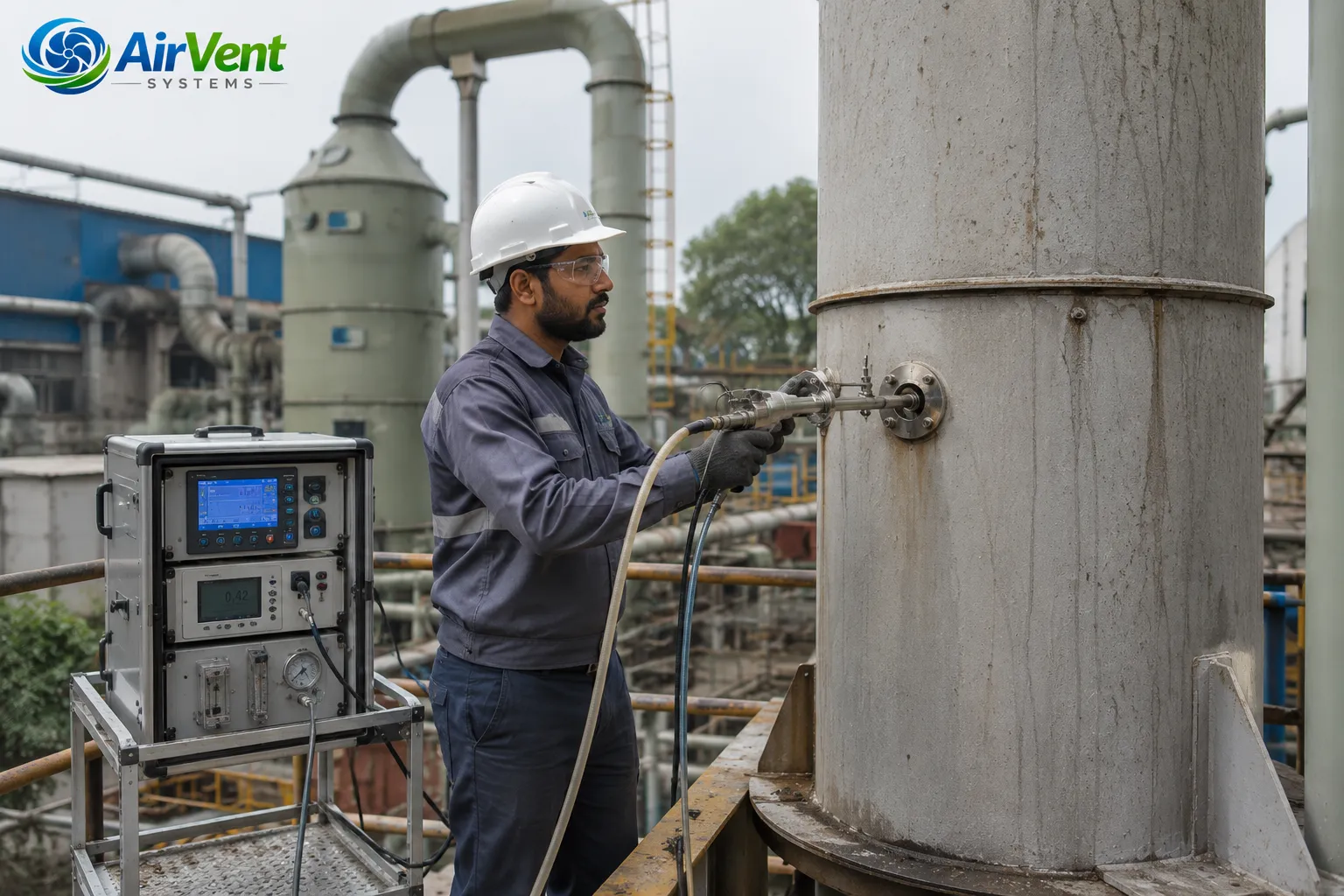
This is the section almost completely missing from competitor content, and it’s arguably the most important for any plant currently facing a compliance notice or setting up new emission control equipment.
The Central Pollution Control Board (CPCB) sets emission limits for particulate matter and specific gases at the stack, and State Pollution Control Boards (Maharashtra’s MPCB, for instance) enforce these limits through consent conditions. Here’s what you need to understand:
Particulate Emission Limits
- Most “Red Category” industries in India must achieve stack particulate emissions below 150 mg/Nm³ and in many cases below 50 mg/Nm³ for new installations
- A wet scrubber alone particularly a spray tower may not achieve sub-50 mg/Nm³ for fine particulate without additional polishing stages
- A high-efficiency venturi scrubber or a two-stage wet scrubber system is typically needed to reliably achieve sub-100 mg/Nm³
Acid Gas Removal
- HCl, SO2, HF, and H2S have specific emission limits under CPCB Schedule norms
- A packed bed scrubber with the correct scrubbing reagent (caustic soda for acid gases, dilute acid for alkaline gases) is typically the most reliable compliance route for acid gas streams
Effluent Handling
- Wet scrubbers generate a liquid effluent (contaminated scrubbing water) that itself requires treatment or disposal in compliance with CPCB/MPCB effluent norms
- Any wet scrubber manufacturer quoting only the scrubber unit without addressing the effluent handling design is giving you an incomplete solution
Key compliance documents to request from any wet scrubber manufacturer in India:
- Stack emission test data from a similar wet scrubber manufacturer installation (at the same efficiency rating you need)
- Removal efficiency guarantee in writing at your specific inlet concentration
- Confirmation that the wet scrubber manufacturer’s design meets the specific CPCB schedule relevant to your industry category
Wet Scrubber Price in India: Real Ranges
This is the most consistently avoided topic across all competitor websites and the most commonly searched. Here are honest, experience-based figures:
| Wet Scrubber Type / Size | Approximate Price Range (INR)* |
| Small spray tower scrubber (up to 1,000 m³/hr) | ₹50,000 – ₹1,50,000 |
| Venturi scrubber, small (1,000–5,000 m³/hr) | ₹1,00,000 – ₹4,00,000 |
| Venturi scrubber, medium (5,000–20,000 m³/hr) | ₹4,00,000 – ₹12,00,000 |
| Packed bed scrubber, small–medium | ₹1,50,000 – ₹6,00,000 |
| Packed bed scrubber, large (20,000+ m³/hr) | ₹6,00,000 – ₹20,00,000 |
| Cyclonic wet scrubber, medium | ₹2,00,000 – ₹8,00,000 |
| Complete two-stage system (wet scrubber + ID fan + pump + effluent tank) | ₹5,00,000 – ₹40,00,000+ |
Indicative ranges based on FRP or PP construction, which is standard for most wet scrubber applications. SS 304/316 construction adds 40–80% to the above figures. Actual wet scrubber price depends on gas volume (m³/hr), inlet pollutant concentration, required removal efficiency, material of construction, and whether an ID fan and liquid handling system are included.
Material of Construction for Wet Scrubbers: FRP, PP, SS or HDPE?
Unlike centrifugal blowers where MS is often adequate, wet scrubbers handle corrosive liquid-gas mixtures and almost never use mild steel as a construction material. Here’s the standard selection guide:
| Material | Corrosion Resistance | Temperature Limit | Relative Cost | Best For |
| FRP (Fibre Reinforced Plastic) | Very High | Up to 80°C | Low–Moderate | Most acid and alkali scrubbing applications |
| PP (Polypropylene) | High | Up to 60°C | Low | Mild acids, cleanrooms, pharmaceutical |
| HDPE | High | Up to 60°C | Low | Similar to PP, good impact resistance |
| SS 304 | Moderate-High | Up to 300°C | Medium | High-temperature applications with mild corrosion |
| SS 316 | High | Up to 300°C | Medium-High | High-temperature + strong acid or chloride environments |
For most Indian industrial applications chemical plant acid fume scrubbing, foundry exhaust, DG set emissions FRP is the standard and most cost-effective choice. SS 316 becomes necessary when operating temperatures exceed 80°C or when the specific acid concentration corrodes FRP over time.
What to Ask Any Wet Scrubber Manufacturer Before Ordering
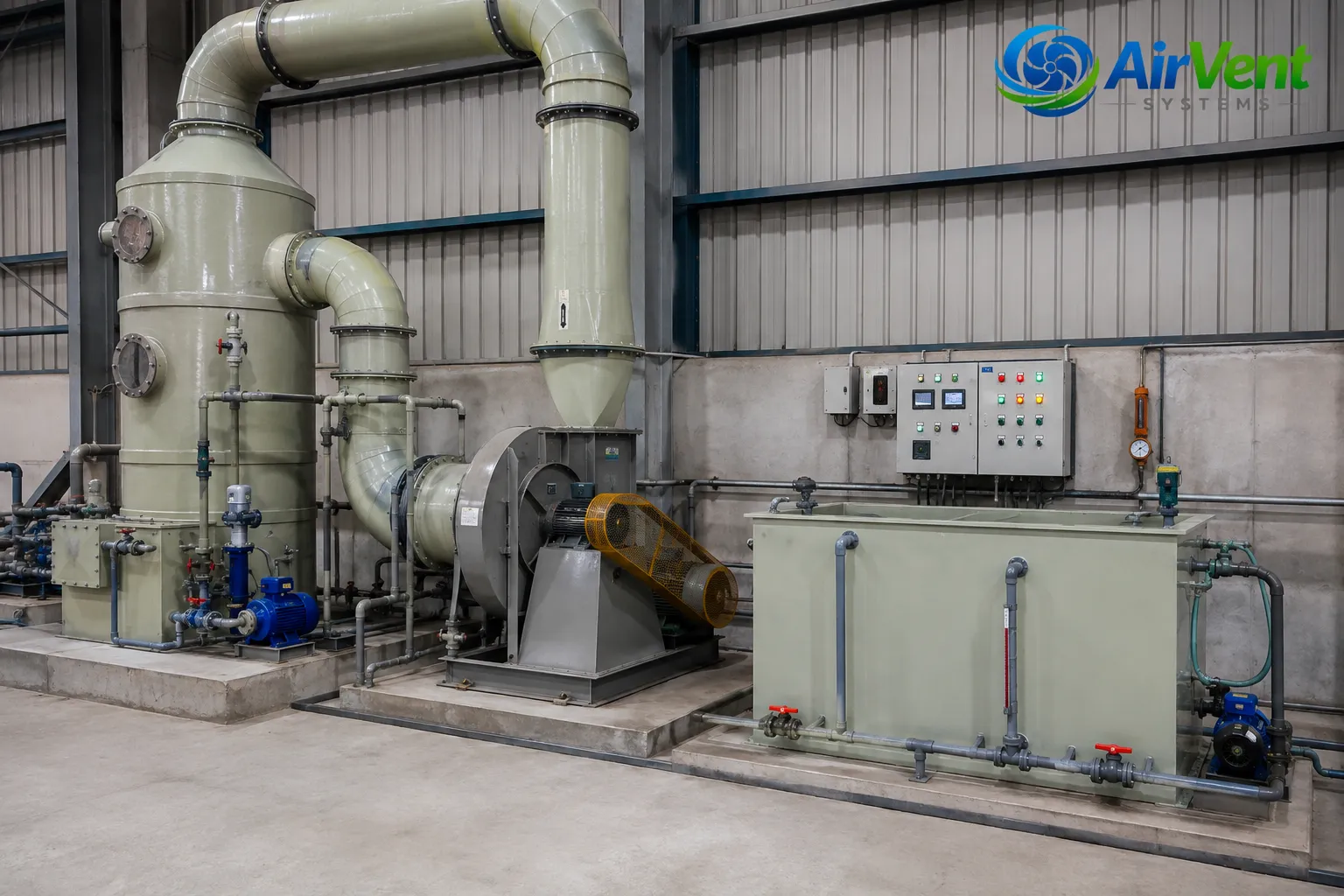
This is the checklist no wet scrubber manufacturer publishes and it’s the most valuable section for anyone currently evaluating wet scrubber manufacturer options in India:
- What removal efficiency do you guarantee at my inlet concentration? Get this in writing, at your specific gas volume and pollutant load not a generic “up to 99%” claim
- Which scrubber type are you recommending and why? A manufacturer who recommends a venturi for a pure gas-absorption application (where a packed bed would be more efficient and cheaper to run) is telling you something about their engineering depth
- How have you sized the liquid-to-gas ratio for my application? This is a core design parameter an undersized L/G ratio directly causes compliance failure
- What material of construction are you using and why? Ask for the specific grade FRP laminate thickness, PP or SS grade not just the material name
- Does your quote include the ID fan, circulation pump, and effluent sump? A wet scrubber without these is not a complete system and sourcing them separately almost always costs more
- Can you provide stack emission test data from a similar installation? Any wet scrubber manufacturer with genuine field experience will have this; one who cannot provide it is offering you an unproven design
Wet Scrubber Manufacturer in Pune and Maharashtra: Why Local Experience Matters
Maharashtra’s MPCB has specific consent conditions and stack emission requirements that can differ from generic CPCB Schedule norms, and they’re enforced actively across MIDC zones in Pune, Nashik, Aurangabad, Navi Mumbai, and Thane. A wet scrubber manufacturer based in Pune understands these conditions from direct field experience not from reading the MPCB website.
Working with a wet scrubber manufacturer in Pune means: – Faster site visits for accurate gas flow measurement and duct sizing – Direct familiarity with MPCB consent application requirements and stack testing protocols – Quicker turnaround on spare nozzles, packing media, and pump components from a local wet scrubber manufacturer – A wet scrubber manufacturer who can attend the MPCB stack test alongside you and address any in-situ findings immediately
These are not minor conveniences they’re genuinely significant when a compliance deadline is approaching or when a stack test result needs to be addressed within days.
For plants with combined air pollution control needs a scrubber for gas absorption paired with a centrifugal blower or ID fan for draft our related guides on Centrifugal Blower Manufacturer in Pune and India and Common Causes of ID Fan Failure and How to Prevent Them cover the complementary equipment that almost always works alongside a wet scrubber system.
Frequently Asked Questions
What is a wet scrubber manufacturer?
A wet scrubber manufacturer designs, fabricates, and supplies industrial air pollution control systems that remove dust, acid gases, chemical vapours, and particulate matter from exhaust streams by bringing contaminated gas into direct contact with a scrubbing liquid.
Which type of wet scrubber is best for acid gas removal?
A packed bed scrubber is generally the best choice for pure acid gas removal HCl, SO2, HF, H2S because its counter-current gas-liquid contact provides the highest absorption efficiency for soluble gases. A venturi scrubber is better when both particulate and acid gases must be removed simultaneously.
What is the price of a wet scrubber in India?
Wet scrubber prices in India range from approximately ₹50,000 for a small spray tower to ₹40,00,000 or more for a complete large-capacity two-stage system with ID fan, pump, and effluent handling. The actual price depends on gas volume, pollutant type, removal efficiency required, and material of construction.
Does a wet scrubber meet CPCB emission norms in India?
A correctly designed and sized wet scrubber can meet CPCB emission norms for both particulate matter and specific gases. However, the design must be sized to your actual gas volume and inlet concentration an undersized or incorrectly specified scrubber will fail compliance testing regardless of build quality.
What is the difference between a wet scrubber and a bag filter dust collector? A bag filter removes dry particulate only, while a wet scrubber removes both particulate and soluble gases simultaneously. Wet scrubbers are preferred when the exhaust is hot, sticky, explosive, or contains acid/chemical gases conditions where fabric filters are unsuitable or unsafe.
Final Thoughts
Choosing a wet scrubber manufacturer is genuinely different from choosing most other industrial equipment because the compliance stakes are higher. A blower that underperforms costs you efficiency; a scrubber that underperforms costs you your MPCB consent and potentially your production licence. That’s why the questions you ask before ordering, the removal efficiency guarantees you get in writing, and the completeness of the system design matter far more than the unit price on the quotation.
At Airvent Systems, we manufacture venturi scrubbers, packed bed scrubbers, spray towers, and cyclonic wet scrubbers in FRP, PP, and SS construction, complete with ID fans, circulation pumps, and effluent sumps designed and sized for your actual gas composition, volume, and CPCB/MPCB compliance requirement. You can explore our Wet Scrubber range or share your stack emission requirement with our engineering team directly.
Need a wet scrubber that actually passes your MPCB stack test? Get a Free System Design Recommendation from Airvent Systems →