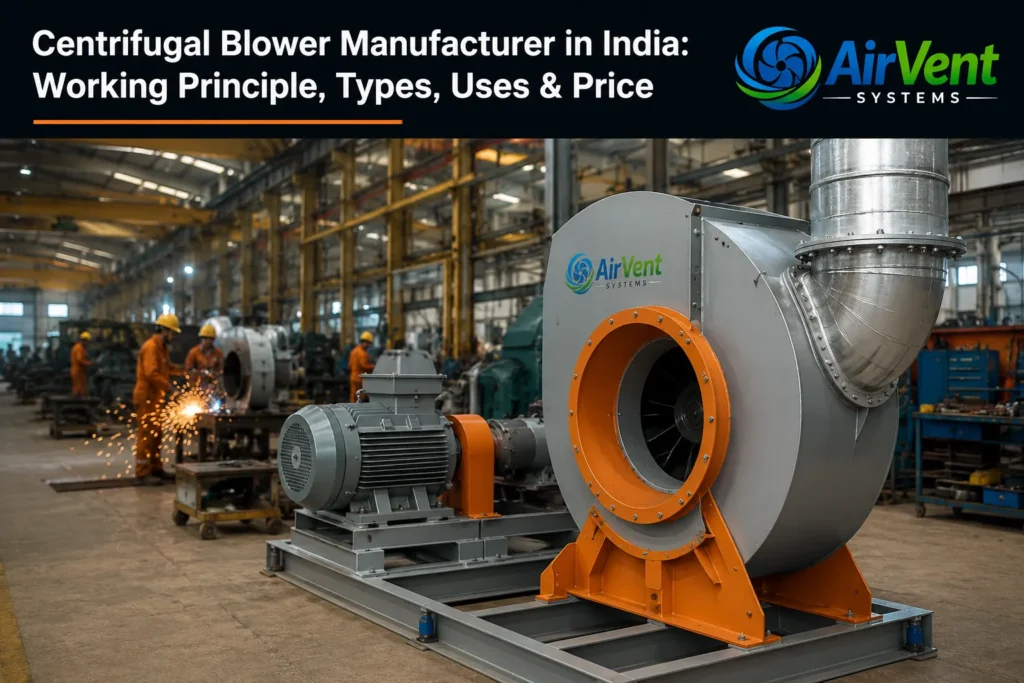
Centrifugal blower manufacturer is one of those searches that hides two very different intents behind the same three words some people are trying to understand what a centrifugal blower actually is and how it works, while others are already past that stage and trying to find a manufacturer they can trust with a real order. This guide is built to answer both properly. We’ll go through the working principle, the different impeller designs, real applications across industries (including a couple that rarely get covered kitchen exhaust and automotive use), realistic pricing, and exactly what separates a dependable centrifugal blower manufacturer from a risky one.
Let’s work through this the way we would with any engineer walking into our facility for the first time.
Table of Contents
- What Is a Centrifugal Blower?
- How Does a Centrifugal Blower Work? (Working Principle Explained)
- Centrifugal Blower vs Blower: What’s the Actual Difference?
- How Many Types of Blowers Are There?
- Types of Centrifugal Blowers by Impeller Design
- Centrifugal Blower Impeller Types Compared
- Centrifugal Blower Applications Across Industries
- Centrifugal Blower for Kitchen: Is It the Right Choice?
- Centrifugal Blower in Cars: Where It’s Actually Used
- Centrifugal Blower Price in India
- What Makes a Reliable Centrifugal Blower Manufacturer?
- Centrifugal Blower Manufacturer in Pune and Maharashtra
- Common Mistakes When Buying a Centrifugal Blower
- Maintenance Tips to Extend Centrifugal Blower Life
- How This Fits Into Your Broader Air System
- Frequently Asked Questions
- Final Thoughts
What Is a Centrifugal Blower?
A centrifugal blower is a mechanical device that moves air or gas by converting rotational energy from a spinning impeller into increased air pressure. Unlike a simple fan that pushes air in a straight line, a centrifugal blower draws air in through the center of the impeller and throws it outward at a 90-degree angle using centrifugal force, building significant static pressure before discharging it through a single outlet.
This distinction matters more than it sounds. In fact, it’s precisely this ability to build pressure not just move volume that makes a centrifugal blower the preferred choice whenever air has to travel through resistance, such as ducting, filters, or dense process equipment.
How Does a Centrifugal Blower Work? (Working Principle Explained)
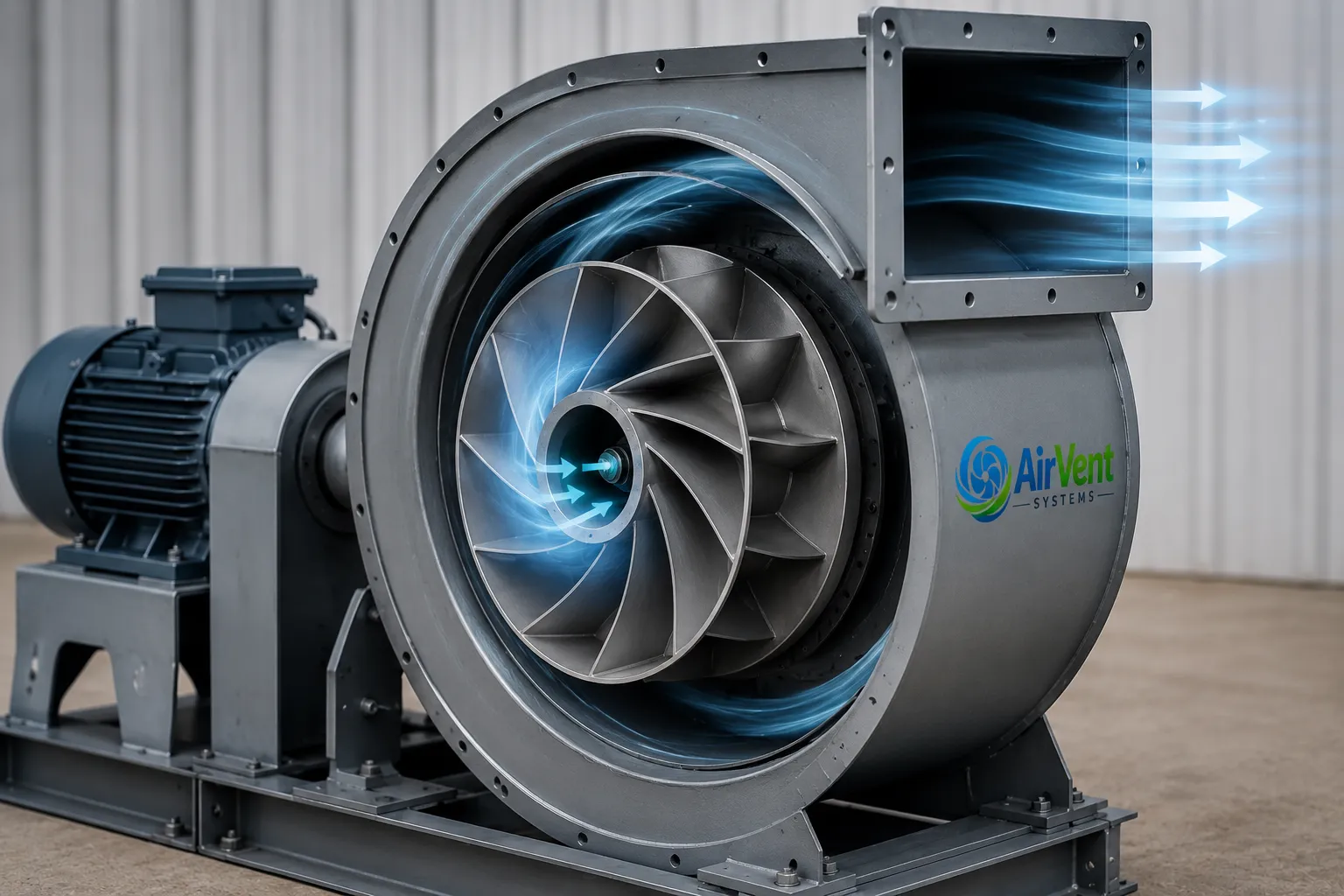
Every centrifugal blower manufacturer builds around the same core physics, even though the specific design details vary. Here’s the working principle broken into clear steps:
- Air intake: Air or gas is drawn into the blower through the inlet, entering at the center of the rotating impeller a point commonly called the “eye” of the impeller.
- Impeller rotation: As the impeller spins at high speed, it lowers pressure at the center, creating continuous suction that pulls fresh air in.
- Centrifugal force takes over: The rotating blades fling the air outward toward the periphery of the impeller, converting rotational energy into velocity.
- Pressure conversion: As the air travels along the curved blades and into the surrounding scroll-shaped housing, its velocity converts into static pressure.
- Discharge: The pressurized air exits through a single discharge outlet, ready to be directed through ducting toward its intended application.
Therefore, the entire process comes down to one elegant principle: spin air fast enough in a controlled path, and it naturally builds the pressure needed to push through real resistance.
Centrifugal Blower vs Blower: What’s the Actual Difference?
This is a common point of confusion, and it’s worth clearing up directly. “Blower” is really an umbrella term covering any device that moves air using mechanical force it includes centrifugal blowers, axial blowers, roots (positive displacement) blowers, and regenerative blowers. A centrifugal blower is simply one specific category within that broader group, distinguished by its 90-degree airflow path and its strength in high-pressure applications.
So, when someone asks “what’s the difference between a blower and a centrifugal blower,” the honest answer is: a centrifugal blower is a type of blower, not a competing category. If your application needs high static pressure pushing air through ducting, filters, or a dust collector a centrifugal blower is almost always the right subtype. If you’re comparing it specifically against an axial fan, our detailed article on Centrifugal Blower vs Axial Fan: Which One Does Your Process Need? covers that comparison in depth.
How Many Types of Blowers Are There?
Beyond centrifugal blowers, the broader blower family includes axial blowers, roots (positive displacement) blowers, and regenerative blowers, each suited to different pressure and volume requirements. We’ve covered all four in detail, along with pricing and selection guidance, in our comprehensive guide on Industrial Blower Manufacturer in India: The Complete Guide. For this article, we’ll stay focused specifically on centrifugal blowers, since that’s the category most industrial applications actually need.
Types of Centrifugal Blowers by Impeller Design
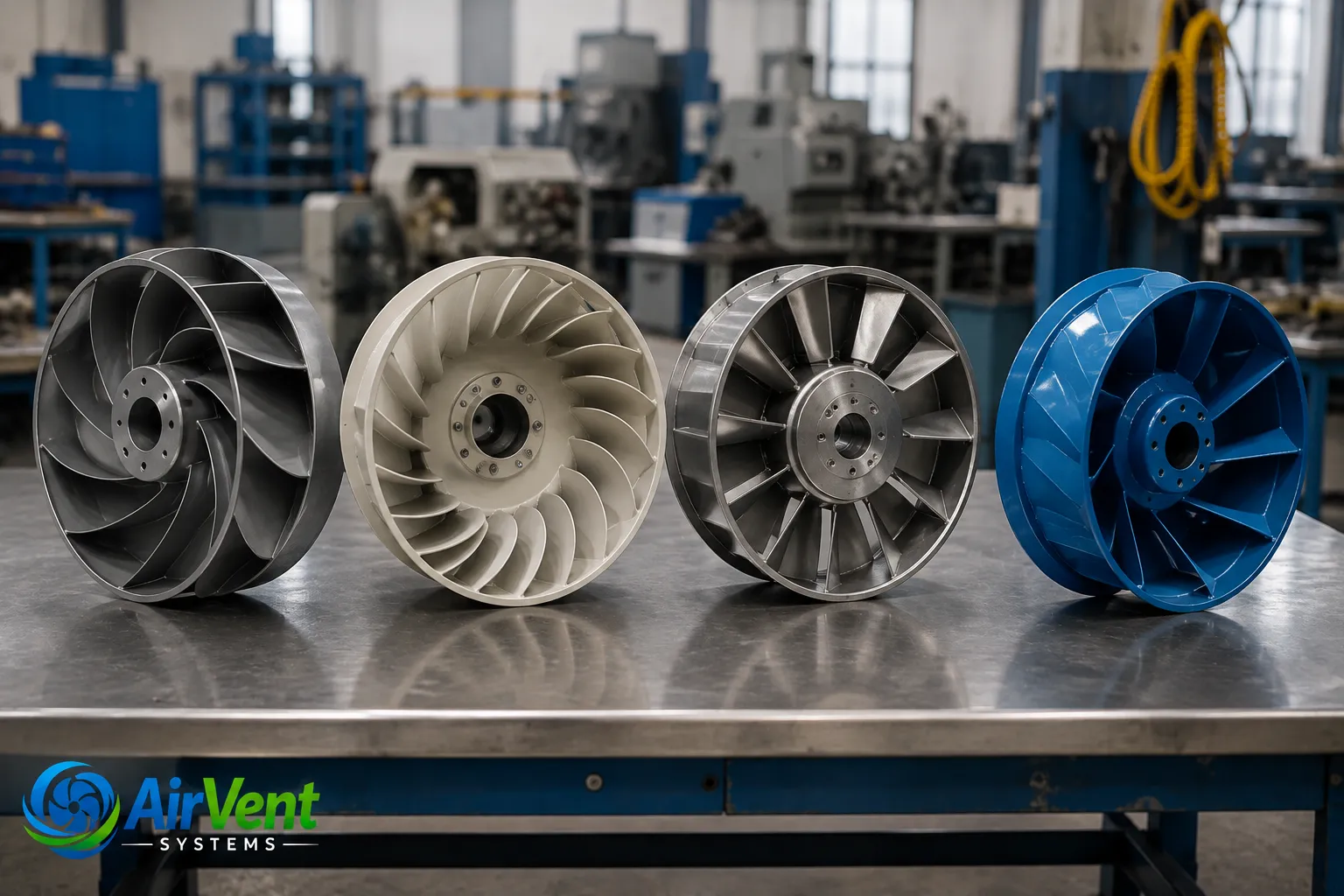
This is where most guides stop short, and it’s genuinely important because the impeller blade design inside a centrifugal blower changes its performance significantly, even though the basic working principle stays the same.
Backward Curved Blades
Blades curve away from the direction of rotation, offering high efficiency and a self-limiting power curve, meaning the motor won’t overload even if system resistance changes unexpectedly.
Best for: HVAC systems, general ventilation, and applications where energy efficiency matters most.
Forward Curved Blades
Blades curve in the direction of rotation, allowing a smaller, more compact wheel to move a given volume of air, though at lower efficiency than backward curved designs.
Best for: Low-pressure, low-noise applications where space is limited.
Radial Blades
Blades extend straight out from the hub, offering excellent resistance to material buildup and strong mechanical strength.
Best for: Dust-laden air, material handling, and abrasive or high-particulate applications.
Aerofoil (Backward Inclined Aerofoil) Blades
Blades are shaped like an aircraft wing cross-section, delivering the highest efficiency of all centrifugal blower designs, though they’re less tolerant of dust buildup.
Best for: Clean air applications requiring maximum efficiency, such as HVAC and process air supply.
Centrifugal Blower Impeller Types Compared
| Impeller Type | Efficiency | Dust Tolerance | Noise Level | Best Application |
|---|---|---|---|---|
| Backward curved | High | Moderate | Low to moderate | General ventilation, HVAC |
| Forward curved | Moderate | Low | Low | Compact, low-pressure systems |
| Radial | Moderate | High | Moderate to high | Dust collection, material handling |
| Aerofoil | Very high | Low | Low | Clean air, process air supply |
Centrifugal Blower Applications Across Industries
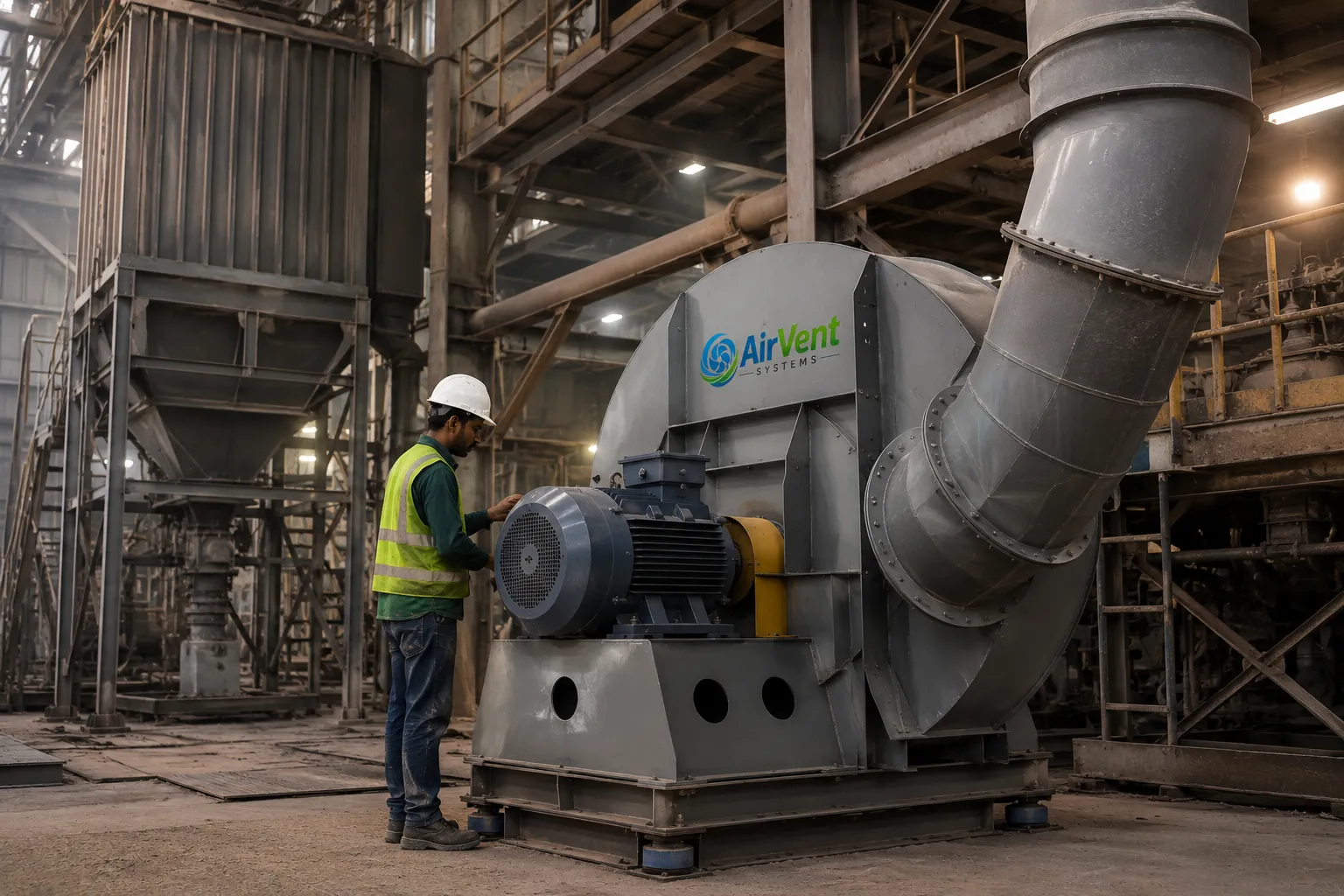
A capable centrifugal blower manufacturer designs differently depending on the industry it serves. Here’s how the same core technology gets applied across sectors:
- Cement and steel plants: combustion air supply and dust collection feed
- Chemical and pharmaceutical units: corrosion-resistant blowers for fume extraction
- Foundries: heavy duty blowers for dust-laden air handling
- HVAC systems: ventilation and air distribution in commercial and industrial buildings
- Pneumatic conveying: moving powders and granular material through ducting
- Paint booths and drying lines: controlled airflow for coating and curing processes
Centrifugal Blower for Kitchen: Is It the Right Choice?
This is a search we see fairly often, and it deserves an honest, direct answer rather than a generic one. In commercial kitchen exhaust systems restaurants, catering units, and large institutional kitchens a centrifugal blower is, in fact, usually the correct choice, precisely because kitchen exhaust ducting involves real resistance from hoods, grease filters, and long duct runs. A centrifugal blower’s ability to maintain pressure against that resistance is exactly what keeps grease-laden air moving reliably out of the kitchen.
However, for small residential kitchen chimneys, a compact centrifugal wheel is often built directly into the chimney unit rather than sourced as a separate industrial blower so if you’re asking about a full commercial kitchen exhaust system, that’s where a proper centrifugal blower manufacturer should be involved directly in sizing the unit to your hood dimensions and duct length.
Centrifugal Blower in Cars: Where It’s Actually Used
Another search we see is centrifugal blower car, and it’s worth clarifying what this actually refers to. In automotive applications, a centrifugal blower motor is most commonly the component inside a vehicle’s HVAC (cabin heating and air conditioning) system, pushing air through the dashboard vents and cabin ducting. This is a genuinely different product category smaller, lower-pressure, and built for automotive-grade vibration and temperature conditions compared to the industrial centrifugal blowers this guide otherwise focuses on. If your interest is industrial or commercial application rather than an automotive HVAC component, the guidance throughout this article applies; automotive blower motors are a specialized, separate product line that most industrial centrifugal blower manufacturers, including us, don’t typically supply.
Centrifugal Blower Price in India
Pricing is understandably one of the top questions we get, and honestly, giving a single number would be misleading cost depends heavily on capacity, pressure rating, and material of construction. That said, here’s a realistic range:
| Centrifugal Blower Size | Approximate Price Range (INR) |
|---|---|
| Centrifugal blower, 1 HP | ₹10,000 – ₹22,000 |
| Centrifugal blower, 2–5 HP | ₹25,000 – ₹90,000 |
| Centrifugal blower, 5–20 HP | ₹90,000 – ₹3,50,000 |
| Centrifugal blower, 20–50 HP | ₹3,50,000 – ₹8,00,000 |
| High pressure / heavy duty centrifugal blower | ₹5,00,000 and above |
These are indicative ranges only. Actual centrifugal blower fan price depends on static pressure requirement, motor rating, impeller design, and material of construction (MS, SS, or FRP). Always request an application-specific quote rather than relying on a catalogue number.
What Makes a Reliable Centrifugal Blower Manufacturer?
Choosing between manufacturers isn’t really about finding the “best brand” in the abstract it’s about finding one that matches these criteria:
- Application-specific sizing based on your actual airflow and static pressure requirement, not horsepower alone
- Correct impeller design for your dust and material conditions radial for abrasive dust, aerofoil for clean air, backward curved for general HVAC
- Material of construction options (MS, SS, FRP) suited to your process environment
- Testing and balancing standards, ideally referencing recognised specifications such as those published by the Air Movement and Control Association (AMCA), rather than an unspecified in-house benchmark
- After-sales support and spares availability, since unplanned downtime typically costs far more than the blower itself
- Transparent, itemized quoting rather than a single lump-sum figure with no breakdown
A centrifugal blower manufacturer who asks detailed questions about your duct layout, dust load, and duty cycle before quoting is, in our experience, a far stronger signal of long-term reliability than one that quotes instantly off a standard size chart.
Centrifugal Blower Manufacturer in Pune and Maharashtra
Pune’s industrial belt spanning Bhosari, Chakan, Talegaon, and Pimpri-Chinchwad is home to a dense mix of automotive, pharmaceutical, foundry, and process manufacturing units, and each of these sectors demands something slightly different from a centrifugal blower manufacturer. An automotive component unit typically needs blowers for paint booth ventilation and fume extraction, a pharma facility needs corrosion-resistant, hygienic designs, and a foundry needs radial-blade blowers built to handle continuous dust loading.
Working with a centrifugal blower manufacturer based in or near Pune brings a genuine practical advantage: faster site visits for accurate sizing, quicker turnaround on spare parts, and a manufacturer who already understands the operating conditions typical of Maharashtra’s MIDC industrial zones.
Common Mistakes When Buying a Centrifugal Blower
Being direct here helps more than being diplomatic, because these mistakes are common and entirely avoidable:
- Selecting based on horsepower alone, without confirming the actual static pressure requirement
- Choosing a forward curved or aerofoil impeller for a dusty application where a radial design was actually needed
- Ignoring material of construction for corrosive or high-temperature processes
- Accepting the lowest quote without checking testing standards or after-sales support
- Skipping a proper site or process discussion before finalizing the order
Every one of these mistakes shows up repeatedly across the plants we work with, and every one of them is preventable with a proper pre-purchase conversation with your centrifugal blower manufacturer.
Maintenance Tips to Extend Centrifugal Blower Life
- Clean the impeller regularly to prevent dust-induced imbalance, particularly with radial designs handling heavy dust load
- Monitor bearing vibration and temperature on a scheduled basis
- Follow a calendar-based lubrication schedule rather than a reactive one
- Check motor current periodically to catch developing electrical issues early
- Keep ducting and dampers clear of obstruction to avoid unnecessary load on the blower
If your blower is already showing signs of strain rising vibration, reduced airflow, or overheating our related guide on Common Causes of ID Fan Failure and How to Prevent Them covers many of the same failure patterns relevant to centrifugal designs under continuous duty.
How This Fits Into Your Broader Air System
A centrifugal blower rarely works alone it’s almost always paired with downstream equipment such as a dust collector or scrubber. If you’re specifying a complete system, our guide on Types of Industrial Dust Collectors: Cyclone, Baghouse and Cartridge Systems Compared will help you match blower output correctly to your filtration stage.
Frequently Asked Questions
What is a centrifugal blower?
A centrifugal blower is a mechanical device that moves air or gas by using a rotating impeller to draw air in at the center and throw it outward at a 90-degree angle, building high static pressure before discharging it through a single outlet.
What is the difference between a blower and a centrifugal blower?
A blower is a general term for any air-moving device, while a centrifugal blower is a specific type of blower that builds high pressure by moving air perpendicular to the direction it enters, unlike axial or other blower types.
How is a centrifugal blower turned (how does it work)?
A centrifugal blower works by drawing air into the center of a spinning impeller, using centrifugal force to fling it outward toward the housing, where its velocity converts into pressure before it exits through the discharge outlet.
How many types of blowers are there?
The main types of blowers are centrifugal blowers, axial blowers, positive displacement (roots) blowers, and regenerative blowers, each suited to different pressure and airflow requirements.
What is the price of a 1 HP centrifugal blower?
A standard-duty 1 HP centrifugal blower typically costs between ₹10,000 and ₹22,000 in India, with the exact price depending on impeller design and material of construction.
Final Thoughts
A centrifugal blower is, at its core, a simple piece of physics spin air fast enough in a controlled path, and it builds the pressure your process needs. However, choosing the right impeller design, the right material, and the right centrifugal blower manufacturer is where the real decision-making happens, and it’s exactly where we’ve seen plants either save significant money over the life of the equipment, or end up replacing an undersized, mismatched unit far sooner than they should have.
At Airvent Systems, we manufacture centrifugal blowers across backward curved, radial, and aerofoil impeller designs, engineered around your actual airflow, pressure, and dust conditions rather than a generic catalogue size. You can explore our Centrifugal Blowers range, or share your application details directly with our engineering team.
Not sure which centrifugal blower fits your process? Get a Free Sizing Recommendation from Airvent Systems →