Centrifugal blower manufacturer is one of the most competitive searches in Indian industrial equipment, and yet, after reading nearly every page currently ranking for it, most of them answer the wrong questions. They explain what a centrifugal blower is. They list blade types. They add a city name to the title. But they rarely tell you how to verify whether a supplier is actually worth trusting, what real pricing looks like, which material of construction suits your specific process, or what genuinely goes wrong when the wrong blower is ordered from the wrong vendor. This guide covers all of that, drawing on real manufacturing and field experience from our facility in Pune, Maharashtra, which serves industries across India including Mumbai, Delhi, Ahmedabad, and beyond.
If you’re searching for a centrifugal blower manufacturer near me, comparing suppliers in Pune, Mumbai, Delhi, or Ahmedabad, or simply trying to understand what to ask before you sign a purchase order with any industrial blower company in India, this is the guide that answers all of it in one place.
Table of Contents
- What Is a Centrifugal Blower?
- How Does a Centrifugal Blower Work?
- Types of Centrifugal Blowers by Blade Design
- Material of Construction: MS vs SS vs FRP – When to Choose Which
- Centrifugal Blower Fan Price in India: Real Ranges
- How to Verify a Centrifugal Blower Manufacturer’s Quality Before Ordering
- Energy Efficiency: IE2/IE3 Motors and VFD Pairing
- Centrifugal Blower Manufacturer in Pune: What Makes the Local Advantage Real
- Red Flags When Buying from a Centrifugal Blower Manufacturer
- Applications of Centrifugal Blowers Across Industries
- How to Get an Accurate Quote from a Centrifugal Blower Manufacturer
- Frequently Asked Questions
- Final Thoughts
What Is a Centrifugal Blower?
A centrifugal blower is an industrial air-moving device that draws air in through the center of a rotating impeller and discharges it at a 90-degree angle using centrifugal force, building high static pressure to push air through ducting, filters, and process equipment. It is the most widely used type of industrial blower in India across HVAC, dust collection, pneumatic conveying, combustion air supply, and fume extraction applications.
This distinction the 90-degree airflow path and the high static pressure output is precisely what separates a centrifugal blower from an axial fan, and it’s why centrifugal blowers are the correct choice for any application where air must travel through real resistance. For a detailed side-by-side breakdown, see our article on Centrifugal Blower vs Axial Fan: Which One Does Your Process Need?.
How Does a Centrifugal Blower Work?
Every blower design, regardless of manufacturer, builds around the same core physics. Here is the working principle in plain terms:
- Air enters through the inlet at the center (eye) of the rotating impeller
- The impeller spins at high speed, creating a low-pressure zone that continuously draws fresh air in
- Centrifugal force flings the air outward toward the periphery of the impeller, converting rotational energy to velocity
- The scroll housing collects the high-velocity air and converts it into static pressure
- The discharge outlet directs the pressurized air into your ducting or process system
The entire performance of a centrifugal blower depends on three things working together correctly:
impeller design, housing geometry, and motor speed. If any one of these is mismatched to your actual requirement, the unit will underperform regardless of what the nameplate says. Our guide on blade design selection walks through how each impeller type affects real-world performance in more depth.
Types of Centrifugal Blowers by Blade Design
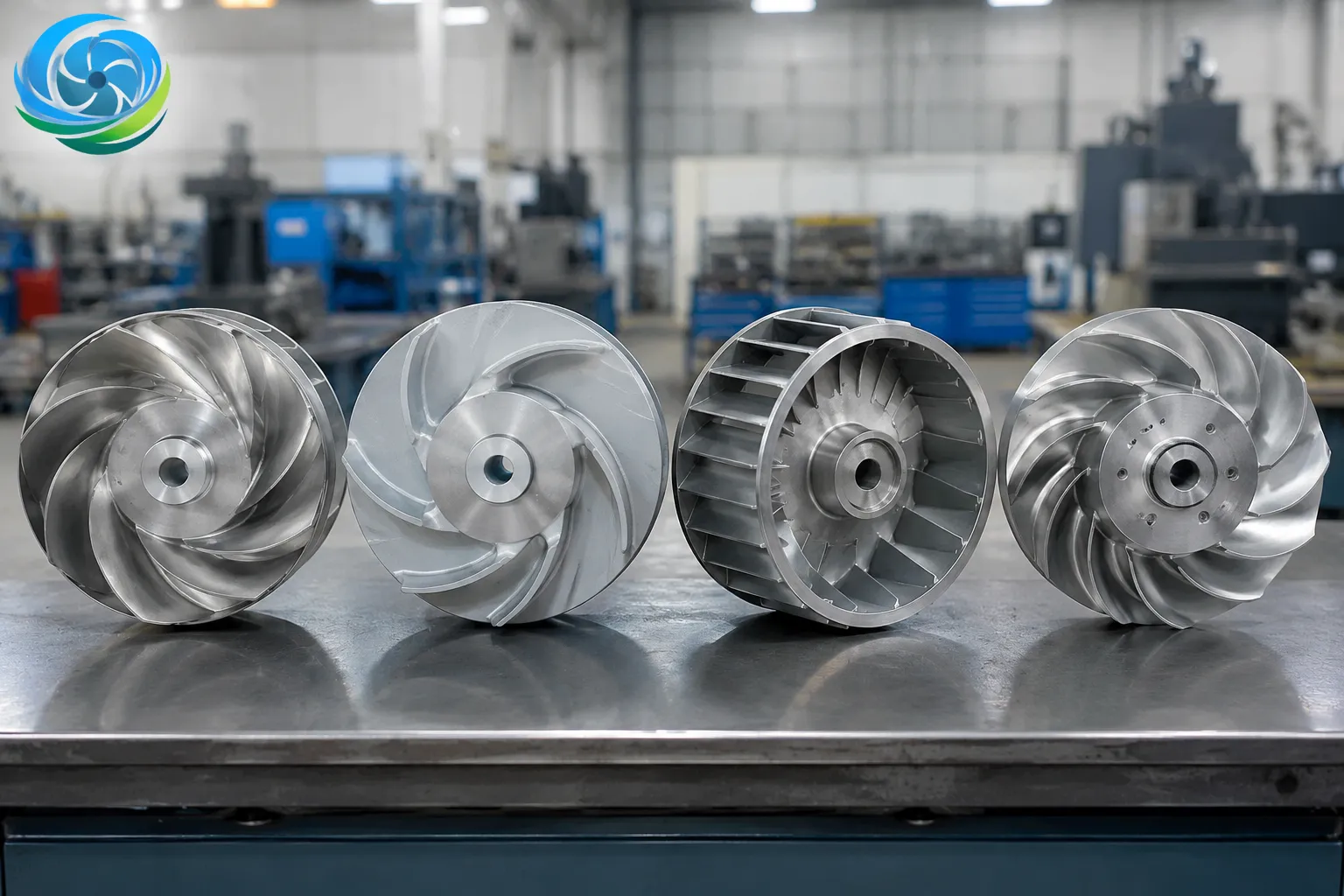
Blade design is genuinely one of the most important decisions in centrifugal blower selection, because it changes not just performance but also suitability for your specific dust and temperature conditions.
Backward Curved Blade
Blades curve away from the direction of rotation. This design offers the highest efficiency of the three main types and has a self-limiting power curve meaning the motor will not overload even if system resistance drops unexpectedly, which protects both the motor and the drive.
Choose when: energy efficiency is a priority, air is relatively clean, and the system involves variable resistance conditions such as HVAC or general ventilation.
Forward Curved Blade
Blades curve in the direction of rotation. This design moves a given volume of air with a smaller, more compact wheel, making the overall unit physically smaller, though at lower efficiency than backward curved.
Choose when: installation space is limited, pressure requirements are moderate, and noise is a concern forward curved units are generally quieter.
Radial Blade
Blades extend straight out from the hub at a right angle. This design sacrifices some efficiency compared to backward curved but provides excellent resistance to dust buildup on blade surfaces and strong structural integrity under abrasive conditions.
Choose when: the airstream carries heavy dust, abrasive particles, or fibrous material cement dust, wood chips, foundry sand, grain, or chemical powders. This is the blade design most commonly specified for industrial dust collection and material handling applications.
Aerofoil Blade
Blades are shaped like an aircraft wing cross-section, delivering the highest aerodynamic efficiency of all centrifugal blower designs. However, the complex blade profile is more expensive to manufacture and less tolerant of dust accumulation.
Choose when: the application involves clean air, maximum energy efficiency is the top priority, and the unit will be properly maintained with regular cleaning.
Blade Types Compared
| Blade Type | Efficiency | Dust Tolerance | Self-Limiting Power | Best Application |
|---|---|---|---|---|
| Backward curved | High | Moderate | Yes | HVAC, general ventilation |
| Forward curved | Moderate | Low | No | Compact, low-noise, low-pressure |
| Radial | Moderate | Very High | Yes | Dust collection, material handling |
| Aerofoil | Very High | Low | Yes | Clean air, maximum efficiency |
Material of Construction: MS vs SS vs FRP – When to Choose Which
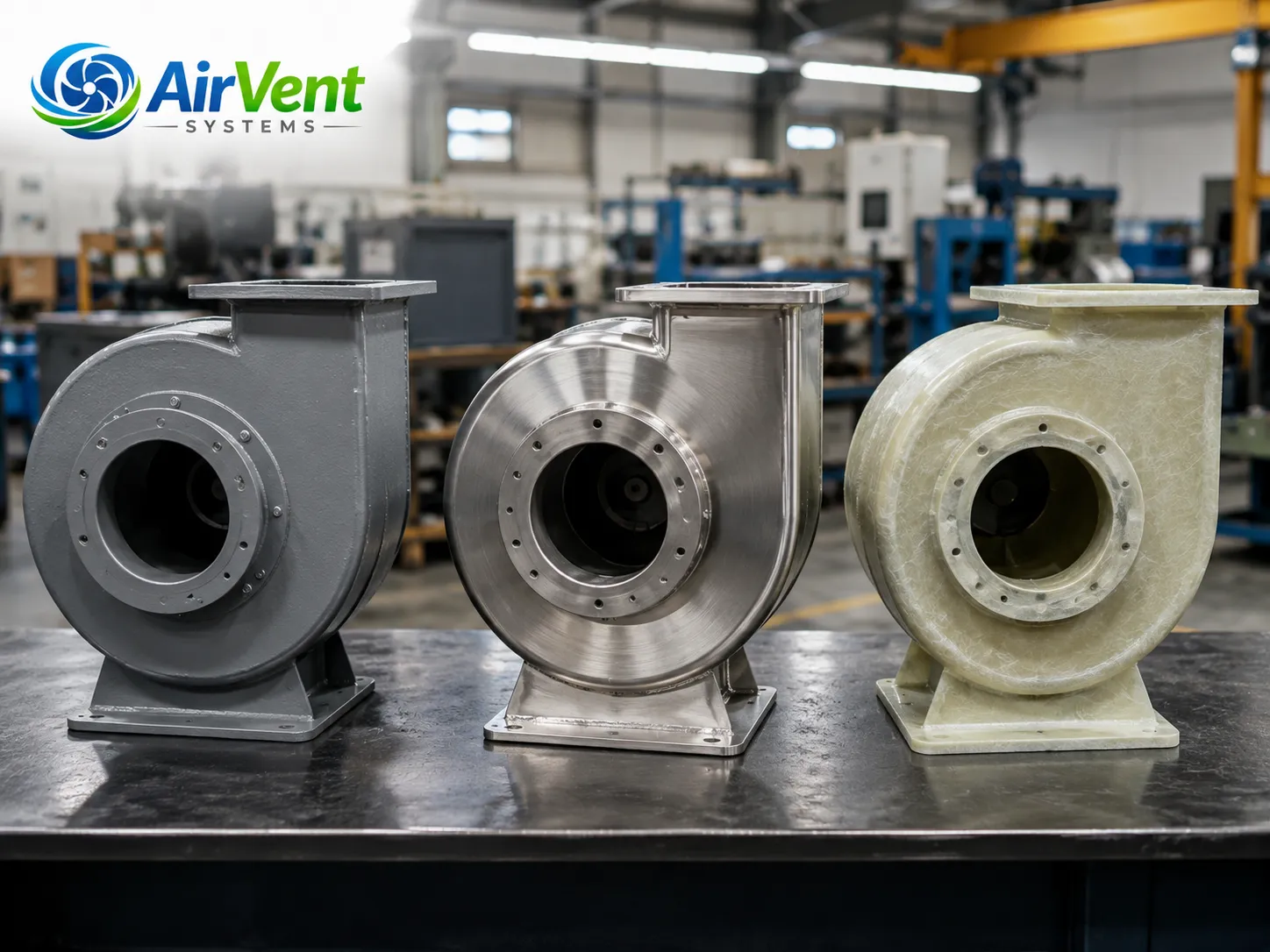
This is one of the most important decisions when specifying a centrifugal blower, and it’s also one of the most consistently underdiscussed topics in supplier literature. Here is a clear, direct guide.
Mild Steel (MS)
Standard-grade carbon steel with a painted or primed finish. The most common and most affordable construction for general-duty applications.
- Choose MS when: air is clean or mildly dusty, temperature is ambient to moderate (up to 150°C), no corrosive gases or chemicals are present
- Typical industries: general factory ventilation, HVAC systems, standard dust collection
Stainless Steel (SS 304 / SS 316)
Corrosion-resistant alloy steel. SS 304 handles most mildly acidic or humid environments; SS 316 adds resistance to chlorides and stronger acids.
- Choose SS 304 when: moderate humidity, mild acidic fumes, food-grade or pharmaceutical applications requiring hygiene compliance
- Choose SS 316 when: chemical plants, coastal locations with salt air, strong acid fumes, or any process where SS 304 has shown pitting corrosion in prior installations
- Typical industries: pharma, food processing, chemical plants, coastal facilities
Fibre Reinforced Plastic (FRP)
Non-metallic composite construction, completely immune to rust and most chemical corrosion, though limited in temperature range (typically below 80°C).
- Choose FRP when: highly corrosive gas streams (strong acids, alkalis, solvents), where even SS 316 corrodes unacceptably fast
- Typical industries: chemical and electrochemical plants, pickling lines, scrubber inlet fans
Material Quick Selection Table
| Material | Max Temperature | Corrosion Resistance | Relative Cost | Best For |
|---|---|---|---|---|
| Mild Steel (MS) | Up to 150°C | Low | Lowest | Clean/dusty air, general duty |
| Stainless Steel 304 | Up to 300°C | Moderate–High | Medium | Pharma, food, mild acids |
| Stainless Steel 316 | Up to 300°C | High | Medium–High | Chemical, coastal, strong acids |
| FRP | Up to 80°C | Very High | Medium | Highly corrosive gas streams |
Centrifugal Blower Fan Price in India: Real Ranges
This is the question every buyer has and almost no supplier answers directly. Here are honest, experience-based price ranges actual pricing depends on blade design, material, static pressure requirement, and motor rating.
| Size / Rating | Approximate Price Range (INR)* |
|---|---|
| 1 HP, MS, standard duty | ₹10,000 – ₹20,000 |
| 2–5 HP, MS | ₹22,000 – ₹85,000 |
| 5–20 HP, MS | ₹85,000 – ₹3,00,000 |
| 5–20 HP, SS 304 / 316 | ₹1,50,000 – ₹5,50,000 |
| 20–50 HP, MS | ₹3,00,000 – ₹8,00,000 |
| 50 HP and above / heavy duty | ₹7,00,000 and above |
| FRP (any size) | Add 30–50% over equivalent MS pricing |
These are indicative ranges based on current manufacturing costs in India. Actual price depends on static pressure requirement, CFM, blade design, motor efficiency grade, and customization. Never accept a quote without confirmed static pressure and airflow specifications.
How to Verify a Centrifugal Blower Manufacturer’s Quality Before Ordering
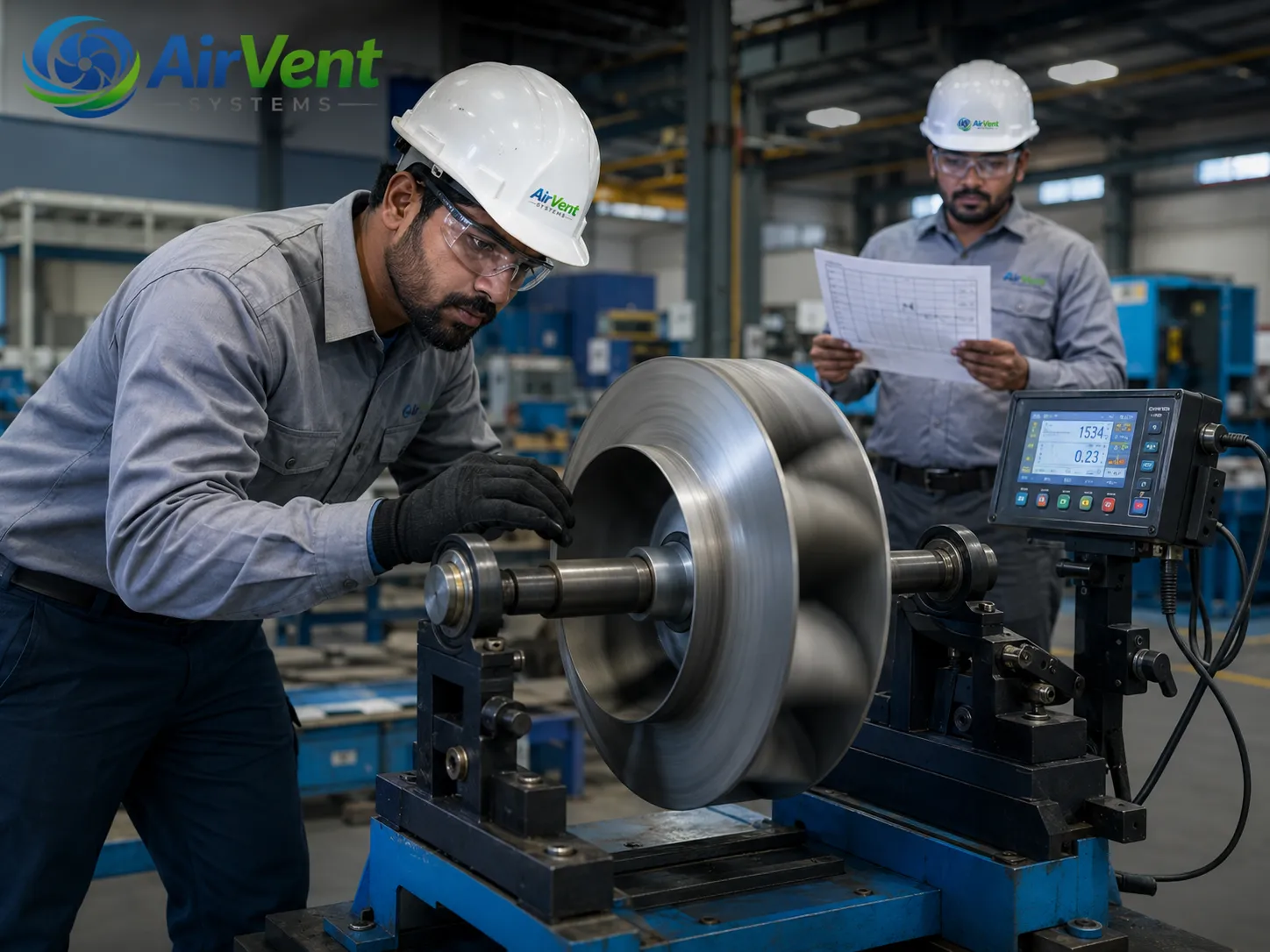
This is the section most competitor content skips entirely and it’s arguably the most valuable part of this guide. Here is what to check before you place an order with any centrifugal blower manufacturer in India.
1. Ask for the Impeller Balancing Grade
Every impeller should be dynamically balanced before assembly. Ask specifically: “What balancing grade do you test to G6.3 or G2.5?” A supplier who balances to G2.5 (the tighter standard) is telling you something important about their precision and the long-term vibration behavior of the unit. A supplier who can’t answer this question is also telling you something important.
2. Request Performance Test Data
Ask whether the blower is performance-tested before dispatch, and whether they can provide a test curve showing actual measured CFM and static pressure at your operating point. A legitimate manufacturer will have this data; one who doesn’t test completed units is selling you a catalogue promise, not verified performance.
3. Check Material Mill Certificates for SS or FRP Units
If you’ve specified SS 304, SS 316, or FRP construction, ask for the material test certificate (MTC) confirming the actual grade of material used. This is standard practice in any serious industrial procurement, and any reputable manufacturer will supply it without hesitation.
4. Confirm After-Sales Support and Spare Parts Availability
Ask specifically: “If a bearing or seal fails six months after installation, how quickly can you supply the replacement, and do you stock critical spares?” A manufacturer who stocks common spares bearings, shaft seals, belt sets and can dispatch within a day or two is fundamentally different from one who needs to manufacture to order for every service call.
5. Ask for References from Similar Applications
If your application is a pharma blower or a foundry dust collection blower, ask whether they’ve supplied similar units to other facilities in the same industry, and whether you can speak to that customer. A supplier with genuine application experience in your industry will offer this readily.
Energy Efficiency: IE2/IE3 Motors and VFD Pairing
This is another topic largely absent from competitor content, and it directly affects your electricity bill every single day the blower runs.
IE2 (High Efficiency) motors are now mandatory for most industrial motors above 0.75 kW under India’s energy efficiency regulations managed by the Bureau of Energy Efficiency (BEE). Confirm that your supplier is providing IE2 or IE3 rated motors as standard, not legacy IE1 units.
- IE3 (Premium Efficiency) motors cost 10–15% more upfront but typically recover that cost within 12–18 months of continuous operation through reduced power consumption.
- Variable Frequency Drives (VFDs) allow you to vary blower speed in real time rather than running at fixed speed and throttling with a damper. On applications where airflow requirement varies through the day HVAC, drying lines, variable-load dust collection a VFD can reduce power consumption by 30–50% compared to fixed-speed operation with damper control.
When comparing quotes from different suppliers, always ask what motor efficiency grade is included and whether VFD compatibility has been considered for your duty profile.
Centrifugal Blower Manufacturer in Pune: What Makes the Local Advantage Real
Pune’s industrial belt Bhosari MIDC, Chakan, Talegaon, Pimpri-Chinchwad hosts one of the densest concentrations of manufacturing units in India, spanning automotive, pharmaceutical, food processing, chemical, and foundry industries. Each of these sectors places genuinely different demands on a blower supplier, which is why choosing one based in Pune rather than in Delhi, Faridabad, or Ahmedabad makes a real operational difference for Maharashtra-based plants. Here’s what each sector typically needs:
- Automotive and fabrication units in Bhosari and Chakan need blowers for paint booth ventilation, fume extraction, and general shop-floor air movement
- Pharmaceutical units in Hinjewadi and Talawade need hygienic SS 316 blowers with smooth internal surfaces and compliance documentation
- Foundry units around Ranjangaon need radial-blade blowers in heavy-duty MS construction rated for continuous high-dust operation
- Food processing units across Pune district need FRP or SS 304 blowers with food-grade sealing
Working with a Pune-based manufacturer means faster site visits for accurate field sizing, same-week spare parts supply, and a partner who already understands Maharashtra’s MPCB compliance requirements and MIDC operating conditions advantages that a supplier based farther away simply cannot replicate at the same response speed.
Red Flags When Buying from a Centrifugal Blower Manufacturer
Being direct here is more useful than being diplomatic, because these mistakes show up repeatedly:
- Quoting based on HP alone without confirming required static pressure and CFM this is the single most common cause of a blower that “doesn’t perform” after installation
- No mention of balancing grade in the specification or quotation
- Vague material specification “MS fabricated” should specify the actual grade; “SS” should specify 304 or 316
- No performance test before dispatch any supplier unwilling to test is telling you they’re not confident in the result
- Unusually low quotes a unit priced significantly below market range is almost always explained by thinner casing, a lower-grade motor, or skipped balancing and testing steps
- No after-sales commitment in writing verbal assurances about spares and service are worth exactly nothing after the purchase order is signed
Applications of Centrifugal Blowers Across Industries
An experienced manufacturer designs differently depending on the industry it serves, and the right supplier will ask about your specific process before recommending a blade type, material, or motor rating. Here’s a quick reference across the most common sectors. For how these units connect to downstream equipment, see our guide on Types of Industrial Dust Collectors.
- Cement and steel plants: radial-blade MS blowers for combustion air and dust collection feed
- Pharmaceutical units: backward curved SS 316 blowers for cleanroom ventilation and process air
- Chemical plants: FRP blowers for corrosive fume extraction
- Food processing: SS 304 backward curved blowers for hygienic drying and conveying
- Foundries: heavy-duty radial-blade MS blowers for fume extraction
- HVAC systems: aerofoil or backward curved blowers for energy-efficient air distribution
- Pneumatic conveying: high-pressure centrifugal blowers for powder and granule transfer
If your application involves combustion-side fans alongside the centrifugal blower, our article on Common Causes of ID Fan Failure is directly relevant to maintaining the complete air system reliably.
How to Get an Accurate Quote from a Centrifugal Blower Manufacturer
Every supplier will quote differently based on the information you provide or don’t. Share these seven data points with any centrifugal blower manufacturer before expecting a meaningful, application-specific quote:
- Required airflow (CFM or m³/hr)
- Required static pressure (mm WG)
- Operating temperature
- Nature of air/gas (clean, dusty, corrosive, humid)
- Duty cycle (continuous or intermittent)
- Available electrical supply (voltage and phase)
- Available installation space and orientation preference
A supplier who provides a quote without asking for most of these is not engineering a solution they’re guessing. An incorrectly sized blower, however well-built, will not deliver what your process needs.
Frequently Asked Questions
What is a centrifugal blower manufacturer?
A centrifugal blower manufacturer designs, fabricates, tests, and supplies industrial centrifugal blowers engineered to move air through process systems under high static pressure, serving industries from HVAC and dust collection to pneumatic conveying and combustion air supply.
Which is the best centrifugal blower manufacturer in Pune?
The best centrifugal blower manufacturer in Pune is one that sizes blowers to your actual static pressure and airflow requirement, offers the correct blade design and material of construction for your application, tests every unit before dispatch, and provides dependable after-sales support rather than simply offering the lowest quote.
What is the price of a centrifugal blower in India?
Prices range from approximately ₹10,000 for a 1 HP standard-duty MS unit to ₹8,00,000 or more for a large 50 HP unit, with SS and FRP construction adding 30–100% to equivalent MS pricing depending on grade and size.
What is the difference between a centrifugal blower manufacturer in Pune and one in Delhi or Ahmedabad?
The core product is the same, but a Pune-based manufacturer offers faster site visits across Maharashtra’s MIDC industrial zones, quicker spare parts supply, and direct familiarity with MPCB compliance requirements practical advantages that matter significantly once the blower is installed and running.
How do I choose the right centrifugal blower manufacturer in India?
Ask for impeller balancing grade (G2.5 or G6.3), performance test certification, material mill certificates for SS/FRP units, after-sales spare parts availability, and references from similar applications in your industry before placing any order.
Final Thoughts
There are many centrifugal blower manufacturers in India in Pune, Mumbai, Delhi, Ahmedabad, and beyond. The difference between a good one and a risky one isn’t always visible in a catalogue or a website. It shows up in the questions they ask before quoting, the testing they do before dispatching, and the support they offer after installation. A correctly sized, correctly built centrifugal blower, matched to your actual process, will run reliably for years. A mismatched one will show you that mismatch every single week.
At Airvent Systems, we manufacture centrifugal blowers across all blade designs backward curved, radial, forward curved, and aerofoil in MS, SS 304, SS 316, and FRP construction, balanced to G2.5, performance-tested before dispatch, and backed by a genuine after-sales team based in Pune. Explore our full Centrifugal Blower range or talk to our engineering team about your specific application.
Looking for a centrifugal blower manufacturer in Pune or anywhere across India? Get a Free Application-Specific Quote from Airvent Systems →