
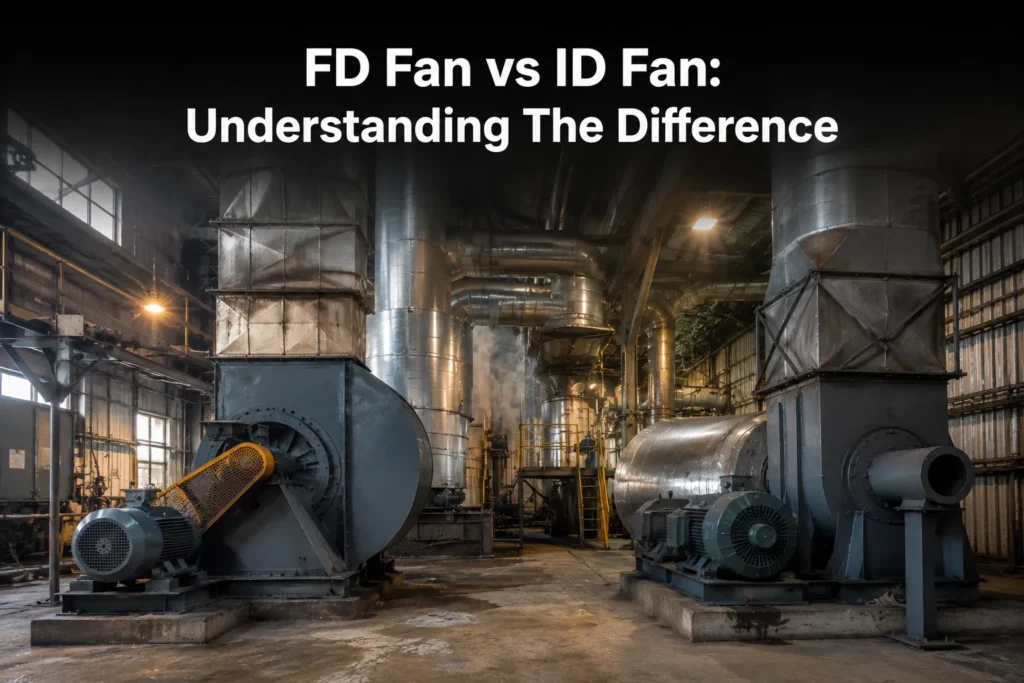
If you operate a boiler, furnace, or thermal process, you’ve almost certainly heard the terms FD fan and ID fan used interchangeably by people who don’t work with combustion systems every day. They’re not interchangeable. Get the wrong one, size it wrong, or place it in the wrong part of the draft system, and you’re looking at poor combustion efficiency, excess fuel consumption, unsafe furnace pressure, or a fan that fails years before it should.
This guide breaks down exactly what separates a Forced Draft (FD) fan from an Induced Draft (ID) fan, where each sits in a real draft system, how to size and specify them correctly, and the maintenance and safety details that most comparison articles skip entirely. Whether you’re troubleshooting an existing boiler house or specifying equipment for a new installation, you’ll walk away knowing which fan does what, why, and what to check before you buy.
Quick Answer
An FD fan (Forced Draft fan) pushes fresh combustion air into a furnace or boiler under positive pressure, sitting at the air inlet side of the system. An ID fan (Induced Draft fan) pulls hot flue gases out of the furnace and through the exhaust path under negative pressure, sitting near the outlet, typically after the dust collector or pollution control equipment and before the chimney or stack. FD fans handle cooler, cleaner air; ID fans handle hot, dust-laden flue gas, which is why the two are built from different materials and rated very differently, even when installed on the same boiler. Explore our FD Fans and ID Fans to see how each is engineered for its role.
What Is an FD Fan (Forced Draft Fan)?
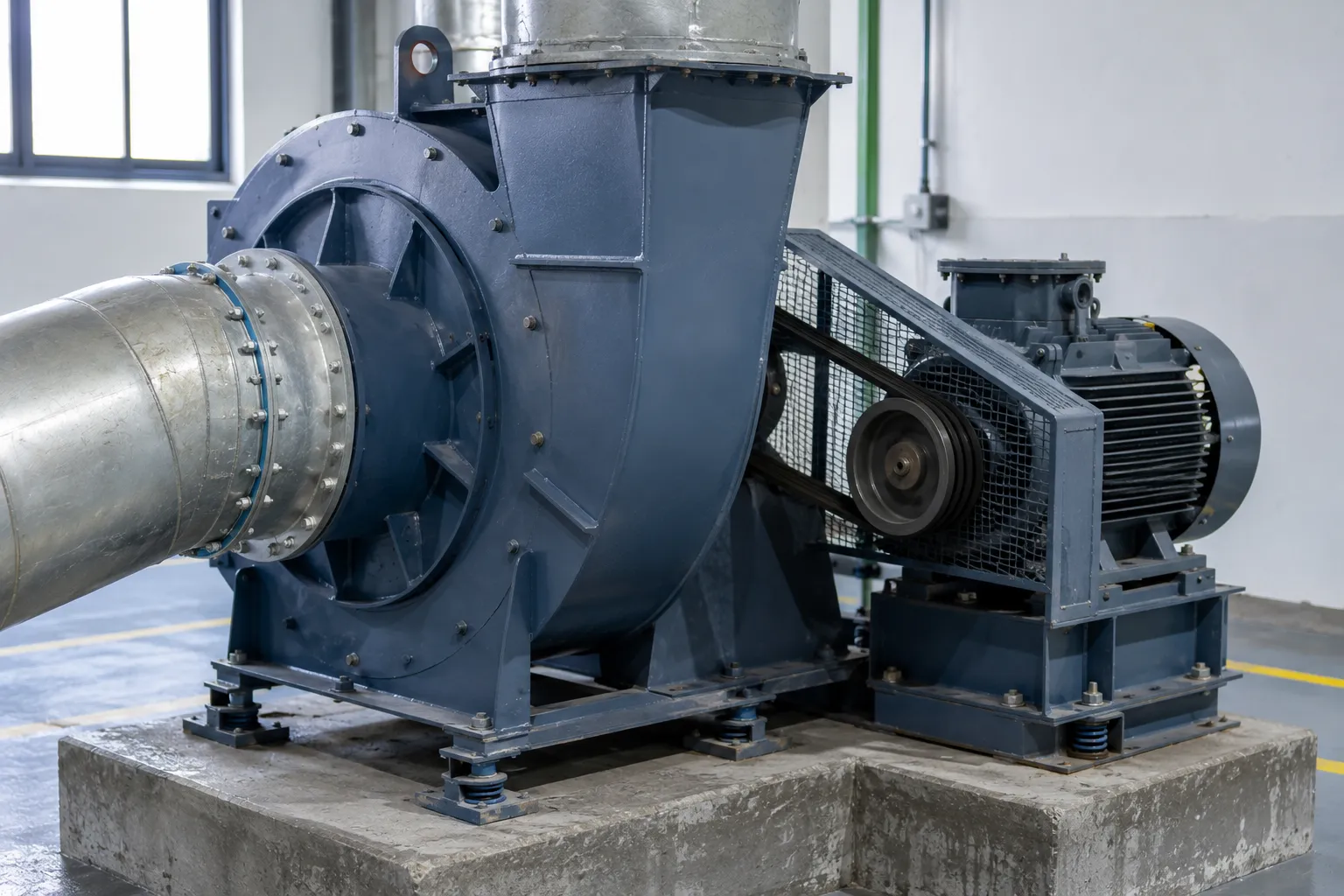
A Forced Draft fan is positioned at the inlet of a boiler or furnace and forces atmospheric air into the combustion chamber under positive pressure. That air mixes with fuel, whether it’s coal, oil, gas, or biomass, to sustain efficient, complete combustion. Without adequate forced draft, a furnace starves for oxygen, combustion becomes incomplete, and you lose efficiency while increasing unburnt fuel and emissions.
Key characteristics of FD fans:
- Location: Installed before the air preheater and burner, at the cold end of the system.
- Air condition: Handles ambient or lightly preheated air, clean and relatively cool compared to what an ID fan sees.
- Pressure type: Builds positive pressure inside the furnace.
- Construction: Because the air is cooler and cleaner, FD fans can generally use standard carbon steel construction and simpler bearing arrangements, though high-capacity boiler applications still demand precision-balanced impellers to handle continuous duty.
- Typical fan type: Usually a centrifugal design, since steady, controllable volume matters more than handling abrasive particulate.
What Is an ID Fan (Induced Draft Fan)?
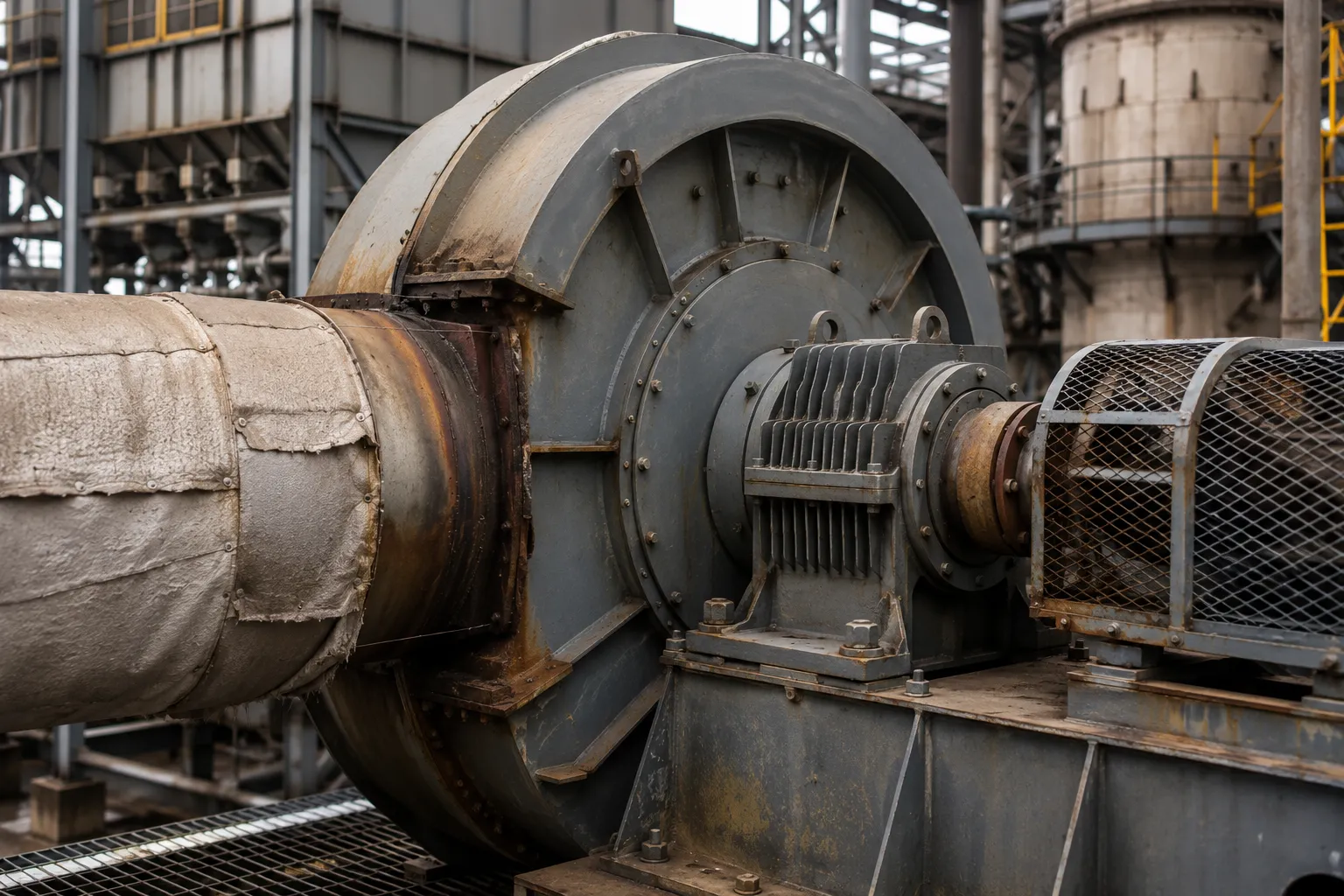
An Induced Draft fan sits on the exhaust side of the system, positioned after the dust collector or electrostatic precipitator and before the chimney. Its job is to pull hot flue gases out of the furnace, through the pollution control equipment, and safely out to atmosphere. In doing so, it maintains a slight negative pressure inside the furnace, which is critical for preventing flue gas and flame from leaking out through furnace openings, inspection doors, or joints.
Key characteristics of ID fans:
- Location: Installed at the hot end of the system, downstream of dust collection and just before the stack.
- Air condition: Handles hot flue gas, often carrying fine particulate, moisture, and corrosive compounds depending on the fuel.
- Pressure type: Creates negative (induced) pressure that draws gases through the system.
- Construction: Because it handles heat, dust, and often corrosive flue gas, an ID fan needs heavier-duty construction: high-temperature alloys, abrasion-resistant wheel coatings, reinforced bearings with cooling provisions, and sometimes water-cooled shaft seals for continuous high-temperature duty.
- Power draw: ID fans typically consume more power than FD fans on the same boiler, because they’re moving a larger volume of hot, less dense gas against the resistance of ductwork, dust collectors, and stack height.
FD Fan vs ID Fan: Side-by-Side Comparison
| Factor | FD Fan | ID Fan |
|---|---|---|
| Function | Supplies combustion air into the furnace | Extracts flue gas out of the furnace |
| Location | Air inlet side, before the burner | Exhaust side, after dust collection, before the stack |
| Pressure created | Positive pressure | Negative pressure |
| Air/gas handled | Cool, clean ambient air | Hot, dust-laden, sometimes corrosive flue gas |
| Construction | Standard carbon steel, simpler design | High-temperature alloys, abrasion-resistant coatings |
| Power consumption | Lower, for a given boiler capacity | Generally higher, due to gas volume and temperature |
| Typical failure point | Bearing wear, motor overload from clogged filters | Wheel erosion, corrosion, thermal fatigue, bearing overheating |
| Common blower type | Centrifugal (forward or backward curved) | Centrifugal (backward-curved or radial, heavy-duty) |
Why Boilers Need Both: The Balanced Draft System
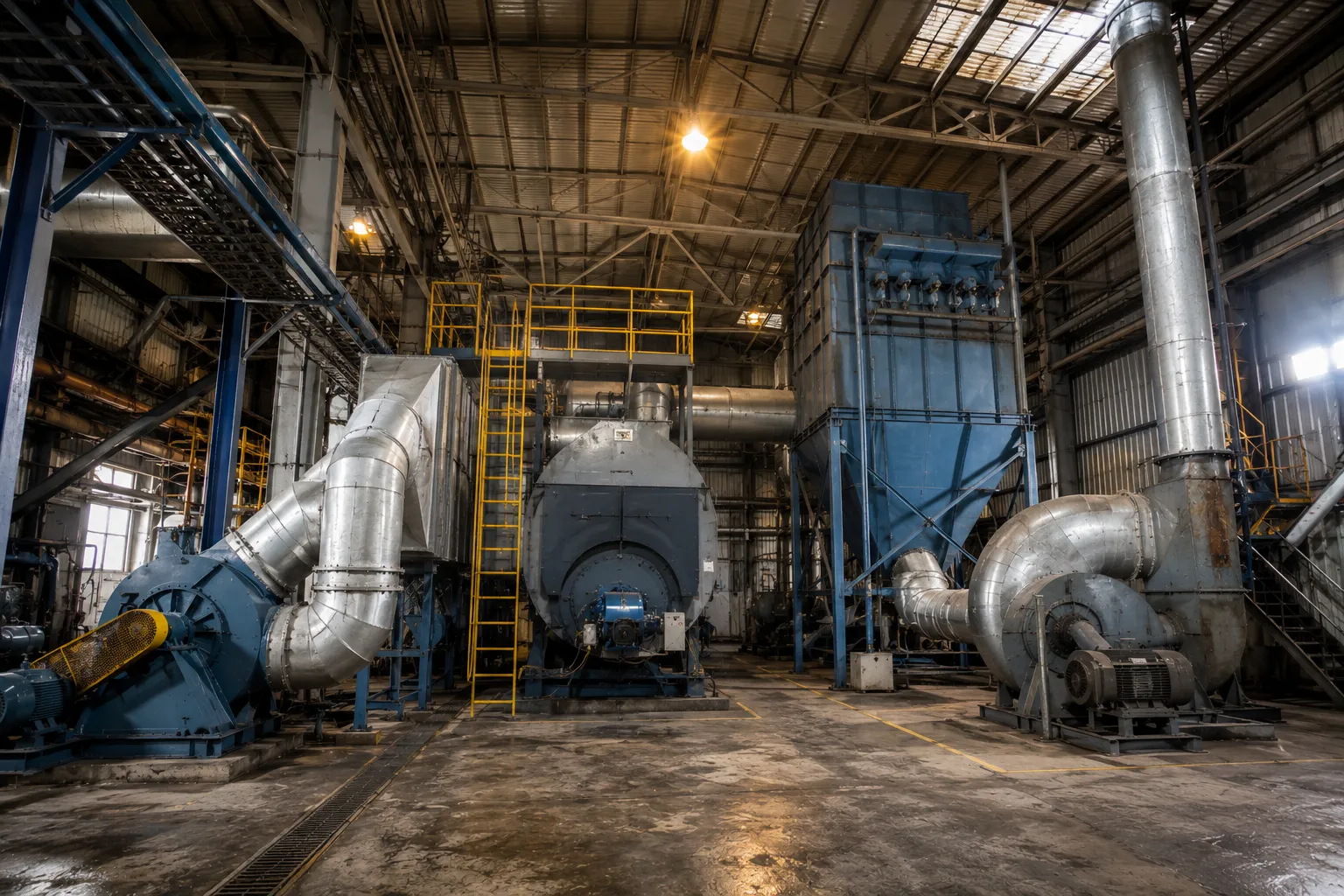
Most industrial boilers don’t run on just one of these fans. They run what’s called a balanced draft system, where the FD fan pushes air in and the ID fan pulls flue gas out, working together to keep the furnace at a slight negative pressure relative to the surrounding room. This balance matters for two reasons:
- Safety. A furnace running under positive pressure (too little induced draft relative to forced draft) can leak hot flue gas and flame through joints, doors, and inspection ports, creating a serious burn and fire hazard for operators.
- Efficiency. Too much negative pressure pulls in excess false air through leaks, cooling the furnace and wasting fuel. Too little draft starves combustion. The two fans have to be sized and controlled together, not selected independently.
Some larger power plant boilers also use a third fan, the Primary Air (PA) fan, which carries pulverized fuel into the furnace separately from the general combustion air supply. If your system burns pulverized coal or similar solid fuel, ask your equipment supplier whether a PA fan applies to your configuration, since it changes the draft balance calculation.
Sizing and Selecting the Right FD and ID Fans
Getting the fan type right is only step one. Sizing them correctly is what determines whether the system actually performs.
For FD fans, sizing is based on the combustion air requirement of the boiler or furnace, typically expressed as a function of fuel firing rate and the stoichiometric air-to-fuel ratio, plus a margin for excess air needed for complete combustion. The fan has to overcome the resistance of ductwork, air preheaters, and burner registers.
For ID fans, sizing is more demanding because you’re calculating volume based on hot flue gas, not cold air, and gas volume expands significantly with temperature. The fan also has to overcome the combined resistance of the boiler passes, economizer, dust collector or precipitator, ductwork, and stack draft loss. Undersizing an ID fan is one of the most common boiler performance complaints, because the resistance added by pollution control equipment is often underestimated at the design stage.
A few sizing principles worth following regardless of fan type:
- Always size against the system’s actual total resistance (in mm or inches of water gauge), not a rounded estimate.
- Ask for a performance curve tested to a recognized standard, not a single rated point, so you can see how CFM changes as resistance changes across the operating range.
- Build in margin for future changes, such as added pollution control equipment or fuel switching, since retrofitting an undersized ID fan later is expensive and disruptive.
- Consider a Variable Frequency Drive (VFD) on both fans where load varies, since matching fan speed to actual demand instead of throttling with a damper can meaningfully cut energy costs over the equipment’s life.
Materials and Construction: Why ID Fans Cost More Per Unit of Capacity
It’s common for buyers to be surprised that an ID fan costs noticeably more than an FD fan of similar airflow capacity. The reason comes down entirely to what each fan handles. An FD fan moves clean, cool air, so standard fabrication and bearing arrangements hold up fine over years of duty. An ID fan moves gas that can exceed 150 to 250°C, often carrying fine ash or particulate even after dust collection, and in many fuels, mildly corrosive compounds.
That combination of heat, particulate, and chemical exposure demands:
- Wear-resistant wheel materials or hard-facing coatings to resist erosion from residual particulate.
- Higher-grade alloys or thicker-gauge housings to resist thermal stress and warping.
- Bearing designs with cooling arrangements, since bearings mounted close to a hot gas stream need protection from conducted heat.
- Shaft seals designed to prevent hot gas leakage at the point where the shaft exits the housing.
If your dust collector isn’t performing well, the ID fan downstream absorbs the consequences in the form of accelerated wheel wear. It’s worth pairing ID fan selection with a properly sized industrial dust collector or wet scrubber upstream, both to meet emission norms and to protect the fan itself.
Maintenance Differences You Should Plan For
Because FD and ID fans operate in such different conditions, they wear differently and need different maintenance schedules.
FD fan maintenance typically centers on:
- Routine bearing lubrication and vibration checks.
- Keeping inlet filters or louvers clean, since a clogged inlet forces the motor to work harder and can trip overload protection.
- Periodic impeller balance checks, since even clean-air fans lose balance over years of continuous duty.
ID fan maintenance is more intensive and should include:
- Regular inspection of the wheel for erosion, pitting, or ash buildup, which unbalances the fan and accelerates bearing wear.
- Monitoring bearing temperature closely, since bearings near a hot gas stream are more prone to overheating than those on a cold-air fan.
- Checking shaft seals for gas leakage, which is both an efficiency loss and a safety concern.
- Scheduled thermal imaging or vibration analysis, since ID fans are typically harder and more expensive to take offline for unscheduled repair, given their role in the exhaust path.
Building these differences into your maintenance calendar upfront, rather than treating both fans the same, is one of the simplest ways to avoid unplanned boiler downtime.
Safety and Compliance Considerations
Because FD and ID fans directly affect furnace pressure balance, incorrect sizing, poor maintenance, or a fan failure on either side can create a genuine safety hazard, not just a performance problem. A few points worth confirming with your supplier or engineering team:
- Draft balance monitoring: Furnace pressure should be actively monitored (not just assumed) so that a drift toward positive pressure is caught before it becomes a flue gas leak hazard.
- Interlocks: Boilers should have safety interlocks that prevent firing if either the FD or ID fan isn’t running or isn’t reaching adequate flow, since firing without proper draft is a serious combustion safety risk.
- Emission compliance: Where the ID fan feeds into pollution control equipment, confirm the fan’s flow capacity matches what the dust collector or scrubber needs to operate within its rated efficiency, since an undersized ID fan can starve the pollution control equipment of the flow it needs to meet emission norms.
- Performance verification: Ask whether the fan’s rated performance was tested to ANSI/AMCA 210 or the equivalent ISO 5801 standard, rather than relying on a manufacturer’s headline number alone.
Common Mistakes in FD and ID Fan Selection
- Treating FD and ID fan sizing as independent problems instead of balancing them together against the same draft system.
- Underestimating flue gas volume by sizing the ID fan on cold-air equivalents instead of actual operating temperature.
- Ignoring the added resistance of dust collectors, scrubbers, or new emission control equipment installed after the original ID fan was sized.
- Specifying standard-duty bearings or wheel materials on an ID fan exposed to abrasive or corrosive flue gas, leading to premature failure.
- Skipping VFDs on fans that operate across a wide load range, and paying for it in ongoing energy waste.
- Assuming a single fan can be “oversized a bit for safety” without checking how that affects draft balance and energy consumption at partial load.
Industries Where This Comparison Matters Most
FD and ID fans aren’t limited to power plant boilers. They’re core to draft systems across industries we serve, including cement plants, steel and foundry operations, chemical processing, textile units running thermic fluid heaters, food processing plants with steam boilers, and paper and pulp mills. Any facility running a fuel-fired furnace, boiler, or thermal oxidizer needs both sides of the draft system engineered correctly, not just one fan selected in isolation.
Frequently Asked Questions
Can one fan do the job of both an FD fan and an ID fan?
No. The two fans handle air at very different temperatures, pressures, and particulate loads, and they’re positioned at opposite ends of the draft system. Combining their function into a single fan isn’t practical for anything beyond very small, simple systems.
Which fan is more expensive, FD or ID?
For a comparable airflow rating, ID fans generally cost more, because they require heavier-duty construction to handle hot, dust-laden, and sometimes corrosive flue gas, whereas FD fans handle cooler, clean air and can use simpler, standard-duty construction.
What happens if the ID fan fails but the FD fan keeps running?
Furnace pressure can shift toward positive, risking flue gas and flame leakage through furnace openings. Most properly designed systems include interlocks that shut down or reduce firing if draft balance is lost, which is why functioning safety interlocks matter as much as the fans themselves.
Do FD and ID fans need to be the same brand or size?
No, but they do need to be engineered together against the same draft calculation, since their combined performance determines furnace pressure balance, not either fan’s rating in isolation.
How do I know if my current ID fan is undersized?
Common signs include difficulty maintaining negative furnace pressure, visible smoke or flue gas leakage at furnace openings, the dust collector or scrubber underperforming despite being properly maintained, or the fan motor running consistently near or above its rated load. A performance review against your actual system resistance is the reliable way to confirm it.
Final Thought
FD and ID fans aren’t a matter of picking whichever one sounds right for your process. They’re two halves of a single draft system, sized, matched, and maintained together to keep combustion efficient and furnace pressure safe. Getting either one wrong, whether through undersizing, the wrong construction for the operating environment, or mismatched maintenance planning, shows up eventually as lost efficiency, unplanned downtime, or a safety risk that’s far more expensive to fix after the fact than to specify correctly at the start.
If you’re evaluating a new boiler installation or trying to figure out why your current draft system isn’t performing the way it should, get in touch with our engineering team. We’ll review your fuel type, boiler capacity, and existing ductwork or pollution control equipment, and help you specify FD and ID fans sized correctly for your actual operating conditions, not just catalogue numbers.