High pressure blower manufacturer is a search that sits at a very specific intersection between someone who genuinely needs high static pressure airflow for a process application, and someone who’s ended up on this page looking for something entirely different, like a high pressure air blower for cleaning a car or a high pressure blower gun for workshop use. This guide is built to serve both honestly, because confusing the two is exactly how plants end up with the wrong equipment on order. We’ll cover what a true industrial high pressure blower is, how it differs from the handheld tools that share its name, the types available, real applications, pricing, design considerations, and what makes a reliable high pressure blower manufacturer worth working with.
Let’s go through this properly.
What Is a High Pressure Blower?
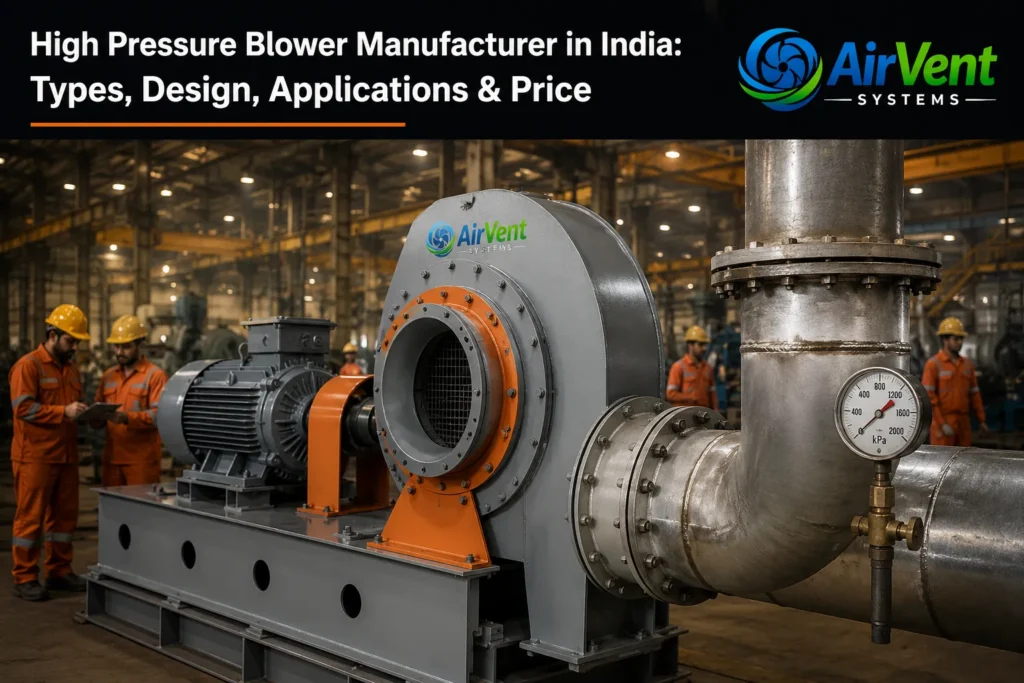
A high pressure blower is an industrial air-moving device specifically engineered to generate significantly higher static pressure than a standard centrifugal or axial blower. While a general-purpose industrial blower might operate at static pressures up to 200–300 mm WG (water gauge), a high pressure blower is designed to deliver pressures anywhere from 500 mm WG to over 2,000 mm WG, depending on the design and application.
This elevated pressure capability is what makes high pressure blowers essential for applications where air simply cannot be “pushed” at lower pressures pneumatic conveying of dense material, high-resistance combustion systems, aeration of deep tanks, and high-velocity industrial cleaning processes.
In fact, the ability to maintain consistent, high static pressure under variable resistance conditions is precisely what separates a true industrial high pressure blower from a standard process fan.
High Pressure Blower vs Standard Blower: Key Differences
| Feature | Standard Centrifugal Blower | High Pressure Blower |
| Static pressure range | Up to 200–300 mm WG | 500 mm WG to 2,000+ mm WG |
| Impeller design | Backward curved, forward curved | Radial, multi-stage, or ring channel |
| Motor HP range | 0.5 HP to 100 HP | 1 HP to 200+ HP |
| Application type | General ventilation, dust collection | Pneumatic conveying, aeration, furnace |
| Build complexity | Standard | Higher reinforced casing and shaft |
| Noise level | Moderate | Higher at peak pressure |
| Typical speed | 960–1,450 RPM | 1,450–3,000 RPM |
Types of Industrial High Pressure Blowers
Not every high pressure blower is built the same way, and the type you need depends almost entirely on your required pressure range and application. Here are the main categories:
Single-Stage Centrifugal High Pressure Blower
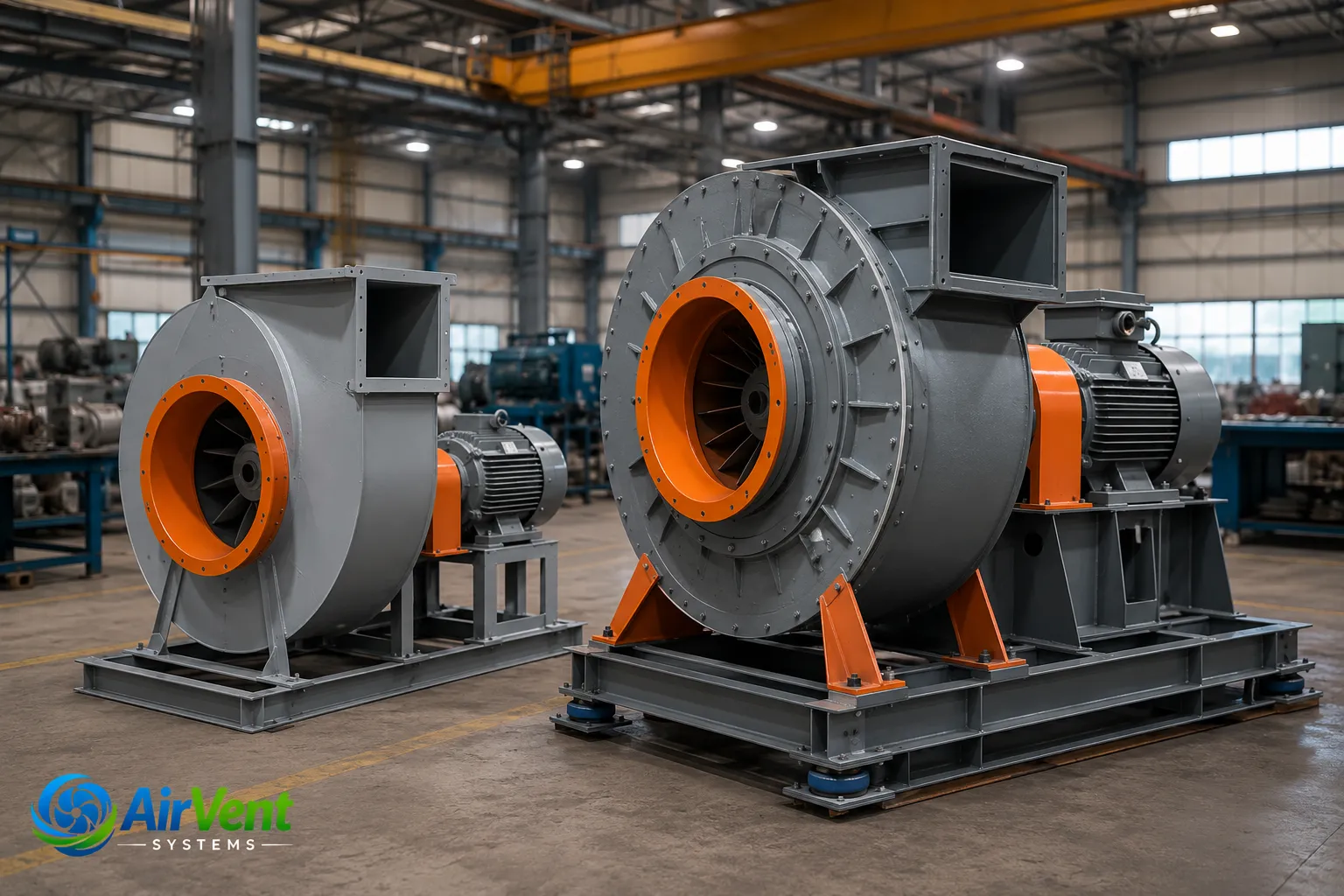
A single-stage design uses one impeller to build pressure in a single pass. This covers most industrial applications in the 500–1,000 mm WG range and is the most common type supplied by an industrial high pressure blower manufacturer in India.
Best for: Pneumatic conveying of light materials, forced draft combustion systems, drying lines.
Multi-Stage High Pressure Blower
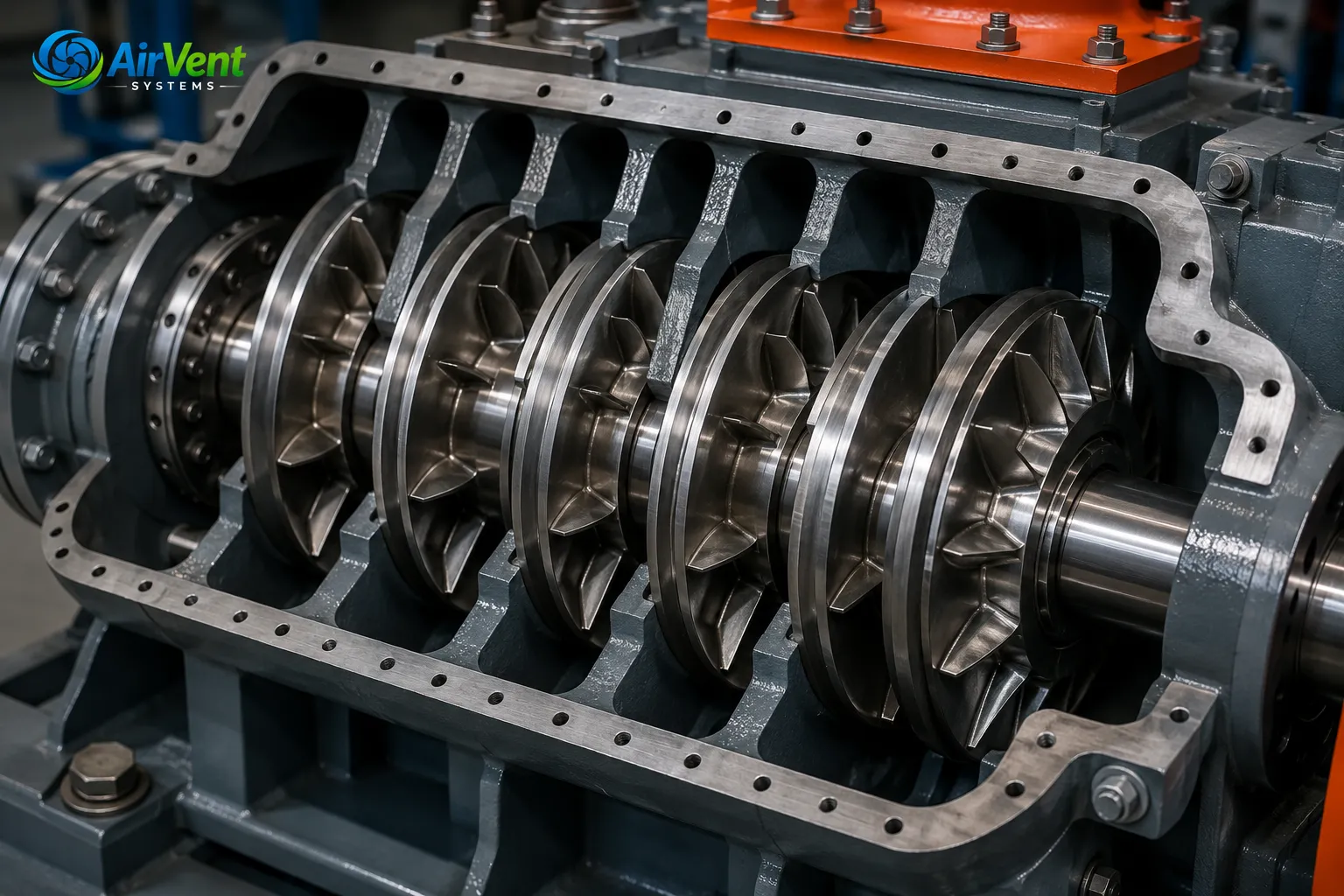
A multi-stage blower uses two or more impellers mounted on the same shaft in series, each adding pressure to the airstream sequentially. This design reaches significantly higher pressures than a single-stage unit without increasing the physical size of the casing.
Best for: Dense-phase pneumatic conveying, high-pressure aeration, deep tank applications, industrial furnaces requiring very high combustion air pressure.
Ring Blower (Side Channel Blower)
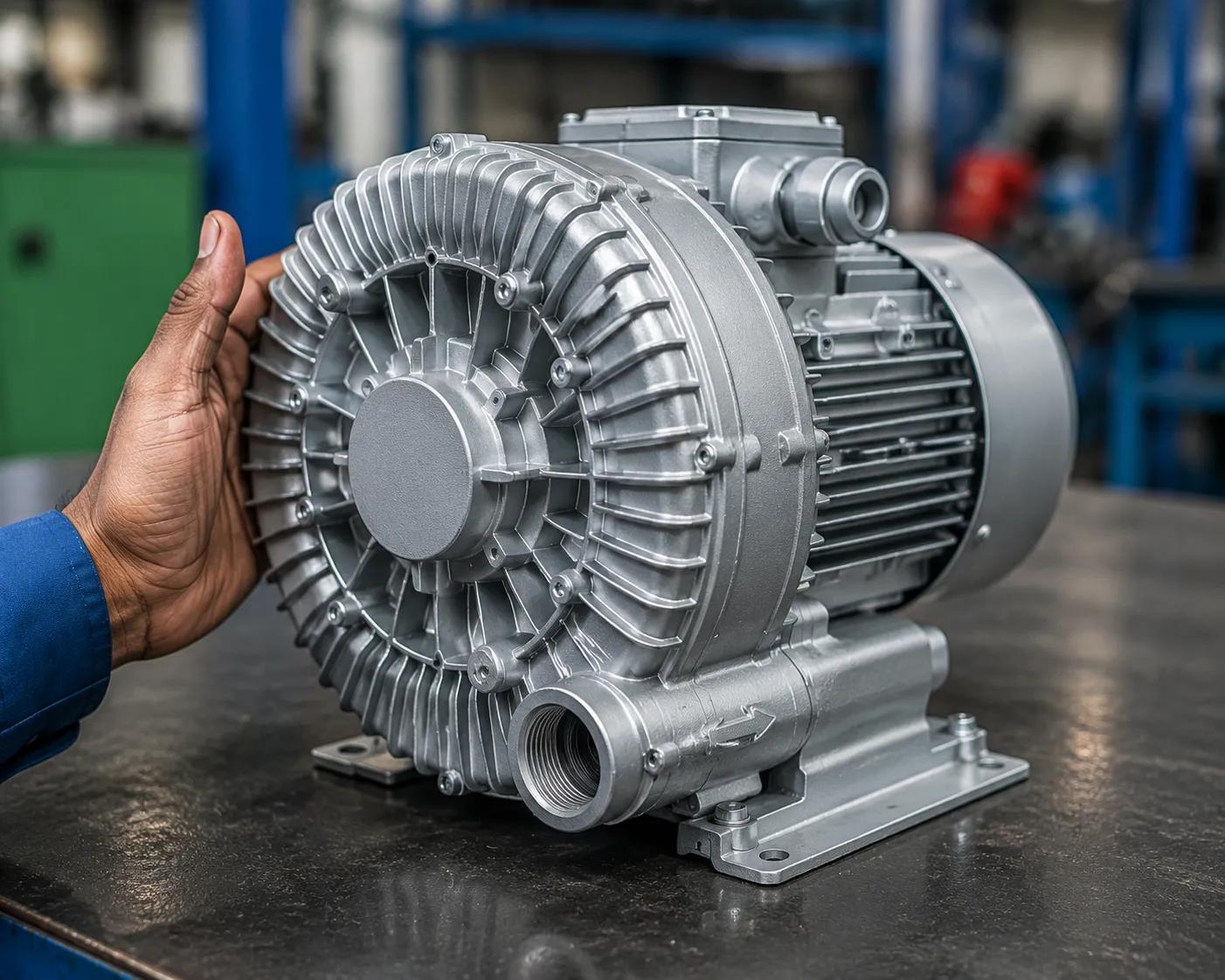
A ring blower also called a side channel blower or regenerative blower uses a single impeller rotating at high speed inside a ring-shaped channel, recirculating air through the blades multiple times before discharge. This builds surprisingly high pressure from a compact, lightweight unit with no internal contact between rotating and stationary parts.
Best for: Small high pressure blower applications laboratory use, vacuum packaging, printing presses, suction cup handling, aquaculture aeration, and medical equipment.
Roots (Twin Lobe) High Pressure Blower
A Roots blower uses two counter-rotating lobed rotors that trap and displace a fixed volume of air with each rotation. It is a positive displacement design meaning it delivers a constant flow volume regardless of system pressure changes and it handles very high pressures reliably.
Best for: Pneumatic conveying of dense or abrasive material, wastewater aeration, cement and lime plant bulk material transfer.
Types of High Pressure Blowers Compared
| Type | Pressure Range | Flow Volume | Noise | Ideal For |
| Single-stage centrifugal | 500–1,000 mm WG | High | Moderate | General high-pressure industrial duty |
| Multi-stage centrifugal | 1,000–3,000 mm WG | Moderate | Moderate to high | Dense conveying, deep-tank aeration |
| Ring blower (side channel) | 300–800 mm WG | Low to moderate | Low | Small high pressure blower applications |
| Roots (twin lobe) | 500–2,000+ mm WG | Constant | Higher | Positive displacement conveying, aeration |
High Pressure Blower Design: What Actually Matters
This is a section that most guides skip entirely, and it genuinely matters when you’re comparing manufacturers. Here’s what separates a well-designed high pressure blower from one that will give you problems within the first year:
Impeller Material and Balancing
At the high rotational speeds required for elevated pressure output, any impeller imbalance creates disproportionately large vibration and bearing load. A reliable high pressure blower manufacturer dynamically balances every impeller ideally to G2.5 or better per IS/AMCA standards before final assembly.
Casing Strength and Sealing
Higher operating pressure means greater outward force on the casing and higher leakage risk at joints. Casings for high pressure blowers need heavier wall thickness, reinforced flanges, and proper sealing at the shaft entry point to prevent air bypass that silently reduces efficiency.
Bearing Selection and Cooling
Bearings in high-speed, high-pressure blowers run hotter than in standard process fans. A well-designed unit will use heavy-duty bearings properly sized for the combined radial and axial loads, with provision for adequate lubrication and in continuous-duty applications cooling.
Drive Arrangement
High pressure blowers can be direct-drive (impeller mounted directly on the motor shaft) or belt-drive. Direct drive eliminates belt maintenance but locks the speed; belt drive allows speed adjustment by changing the pulley ratio, which is useful when your pressure requirement might vary. Ring blowers are almost always direct-drive for compactness.
High Pressure Blower Applications in Indian Industry
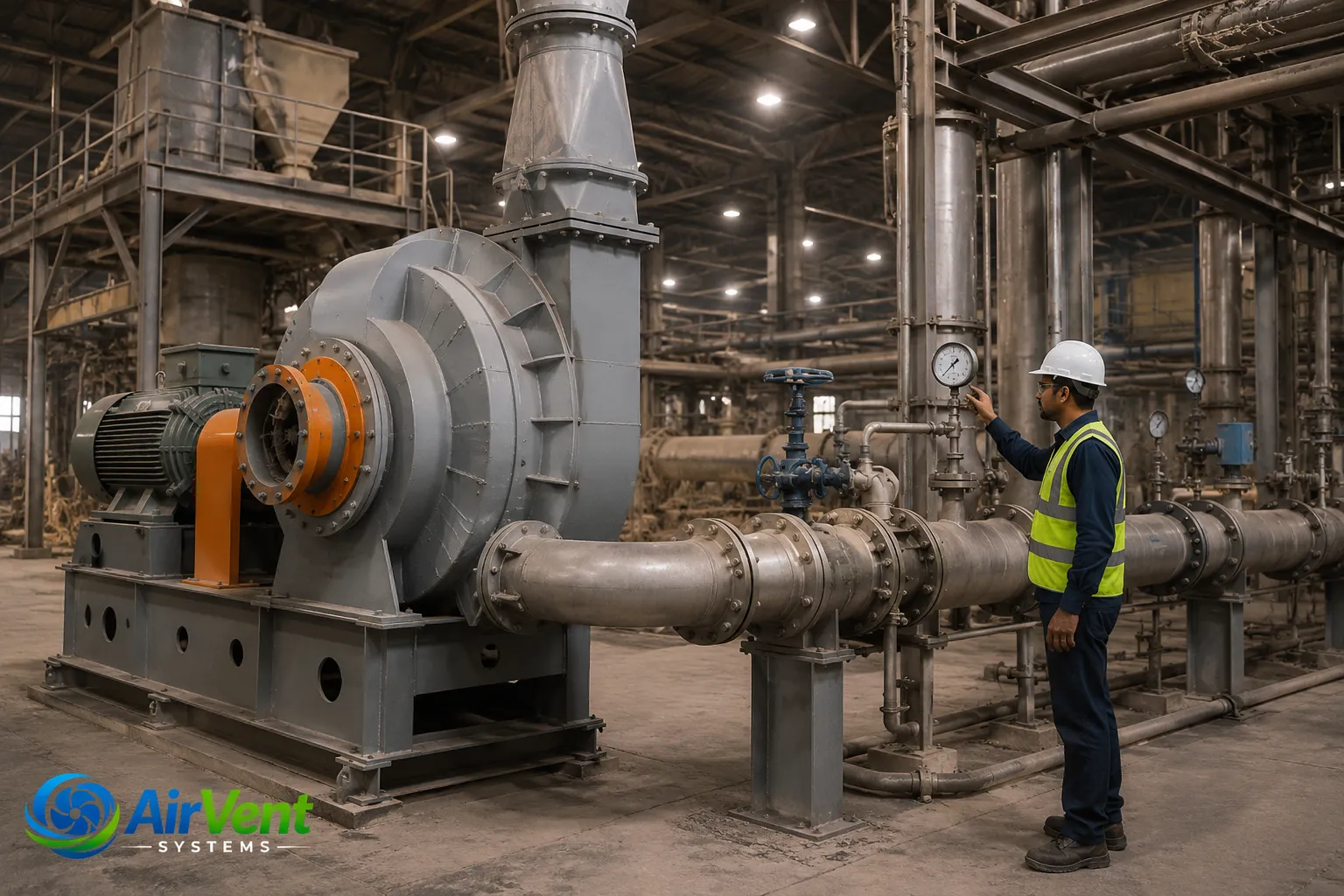
An experienced industrial high pressure blower manufacturer will tell you the same thing: application matching is more important than pressure rating alone. Here’s how high pressure blowers are actually deployed across Indian industries:
- Pneumatic conveying systems: Moving cement, fly ash, flour, plastic granules, and pharmaceutical powders through pipelines over long distances
- Foundry and steel plants: High-pressure combustion air for cupola furnaces, arc furnace cooling, and slag granulation
- Chemical and pharmaceutical plants: Pressure conveying of powders, reactor aeration, and vacuum generation for filtration
- Wastewater treatment: Submerged aeration for biological treatment tanks, where depth of submergence directly drives pressure requirement
- Textile mills: High-pressure air jets for yarn texturizing and loom cleaning
- Food processing: Pressure conveying of sugar, spice, grain, and flour with hygienic-grade blowers
- Paper and printing industry: Air cushion systems, paper web handling, and ink drying
- Electroplating and surface treatment: Aeration of treatment tanks and drying after rinse stages
High Pressure Air Blower for Cleaning: Clearing Up the Confusion
We need to address this directly, because “high pressure air blower for cleaning car” and “high pressure blower gun” are among the top-searched related queries and they refer to a completely different category of product.
A high pressure blower gun or high pressure air blower for cleaning is a handheld, nozzle-equipped tool that uses compressed air or a small electric blower motor to blow dust and debris off surfaces typically a car, electronic components, or a workshop surface. These are consumer or light workshop tools, typically powered at very low HP, and they’re an entirely different product from an industrial high pressure blower.
If your requirement is: – Cleaning car surfaces, electronic boards, or light workshop debris → you need a handheld blower gun or a compressed air nozzle, not an industrial blower – Cleaning heavy industrial components at scale (conveyor belts, filter surfaces, moulds) using high-velocity air → you may need a small high pressure blower with a properly designed nozzle attachment, and this is where an industrial high pressure blower manufacturer becomes relevant
Making this distinction upfront saves both time and money, and any manufacturer worth working with will ask about your actual application before quoting.
High Pressure Blower Price in India
Pricing varies significantly based on type, capacity, and build specification. Here’s a realistic range:
| High Pressure Blower Type / Size | Approximate Price Range (INR)* |
| Small ring blower / side channel (0.5–2 HP) | ₹8,000 – ₹35,000 |
| Single-stage centrifugal, 2–10 HP | ₹40,000 – ₹2,50,000 |
| Single-stage centrifugal, 10–50 HP | ₹2,50,000 – ₹8,00,000 |
| Multi-stage centrifugal, 5–50 HP | ₹3,00,000 – ₹15,00,000 |
| Roots (twin lobe) blower, 5–50 HP | ₹2,00,000 – ₹12,00,000 |
*Indicative ranges only. Actual high pressure blower price depends on static pressure requirement, impeller design, material of construction (MS, SS, FRP), motor rating, and customization. Always request a quote based on your specific CFM and pressure requirement.
High Pressure Blower Manufacturer in Pune and Maharashtra
Maharashtra’s industrial belt spanning Bhosari, Chakan, Talegaon, and Pimpri-Chinchwad in Pune, plus Nashik, Aurangabad, and Navi Mumbai further out runs a dense mix of automotive, pharma, chemical, and process manufacturing units, and every single one of them places different demands on a high pressure blower manufacturer.
An automotive press shop needs blowers for pneumatic conveying of scrap; a pharma unit needs hygienic-grade ring blowers for cleanroom pressure differential control; a chemical plant needs corrosion-resistant high-pressure blowers for reactor aeration. Working with a high pressure blower manufacturer based in Pune gives you faster site visits for accurate sizing, quicker spare parts turnaround, and a supplier who already understands Maharashtra’s MIDC operating conditions and MPCB compliance requirements.
Common Mistakes When Buying a High Pressure Blower
Being direct here saves you money in the long run:
- Specifying pressure in HP instead of mm WG or kPa – horsepower tells you nothing about pressure output; a 10 HP blower can be built for 200 mm WG or 1,500 mm WG depending on design, so always specify your required static pressure and flow rate
- Choosing a ring blower for heavy industrial duty – ring blowers are excellent small high pressure blowers but are not designed for continuous heavy dust loads or very high temperatures
- Ignoring noise levels – high pressure blowers are inherently noisier than standard fans; if your installation is near an occupied area, discuss acoustic enclosures or silencer options upfront
- Skipping balancing specifications – asking for dynamic balancing grade upfront costs nothing; discovering excessive vibration after installation costs significantly more
- Accepting catalogue pricing without confirming design parameters – a quote without stated static pressure, airflow, and material grade is not a real quote
Maintenance Checklist for Industrial High Pressure Blowers
- Inspect and clean impeller monthly in dusty applications to prevent imbalance
- Monitor bearing vibration and temperature on a scheduled basis high-speed bearings are more sensitive to early-stage imbalance than lower-speed standard blowers
- Check belt tension and alignment on belt-drive units at least monthly
- Confirm shaft seal integrity at every service interval to prevent pressure bypass
- Log motor current readings at standard operating conditions and watch for upward trends
If your current system also includes an ID fan or dust collector downstream, our guides on Common Causes of ID Fan Failure and How to Prevent Them and Types of Industrial Dust Collectors cover the complementary failure patterns worth monitoring in parallel.
How to Get an Accurate Quote from a High Pressure Blower Manufacturer
Share these details with any high pressure blower manufacturer before expecting a meaningful quote:
- Required airflow (CFM or m³/hr at operating conditions)
- Required static pressure (mm WG or kPa)
- Operating temperature (ambient, or elevated if handling hot gas)
- Gas composition (clean air, dusty, corrosive, humid)
- Duty cycle (intermittent or continuous)
- Electrical supply (voltage, phase, frequency)
- Available installation space and orientation
These seven data points are the difference between a quote that fits and one that sounds good on paper but causes problems after installation. A high pressure blower manufacturer who doesn’t ask for at least most of these before quoting is telling you something important about how carefully they’ll engineer the unit itself.
For a broader understanding of how this fits into your complete air system, our guide on Industrial Blower Manufacturer in India: The Complete Guide covers the full blower selection framework, and our comparison article on Centrifugal Blower Manufacturer in India covers the specific design choices relevant to centrifugal-type high pressure units.
Industry standards for high pressure blower performance and testing are documented by the Air Movement and Control Association (AMCA), and working with a manufacturer who references these standards in their testing process is a meaningful quality indicator.
Frequently Asked Questions
What is a high pressure blower?
A high pressure blower is an industrial device that generates significantly elevated static pressure typically 500 mm WG and above to move air or gas through high-resistance systems such as pneumatic conveying pipelines, deep aeration tanks, or high-pressure combustion systems.
What is the difference between a high pressure blower and a standard industrial blower?
A standard industrial blower operates at 200–300 mm WG static pressure for general ventilation and dust collection, while a high pressure blower is specifically engineered with reinforced casing, high-speed impellers, and heavier bearings to deliver 500 mm WG to over 2,000 mm WG continuously.
What is a high pressure blower gun?
A high pressure blower gun is a handheld consumer or workshop tool used to blow dust and debris off surfaces using compressed air or a small electric motor it is a completely different product from an industrial high pressure blower and is not manufactured by industrial blower suppliers.
What is the price of a high pressure blower in India?
High pressure blower prices in India range from approximately ₹8,000 for a small ring blower to ₹15,00,000 or more for a large multi-stage centrifugal unit, depending on pressure rating, airflow requirement, and material of construction.
Which type of high pressure blower is best for pneumatic conveying?
For light-material pneumatic conveying, a single-stage centrifugal high pressure blower is usually sufficient. For dense-phase conveying of heavy or abrasive materials over longer distances, a Roots (twin lobe) or multi-stage centrifugal blower is the more reliable choice.
Final Thoughts
High pressure blower manufacturer searches often land on pages that list products without actually helping you understand what you need and why. We’ve tried to do the opposite here giving you a complete picture of types, design factors, pricing, applications, and the questions worth asking before you place an order.
The honest truth is this: the right industrial high pressure blower, correctly sized for your actual pressure and flow requirement, will run reliably for years with minimal intervention. The wrong one undersized, over-sped, or built without the right material grade will show you that mismatch in vibration, overheating, and premature failure within months.
At Airvent Systems, we manufacture single-stage and multi-stage high pressure centrifugal blowers engineered around your actual operating conditions. You can explore our High Pressure Blowers range or share your application details with our engineering team for a precise sizing recommendation.
Need a high pressure blower sized for your exact process? Get a Free Engineering Recommendation from Airvent Systems →