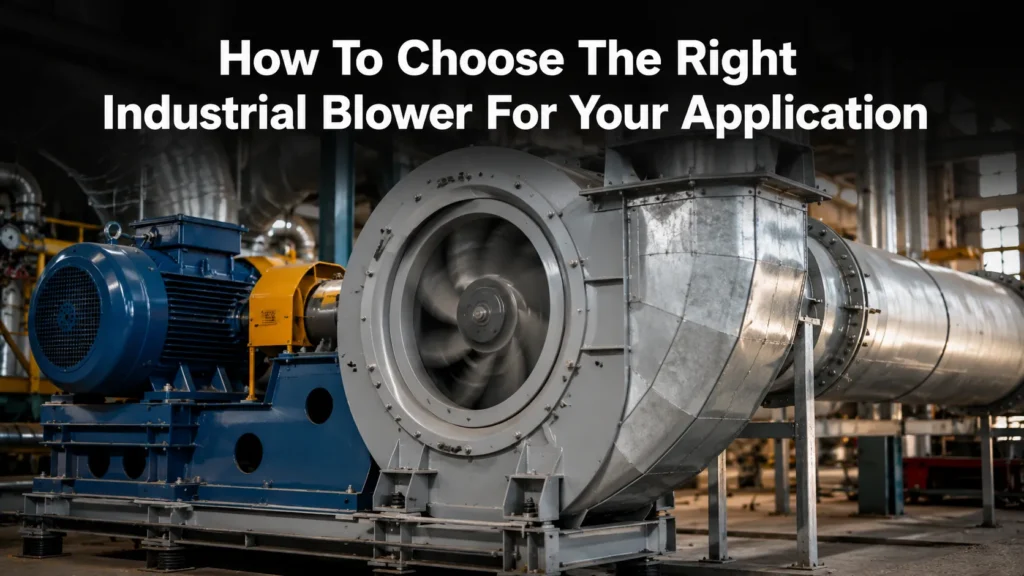
If you’ve ever installed a blower that turned out too weak to overcome your system’s resistance or too powerful and wasteful, you already know that “bigger” and “more powerful” aren’t the same thing as “right.” Choosing an industrial blower isn’t a catalog-browsing exercise. It’s an engineering decision that depends on how much air you need to move, how much resistance that air will fight against, what’s actually in that air, and where the blower will live day to day.
This guide walks through that decision step by step, from the two numbers that matter most, to the blower types built to handle them, to the standards, materials, and drive configurations that separate a blower that lasts a decade from one that fails in year two.
Quick Answer
The right industrial blower for your application is determined by four factors, in this order: required airflow (CFM), the static pressure your system creates, the condition of the air (clean, hot, wet, corrosive, or particulate-laden), and the environment the blower operates in (temperature, space, and any explosion or contamination risk). Match those four factors to a blower type, centrifugal, positive displacement, regenerative, or axial, before comparing brands or price. Browse our full range of air handling products to see how each type is engineered.
Start With Your Application, Not the Catalog
Every blower selection mistake traces back to the same root cause: skipping straight to horsepower or brand comparisons before defining the job. A paint booth, a pneumatic conveying line, and a wastewater aeration basin all “need a blower,” but they need fundamentally different machines.
Before you look at a single spec sheet, answer these questions:
- What is the blower moving? Clean makeup air, hot process exhaust, abrasive dust, corrosive fumes, or wet/humid air all demand different wheel designs and materials.
- How much air do you need to move? This is your required airflow, measured in cubic feet per minute (CFM).
- How much resistance is in the system? Ductwork length, filters, cyclones, bends, and hoods all add up to static pressure, measured in inches of water gauge (in. w.g.).
- Is the environment hazardous? Combustible dust, flammable vapors, or explosive atmospheres change everything about motor selection and construction.
- Does the process require constant pressure or constant volume? Some applications (like pneumatic conveying) need steady flow regardless of pressure swings; others tolerate flow that varies with resistance.
Get these five answers first, and the rest of the selection process becomes far more straightforward.
Calculating the Two Numbers That Actually Matter: CFM and Static Pressure
Airflow (CFM). For a ventilation or exhaust application, a simplified starting formula is:
CFM = Room Volume (cubic feet) × Air Changes per Hour ÷ 60
For a process application like drying, conveying, or combustion air, CFM is usually dictated by the equipment manufacturer’s specification or by the mass of material being moved per minute, which a process engineer converts to a volumetric flow rate.
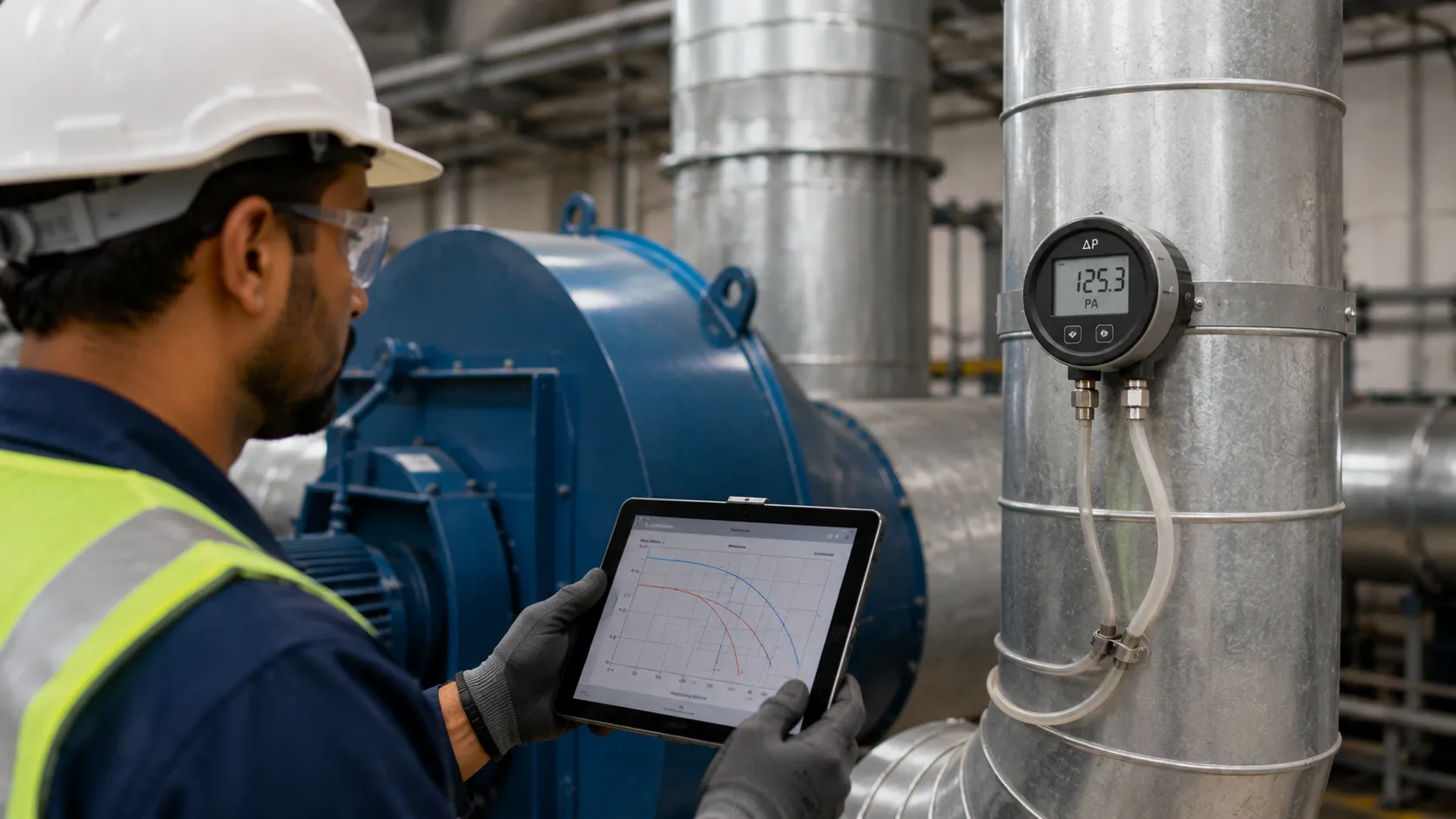
Static pressure. This is the total resistance the blower has to push against, the sum of friction losses through ducts, hoods, filters, dampers, and any elevation change. It’s calculated in inches of water gauge, and every component in the airstream (a 90-degree elbow, a bag filter, a cyclone separator) has a published or measurable pressure-drop value. Add them all together and you get your system’s total static pressure requirement.
Once you have both numbers, you plot them against a blower’s published performance curve, not its single “rated” number. A performance curve shows CFM at multiple static pressure points, because a blower’s output changes as system resistance changes. A blower selected only on its peak-rated CFM, without checking the curve at your actual static pressure, is one of the most common and costly selection errors.
If you want manufacturer-verified performance data rather than marketing numbers, look for ratings tested to ANSI/AMCA 210 (or the international equivalent, ISO 5801), which is the industry-standard laboratory method for measuring airflow, pressure, and power on fans and blowers.
The Main Types of Industrial Blowers and What Each One Is Actually Good At
Centrifugal Blowers
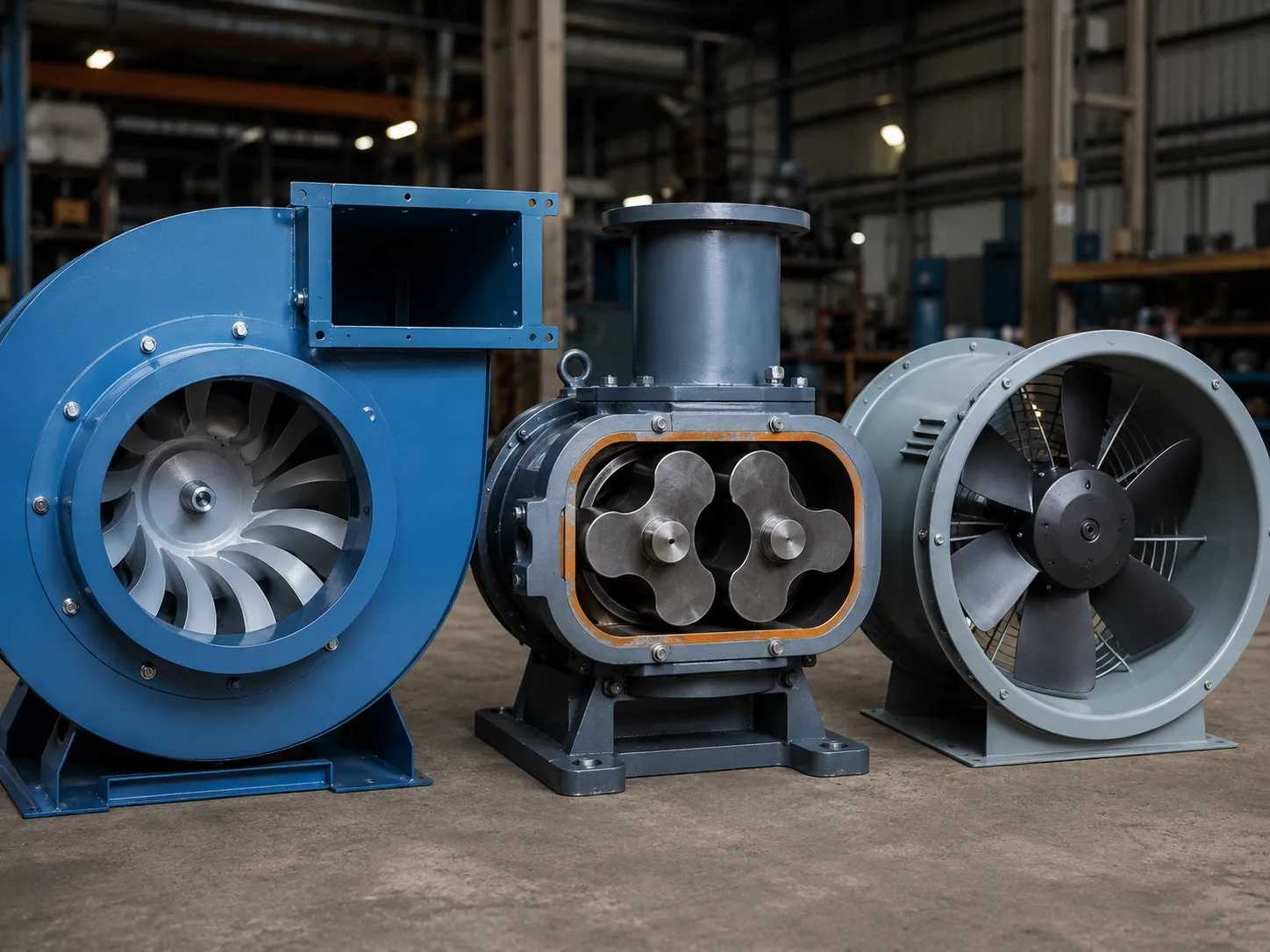
Centrifugal blowers (radial) use a spinning impeller to pull air into the center and throw it outward through a discharge outlet. They deliver steady airflow at low-to-moderate pressures and are the workhorse choice for general ventilation, dust collection, and HVAC exhaust.
- Forward-curved blades: high volume, low pressure, best for clean-air, general ventilation duty.
- Backward-curved or radial blades: handle higher pressures and dirtier or particulate-laden air more effectively, making them the better choice for dust and fume collection systems.
Positive Displacement (Roots/Lobe) Blowers
PD blowers trap a fixed volume of air with rotating lobes and force it through the discharge port at essentially constant volume, regardless of pressure fluctuations downstream. This makes them the standard choice for pneumatic conveying, where a steady, predictable flow rate is critical even as line pressure varies with material loading. They excel at high pressure, moderate volume applications, but are less energy-efficient at partial load than centrifugal designs. For demanding pressure requirements, see our high pressure blowers.
Regenerative (Side-Channel) Blowers
Regenerative blowers use a bladed impeller that re-accelerates air multiple times as it moves through a peripheral channel, producing moderate pressure and moderate flow in a compact, oil-free package. They’re common in wastewater aeration, vacuum lifting, and packaging equipment, where footprint and clean, oil-free air matter more than raw pressure capability.
Axial Blowers
Axial blowers move air parallel to the shaft, like a propeller. They move very high volumes at low pressure and are the right call when you need to clear large volumes of air or hot exhaust quickly, think large-space HVAC, tunnel ventilation, or rapid fume removal, but they struggle against significant system resistance. Our tube axial fans are built for exactly this kind of high-volume ventilation duty.
Multistage Centrifugal Blowers
For applications needing both high volume and moderate-to-high pressure, combustion air for large boilers, or long-run pneumatic conveying, multistage centrifugal blowers stack several impellers in series, building pressure incrementally through each stage.
| Application | Typical Best Fit |
|---|---|
| General ventilation / makeup air | Centrifugal (forward-curved) |
| Dust and fume collection | Centrifugal (backward-curved/radial) |
| Pneumatic conveying | Positive displacement or multistage centrifugal |
| Wastewater aeration | Regenerative or multistage centrifugal |
| Combustion / boiler air | Multistage centrifugal |
| Paint booths | Centrifugal, high volume/low pressure |
| Large-space exhaust / tunnel ventilation | Axial |
| Vacuum lifting / packaging | Regenerative |
Material and Construction: Matching the Blower to What’s in the Air
Airflow and pressure get most of the attention, but material selection is what determines whether a blower survives its environment.
- Mild/carbon steel is standard for clean, dry, non-corrosive air and is the most cost-effective option where corrosion isn’t a concern.
- Stainless steel or specialty alloy construction is necessary for corrosive fumes, chemical processing, or washdown environments where carbon steel would degrade quickly.
- Abrasion-resistant coatings or hardened wheels extend service life in applications moving dust, grit, or particulate-heavy air, where standard wheels would erode within months. Pairing the right blower with an industrial dust collector further protects the wheel and housing from abrasive wear.
- High-temperature alloys and bearing designs are required for process heating, exhaust, or combustion air applications where standard construction would fail from thermal stress, conditions typical of FD fans and ID fans on boilers and furnaces.
- Explosion-proof or spark-resistant construction is mandatory anywhere combustible dust or flammable vapors are present, this typically means non-sparking wheel materials, explosion-proof motors rated for the specific hazard classification, and grounding provisions.
If your application touches any of these conditions, tell your supplier up front. Retrofitting a standard-construction blower for a corrosive or hazardous environment after the fact is far more expensive than specifying it correctly the first time.
Drive Configuration: Direct Drive vs. Belt Drive, and the Case for VFDs
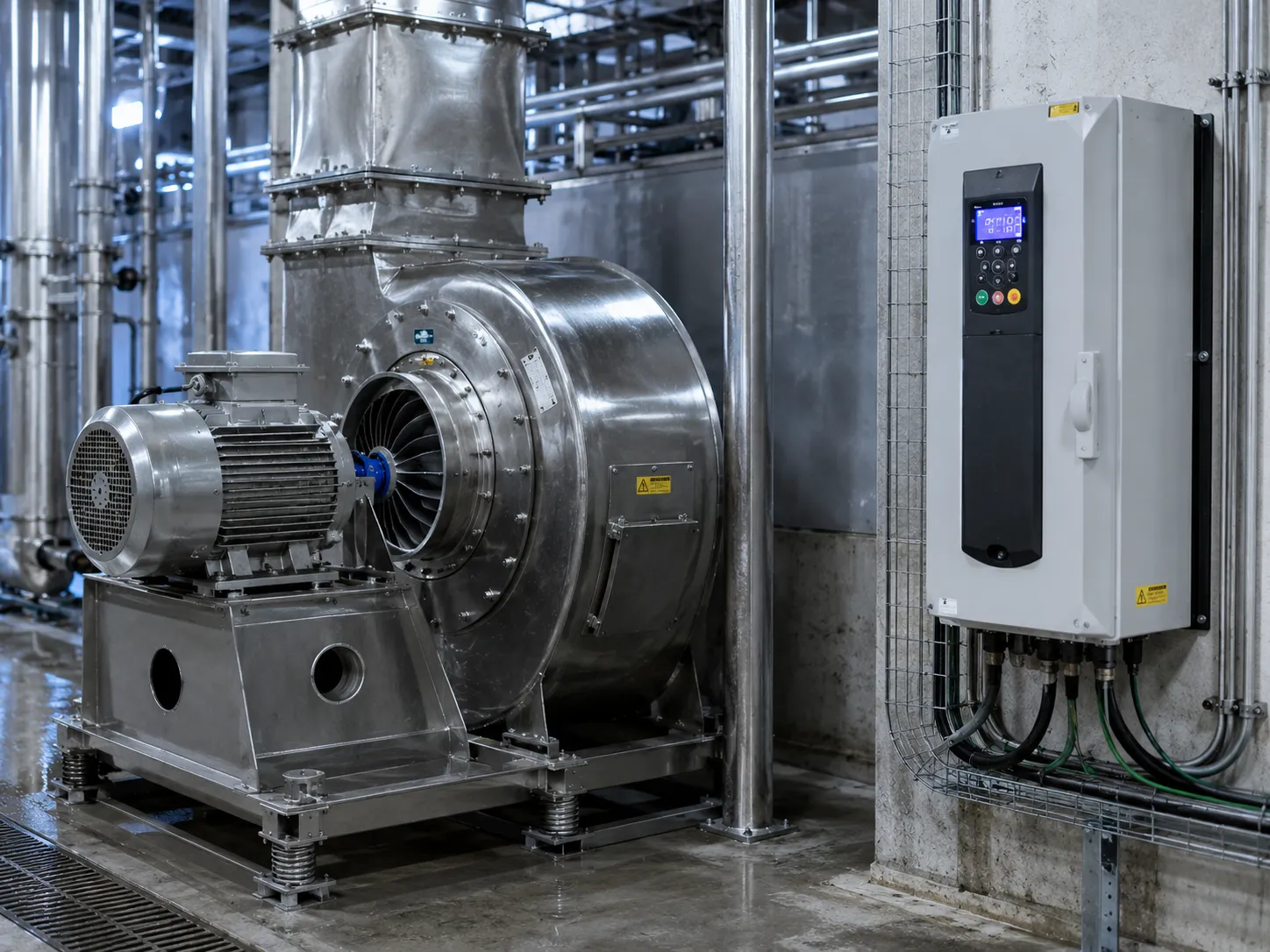
Direct drive blowers couple the motor shaft straight to the impeller. They’re simpler, have fewer wear parts, and require less maintenance, but they lock you into the motor’s fixed speed unless paired with a variable frequency drive (VFD).
Belt drive blowers use a motor-and-pulley arrangement, which allows the blower speed to be adjusted independently of motor speed by changing pulley sizes. This gives more flexibility for fine-tuning airflow after installation, at the cost of an added maintenance item (belt wear and tensioning).
Variable frequency drives are increasingly the deciding factor in total cost of ownership. Because blower power consumption rises steeply with speed, a VFD that lets the blower run at only the speed the process actually needs, rather than full speed with a damper throttling the excess, can cut energy use substantially over the equipment’s lifetime. Since energy consumption typically makes up the majority of a blower’s total ownership cost, this is often where the real savings are, not in the sticker price of the unit itself.
Efficiency and Total Cost of Ownership
The purchase price of an industrial blower is usually the smallest line item over its operating life. Energy costs, maintenance, and downtime from an undersized or oversized unit dominate the real cost. Two sizing mistakes drive most of that waste:
- Undersizing forces the blower to run continuously at or beyond its capacity, increasing energy draw, wear, and failure risk.
- Oversizing wastes energy at partial load and, without a VFD or other modulation, an idling blower can still consume the large majority of full-load energy despite doing a fraction of the work.
Correct sizing against your actual CFM and static pressure, not a padded “safety margin” guess, is the single highest-leverage decision in the entire selection process.
Noise and Placement
Blower noise is generated by the impeller, the motor, and airflow turbulence at the inlet/outlet, and it’s amplified by poor ductwork transitions or tight enclosures. If the unit will sit near a workspace, office, or residential boundary, ask for sound power data (typically in dBA at a stated distance) before you buy, and consider inlet/outlet silencers or vibration isolation mounts rather than trying to solve a noise problem after installation.
Standards, Certifications, and Safety Compliance to Verify
- ANSI/AMCA 210 / ISO 5801: laboratory-verified airflow, pressure, and power ratings. If a supplier’s performance data isn’t tested to one of these standards, treat the numbers as estimates, not guarantees.
- Hazard classification compliance: for combustible dust or flammable atmospheres, confirm the motor and construction meet the applicable explosion-proof or spark-resistant classification for your specific hazard zone, not just a general “industrial rated” claim.
- OSHA workplace exposure and noise requirements: relevant wherever the blower affects worker air quality or ambient noise levels.
- Energy efficiency ratings: increasingly relevant as regulatory bodies introduce efficiency standards for fans and blowers; ask whether a given model has published efficiency data, not just performance data.
Common Mistakes We See Most Often
- Sizing off peak CFM alone, without checking the performance curve at the system’s actual static pressure.
- Ignoring particulate or corrosive content in the airstream, leading to premature wheel or housing failure.
- Choosing a fixed-speed blower for a variable-load process, then paying for it in wasted energy for years.
- Underestimating ductwork losses, which quietly push real-world static pressure well above the initial estimate.
- Treating explosion-proof requirements as optional in marginal hazard environments, rather than confirming the classification with a qualified engineer.
- Skipping performance data verification, and accepting a manufacturer’s headline number without asking whether it was tested to AMCA 210 or an equivalent standard.
Maintenance Considerations That Affect Lifespan
Blower type drives maintenance needs as much as it drives performance. Positive displacement blowers need scheduled lobe clearance checks and timing gear lubrication. Belt-drive units need periodic belt tension and wear inspection. Bearings, regardless of blower type, are usually the first component to fail from either under-lubrication or contamination, and vibration monitoring can catch bearing wear well before a failure causes downtime. Building a basic maintenance schedule into your selection decision, rather than treating it as an afterthought, is what actually determines whether a blower reaches or falls short of its rated service life.
Working With a Supplier: Questions Worth Asking Before You Buy
- Can you provide a performance curve (not just a single rated point) tested to AMCA 210 or ISO 5801?
- What construction and coating options do you offer for my specific airstream conditions?
- Is a VFD-compatible motor available, and what’s the estimated energy savings versus a fixed-speed unit at my typical load?
- What’s the expected maintenance interval, and what does a rebuild or bearing replacement cost and take?
- Do you have sound power data, and what noise mitigation options exist if needed?
- What lead time and local support are available if the unit needs service?
A supplier who can answer these clearly, with data, not just assurances, is generally a good sign you’re being sized correctly rather than sold whatever’s in stock. If your requirement doesn’t fit a standard model, our customized air handling solutions team can engineer a blower around your exact process conditions.
Frequently Asked Questions
What’s the difference between a fan and a blower?
A blower moves air using a fully or partially enclosed impeller within a housing, generating higher pressure than a typical fan, which moves air with an exposed, open blade design and is better suited to low-resistance, high-volume applications.
How do I know if I need a centrifugal or positive displacement blower?
Choose centrifugal for general ventilation, dust collection, or moderate pressure needs; choose positive displacement when your process, like pneumatic conveying, requires constant airflow volume even as system pressure fluctuates.
What size blower do I need for my application?
The correct size is determined by your required CFM and your system’s total static pressure, calculated from ductwork, filters, and equipment resistance, not by horsepower or motor size alone.
Can a standard blower be used in a dusty or explosive environment?
No. Dusty, combustible, or explosive environments require blowers with spark-resistant construction and explosion-proof motors rated for the specific hazard classification present, which must be confirmed before installation, not assumed.
Does a variable frequency drive (VFD) really save money on blower operation?
Yes, because blower power draw increases sharply with speed, a VFD that matches blower speed to actual process demand typically reduces energy costs significantly compared to running a fixed-speed blower with a throttling damper.
Final Thought
The right industrial blower isn’t the one with the biggest horsepower number or the lowest sticker price. It’s the one whose performance curve, construction, and drive configuration match the actual conditions of your application. Nail down your CFM and static pressure requirements, be honest about what’s in your airstream, and verify performance data against a recognized testing standard, and the rest of the selection process gets a lot simpler.
If you’re working through a specific application and want a second set of eyes on your sizing calculations or material selection, our team is happy to review your requirements and help you land on the right configuration the first time.