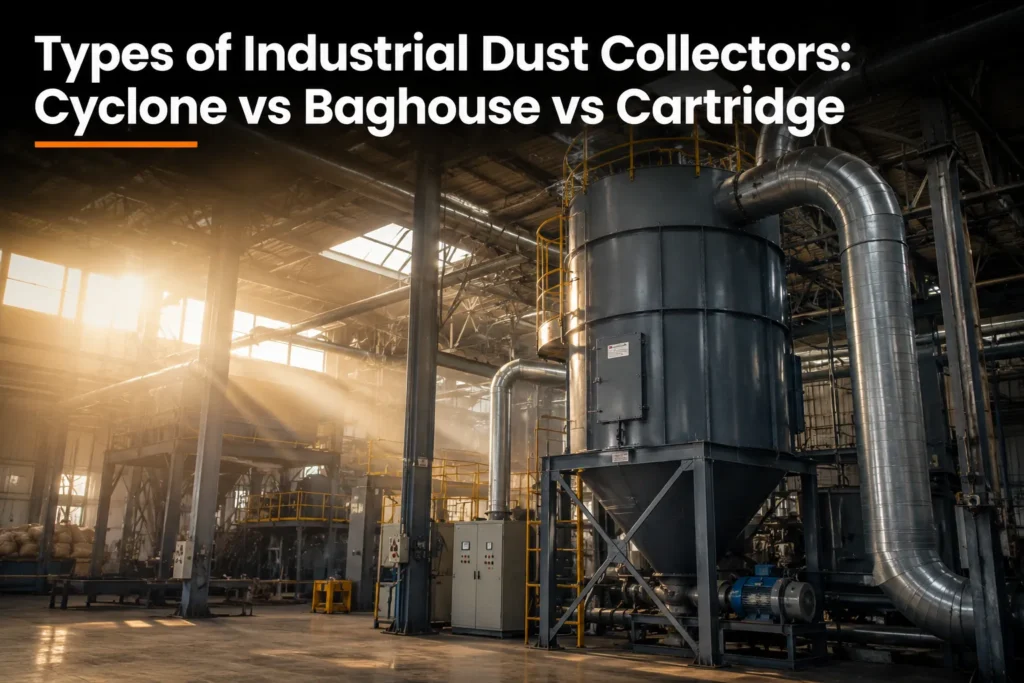
Types of industrial dust collectors is one question I get asked almost every single week, and honestly, I never get tired of answering it, because every time someone asks, it means one more factory floor is about to become a little safer to breathe in. I still remember the first time I walked into a foundry near Chakan, years back, and the air was so thick with fine dust that you could see it hanging in the sunlight coming through the shed windows. That image never left me. It’s a bit like the feeling you get walking into a temple early in the morning, a certain stillness, a certain respect for the space you’re standing in. Except here, instead of incense, it was silica dust, and instead of stillness, there was a very real health hazard waiting to happen. That day changed how I look at every plant I walk into, and it’s shaped everything I want to share with you in this article.
At Airvent Systems, we’ve spent years working with plant engineers across Pune, Maharashtra and India to design dust collection systems that actually perform, and in that time, we’ve learned exactly where the confusion lies. So, let’s slow down and go through this properly, the way I would if you and I were standing on your shop floor together, looking up at your ducting and trying to figure out what’s going to actually work for you.
What Is an Industrial Dust Collector, and Why Does Every Plant Need One?
An industrial dust collector is a system that pulls dust-laden air out of a process area, separates the particulate from the airstream, and releases cleaner air back out, either into the plant or the outside atmosphere, depending on your setup. It sounds mechanical when I put it that way, but in practice, it’s much more personal than that. It’s the difference between an operator finishing an 8-hour shift coughing, or finishing that same shift breathing easy.
Over the years, I’ve come to genuinely respect this equipment. Not because it’s glamorous, it isn’t, but because it quietly does one of the most important jobs in any factory: protecting the people inside it. And that’s really the heart of why I’m writing this. Before we talk about cyclone separators or bag filters, I want you to walk away understanding why this decision matters, not just what the options are. We serve industries across cement, pharma, foundry, food processing, and more, you can explore the full list on our Industries We Serve page.
The Three Main Types of Industrial Dust Collectors
When people ask me about the types of industrial dust collectors, I always narrow it down to three that cover about 90% of real-world industrial applications in India:
- Cyclone dust collectors mechanical, simple, great for coarse dust
- Baghouse (bag filter) dust collectors fabric filtration, the workhorse of Indian industry
- Cartridge dust collectors pleated media, compact, built for fine dust
Let’s go through each one properly, because the type you choose isn’t a small decision it decides whether your plant meets emission norms comfortably or struggles with it every single month.
Cyclone Dust Collectors
How They Work
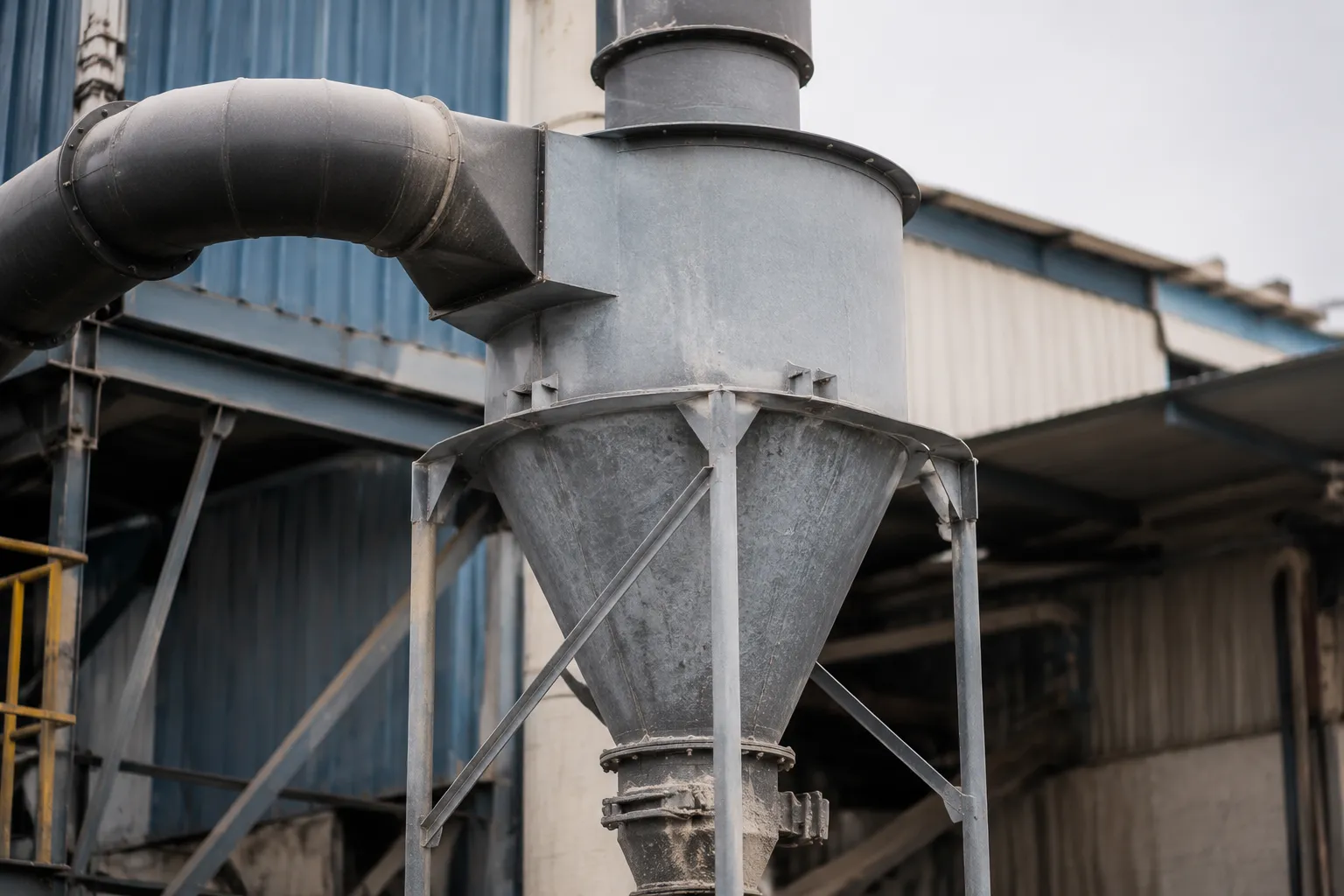
A cyclone dust collector uses centrifugal force, not a filter, to separate dust from air. Dust-laden air enters the cyclone body at an angle, spins downward in a vortex, and the heavier particles get flung outward against the cone wall before dropping into a collection hopper. Meanwhile, the cleaner air spirals back up and out through the top.
I always tell people: think of it like swirling tea leaves in a cup. Spin the water fast enough, and the leaves settle at the bottom on their own, without you doing anything else. That’s essentially what’s happening inside a cyclone.
Where They Fit Best
- Woodworking units handling shavings and sawdust
- Grain, cement and foundry sand handling
- As a pre-cleaner before a baghouse or cartridge system, to reduce the load on finer filtration
However, cyclones don’t catch fine or sub-micron dust well on their own. If your process produces very fine particulate say, from a grinding or blending operation a cyclone alone will not get you compliant. It’s a first stage, not a final answer.
Baghouse (Bag Filter) Dust Collectors
How They Work
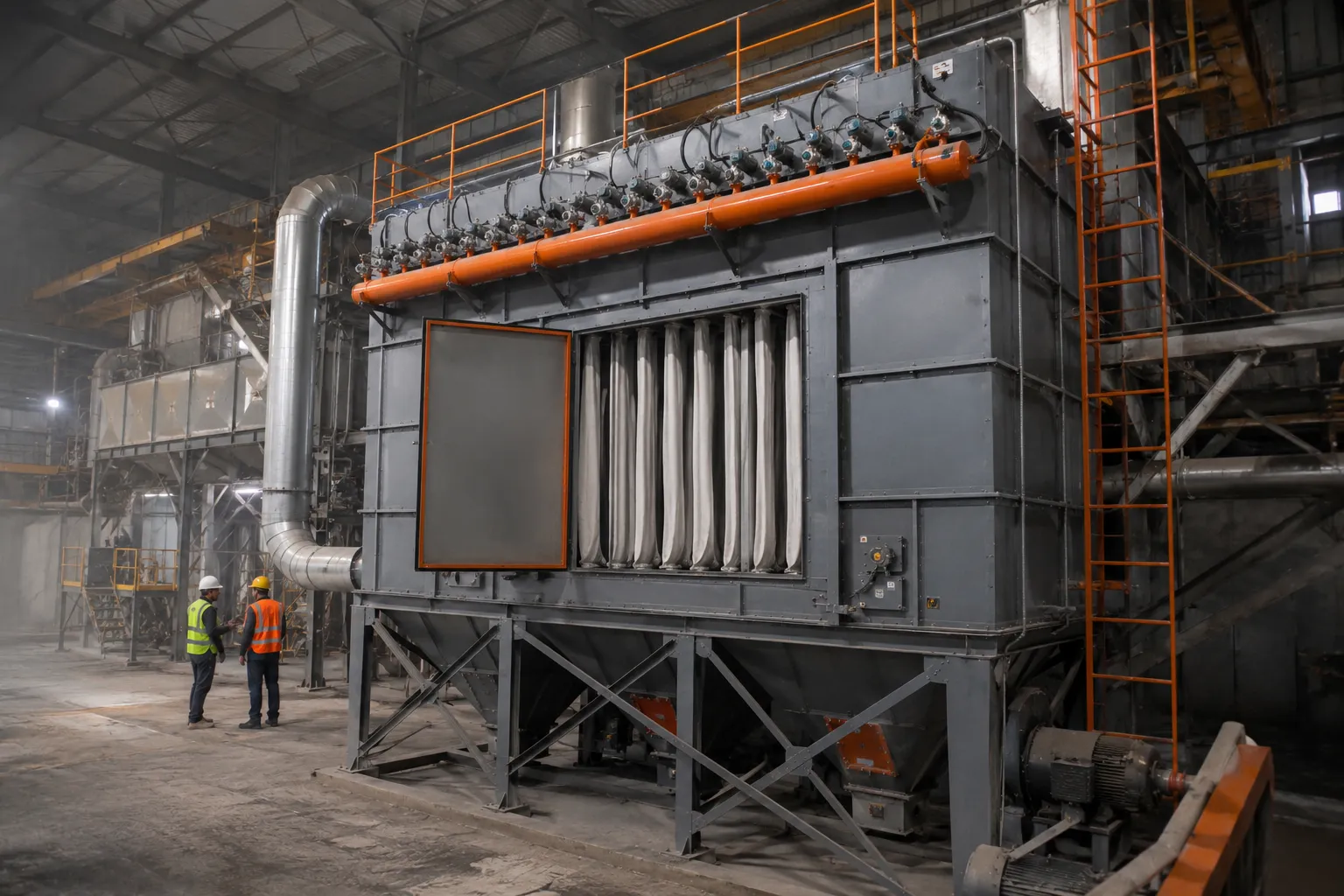
A baghouse dust collector also called a bag filter dust collector pulls dust-laden air through long fabric filter bags. Dust collects on the outside of the bags while clean air passes through to the inside and exits the system. Periodically, a pulse-jet of compressed air blasts through each bag in reverse, knocking the accumulated dust cake off into a hopper below.
This is, without question, the most common type I install across cement plants, foundries, and chemical units in Maharashtra. It’s not flashy, but it’s dependable and dependable is exactly what a plant manager wants at 2 AM when nobody’s watching the equipment.
Where They Fit Best
- Cement, foundry, and steel plants with high, continuous dust volume
- Applications needing very high filtration efficiency (up to 99.9% for fine particulate)
- Processes where dust load fluctuates heavily throughout the shift
Moreover, baghouse systems handle both fine and coarse dust in the same unit, which is exactly why they’ve become the default choice across Indian heavy industry.
Cartridge Dust Collectors
How They Work
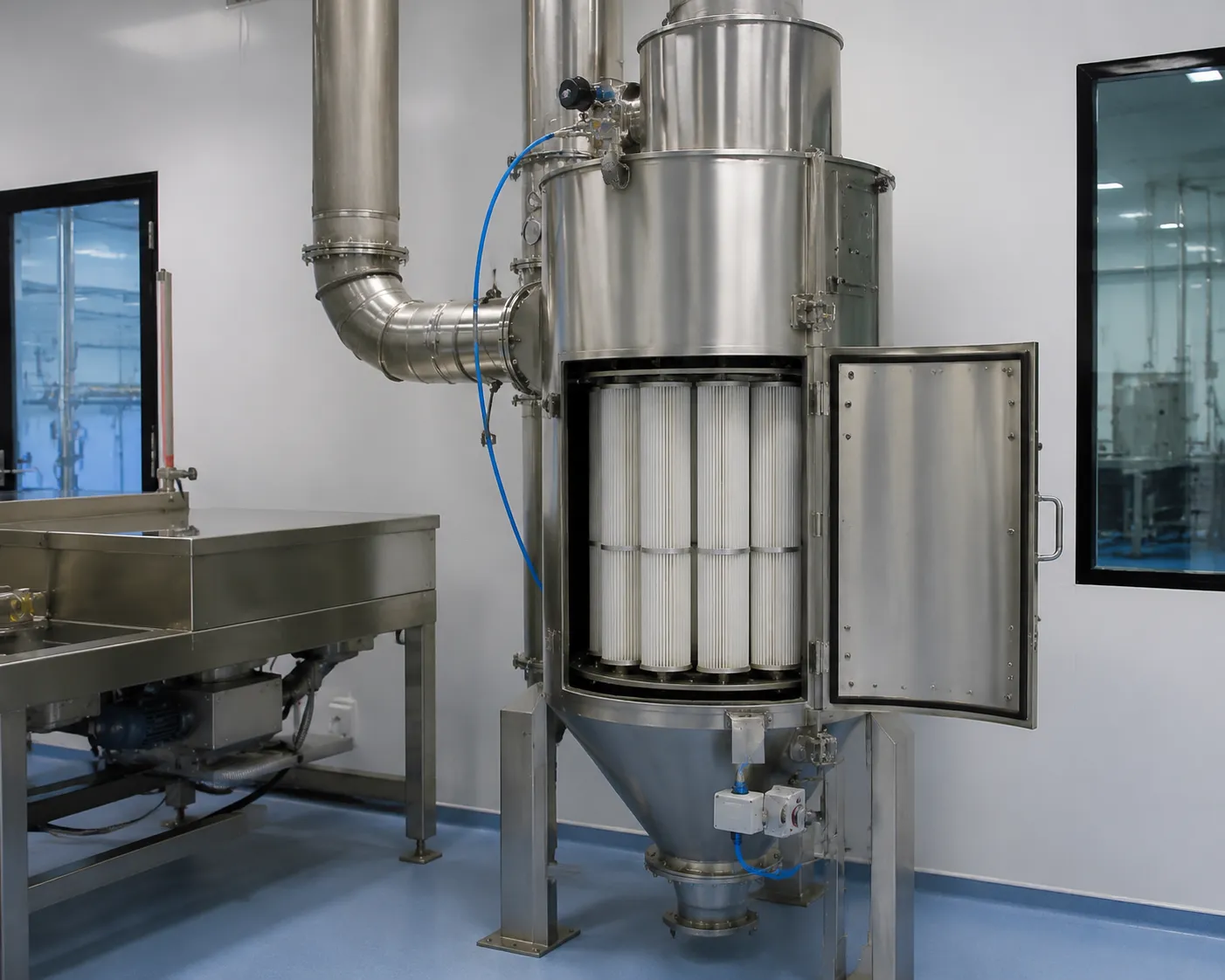
A cartridge dust collector uses pleated filter media usually cellulose, polyester, or a combination packed into a compact cylindrical cartridge. Because the media is pleated, it packs far more filtration surface area into a much smaller footprint than an equivalent baghouse.
Where They Fit Best
- Pharmaceutical and food processing units with limited floor space
- Welding, grinding, and metalworking operations producing fine metallic dust
- Facilities that need a compact system without sacrificing filtration efficiency
In fact, if you’re tight on space but still need serious filtration performance, a cartridge dust collector is almost always the right call over a baghouse of equivalent capacity.
Types of Industrial Dust Collectors Compared Side by Side
| Feature | Cyclone Collector | Baghouse (Bag Filter) | Cartridge Collector |
|---|---|---|---|
| Filtration method | Centrifugal force | Fabric bag filtration | Pleated media filtration |
| Best for dust size | Coarse (50 microns+) | Fine to coarse | Very fine dust |
| Filtration efficiency | 60–90% | Up to 99.9% | 99%+ |
| Footprint | Compact | Large | Compact |
| Maintenance need | Very low | Moderate (bag replacement) | Moderate (cartridge replacement) |
| Typical industries | Woodworking, foundry sand | Cement, foundry, steel | Pharma, welding, food processing |
| Upfront cost | Low | Moderate to high | Moderate |
| Common use case | Pre-cleaning stage | Primary dust collection | Space-constrained applications |
How to Choose the Right Type of Dust Collector for Your Process
I always walk clients through the same set of questions before recommending a system, and honestly, this checklist has saved more than one plant from an expensive mistake:
- What is your dust particle size? Fine dust needs a cartridge or baghouse; coarse dust can often be handled with a cyclone alone.
- What is your air volume (CFM)? This decides the size and number of filtration units required.
- Is the dust combustible? Certain dusts (wood, aluminium, some organic powders) need explosion venting or isolation valves this is non-negotiable.
- How much floor space do you actually have? A cartridge system may cost more per unit but save significantly on space.
- What’s your duty cycle? Continuous, high-volume dust generation almost always points toward a baghouse.
- Do you need to comply with CPCB emission norms for your state? This affects your minimum required filtration efficiency.
Therefore, the right type of dust collector isn’t about which one is “best” in general it’s about which one matches your dust, your volume, and your space. I’ve seen plants overspend on an oversized baghouse when a compact cartridge system would have done the job just as well, and I’ve seen the opposite too, where a cyclone alone was installed and the plant kept failing emission checks within months.
Mistakes I See Plants Make When Selecting a Dust Collector
I’ll be honest with you, because I’d rather you learn from someone else’s mistake than your own:
- Choosing a system based purely on lowest quote, without checking filtration efficiency data
- Ignoring dust combustibility testing, which can turn a maintenance issue into a genuine safety incident
- Under sizing the CFM rating to save on upfront cost, only to end up with a system that can’t keep up with actual dust load
- Skipping proper ducting design, which quietly kills the efficiency of even a well-chosen dust collector
- Not planning for filter bag or cartridge replacement costs, which are the real long-term cost of ownership
These aren’t rare mistakes. I see at least one of these on almost every retrofit project I get called into.
Warning Signs Your Dust Collector Is Already Struggling
If any of this sounds familiar, your existing system may already be falling behind, and it’s worth reading our detailed guide on 5 Signs Your Dust Collection System Needs Maintenance for a full breakdown:
- Visible dust settling on surfaces near the collection point
- A noticeable rise in differential pressure across the filter
- Bags or cartridges needing replacement far more often than expected
- Reduced suction at the hood or capture point
CPCB Compliance and Why Dust Collector Type Matters
In Maharashtra, and across India more broadly, industrial emissions are governed by norms set by the Central Pollution Control Board (CPCB). Depending on your industry category, your plant may be required to maintain a specific particulate emission limit at the stack. This is precisely why the type of dust collector you choose isn’t just an engineering decision it’s a compliance one too. A cyclone alone, for instance, simply cannot meet the filtration efficiency that most CPCB norms require for fine particulate industries. A properly sized baghouse or cartridge system, on the other hand, comfortably clears these limits when designed correctly.
If you’re also reviewing your combustion-side equipment alongside your dust collection system, it’s worth reading our article on FD Fan vs ID Fan: Understanding the Difference, since dust collectors are almost always paired with an ID fan on the suction side of the system.
Frequently Asked Questions
What are the main types of industrial dust collectors?
The three main types of industrial dust collectors are cyclone collectors, baghouse (bag filter) collectors, and cartridge collectors, each suited to different dust sizes, volumes, and space constraints.
Which type of dust collector is best for fine dust?
Cartridge and baghouse dust collectors both handle fine dust well, with cartridge systems generally offering higher filtration efficiency in a smaller footprint.
Can a cyclone dust collector be used alone?
A cyclone dust collector works best as a pre-cleaning stage before a baghouse or cartridge system, since it doesn’t reliably capture fine particulate on its own.
How do I know what size dust collector I need?
Sizing depends on your air volume (CFM), dust particle size, and duty cycle it’s best to share these details with an experienced manufacturer so the system is neither oversized nor undersized.
Do industrial dust collectors need CPCB approval?
Your dust collector itself doesn’t need separate approval, but your plant’s stack emissions must meet CPCB norms, which directly depends on choosing a dust collector type with sufficient filtration efficiency.
Final Thoughts
If there’s one thing I want you to remember from everything I’ve shared here, it’s this choosing between the types of industrial dust collectors isn’t about picking the most popular option, it’s about respecting your specific process enough to match it properly. I’ve spent enough time on enough shop floors to tell you honestly: a well-matched dust collector, even a modest one, will outperform an expensive but poorly matched system every single time. And on the flip side, a mismatched system, no matter how well-intentioned the purchase, will keep letting your team down month after month.
Ready to get the right dust collector for your plant? Get a Free Quote from Airvent Systems →