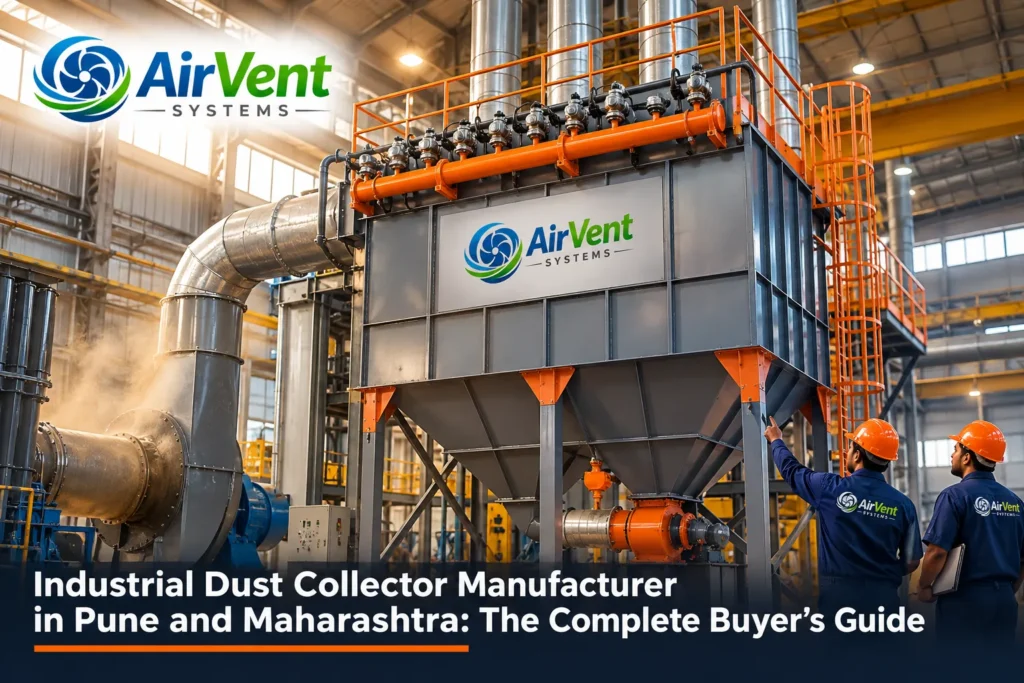
Industrial dust collector manufacturer is the search that arrives when a plant is either struggling with dust compliance, setting up a new production line that generates particulate, or replacing a system that has failed to perform. In every one of these situations, the buyer needs the same things: a clear understanding of which type of dust collector machine suits their specific process, a manufacturer who asks the right questions before quoting, and an honest picture of what the equipment costs and what it delivers. This industrial dust collector manufacturer guide provides all of that, drawing on manufacturing experience from our Bhosari MIDC, Pune facility and backed by the engineering depth of our parent company Ravi Air Tech, established in Pune since 2005 with over 17 years of industrial dust collector and air pollution control equipment manufacturing experience across Maharashtra and India.
Whether you are looking for an industrial dust collector manufacturer in Pune, or comparing one industrial dust collector manufacturer against another across India, a dust collector machine for factory use, a system for your pharmaceutical plant, or a dust collector manufacturer near me, this guide covers every aspect of your decision.
At Airvent Systems, serving as your industrial dust collector manufacturer in Pune, we manufacture industrial dust collectors, bag filter systems, and complete air pollution control equipment from our Pune facility. Learn more About Airvent Systems and our engineering approach, or explore our complete Products range.
What Is an Industrial Dust Collector Manufacturer and Why Pune Leads This Space
An industrial dust collector manufacturer is a company that designs, fabricates and delivers systems. Every industrial dust collector manufacturer must understand, fabricates, tests, and supplies systems that capture airborne dust, particulate matter, and fumes from industrial processes, protecting both workers and the environment from harmful airborne contamination. These systems are not optional equipment in most Indian manufacturing environments. They are required by CPCB and MPCB consent conditions, mandated under the Factories Act for worker safety, and essential for maintaining product quality in sensitive industries such as pharmaceuticals, food processing, and electronics.
Pune leads the industrial dust collector manufacturer landscape in Maharashtra, and working with an industrial dust collector manufacturer in Pune in Maharashtra for the same reasons it leads blower manufacturing: the density of its industrial customer base across Bhosari, Chakan, Talwade, Ranjangaon, Pimpri-Chinchwad, and Hadapsar MIDC zones means that Pune-based manufacturers receive constant field feedback from diverse applications, refining their designs faster than manufacturers working at a distance. The city hosts manufacturers serving automotive foundries, pharmaceutical plants, cement units, woodworking factories, and chemical processors, each with distinct dust properties and distinct collection requirements.
Critically, as the search data above shows, every buyer looking for an industrial dust collector manufacturer has an application-specific need, the most common searches, including dust collector machine for factory, dust collector manufacturers in Pune, dust collector machine for industry, and dust collector machine for pharmaceutical industry, all come from buyers with immediate, application-specific needs. This guide is structured to answer every one of those intent categories directly.
How an Industrial Dust Collector Works: The Core Principle
Every industrial dust collector, regardless of its specific type, operates on the same fundamental principle: it creates a controlled airflow that pulls dust-laden air away from the source, separates the particulate from the airstream, and releases cleaned air back into the facility or to the atmosphere through a stack.
The four-stage process common to all industrial dust collectors:
- Capture: A hood, inlet, or collection point positioned at the dust source draws contaminated air into the system using suction created by the blower
- Transport: Ducting carries the dust-laden airstream from the capture point to the collector housing
- Separation: Inside the collector, a filter medium, centrifugal force, or a combination of both separates particulate from the airstream
- Clean air discharge: Filtered air exits through the clean air plenum and either recirculates into the building or discharges to atmosphere through a stack, depending on the dust type and regulatory requirements
The effectiveness of this process depends on correctly designing each stage, and the most common reason industrial dust collectors fail to perform is not a manufacturing defect in the unit itself. It is a design error in either the capture velocity at the hood, the duct velocity, or the filter area relative to the actual airflow. Any experienced industrial dust collector manufacturer in Pune will assess all four stages will assess all four stages, not just supply a unit.
Types of Industrial Dust Collector Machines Explained
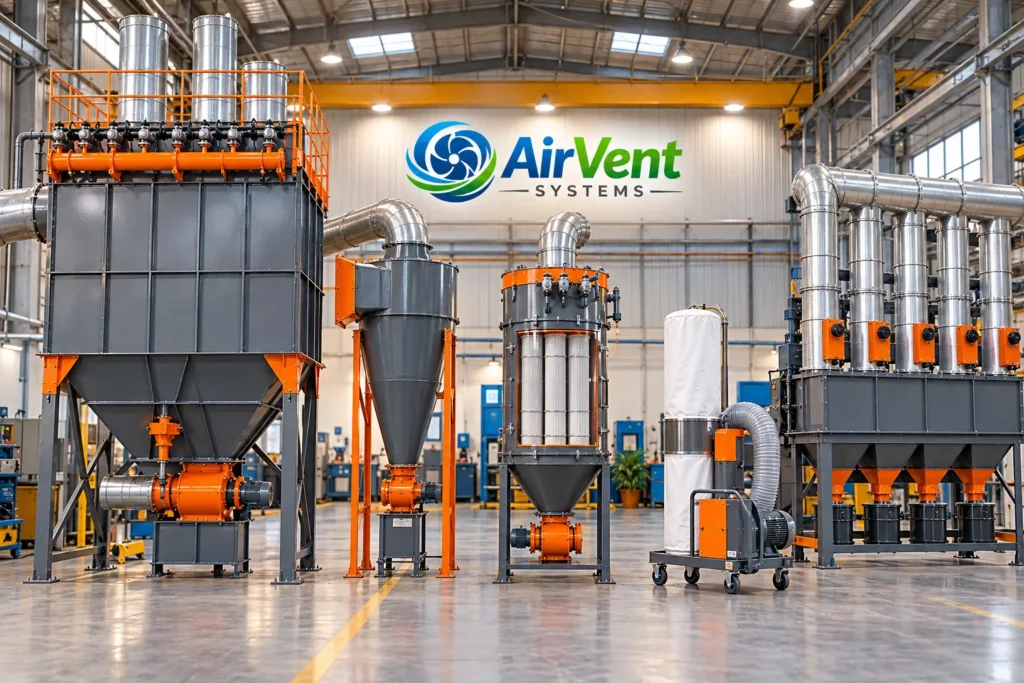
Choosing the correct type of industrial dust collector machine from your industrial dust collector manufacturer is the most important decision in the entire procurement process. A dust collector machine that is the wrong type for your dust will consistently underperform, regardless of its size or the reputation of its manufacturer.
Pulse Jet Bag Filter Dust Collector
The most widely used industrial dust collector type in Maharashtra’s manufacturing plants. A pulse jet bag filter uses fabric filter bags to capture dust on the outer surface. Periodically, a pulse of compressed air is fired in reverse through each bag row, dislodging the accumulated dust cake into a hopper below, while the remaining bags continue filtering. This on-line cleaning mechanism makes pulse jet bag filters suitable for continuous-duty, high-dust-load applications.
Best for: Cement plants, foundries, grain handling, steel plants, woodworking factories, and any high-dust-volume continuous industrial process
Filtration efficiency: Up to 99.9 percent for fine particulate above 1 micron
Key advantage: On-line cleaning means no production interruption for maintenance
Limitation: Not suitable for sticky, hygroscopic, or wet dust that binds to fabric bags
Cyclone Dust Collector
A cyclone dust collector uses centrifugal force rather than a filter to separate dust from air. Contaminated air enters the cyclone body tangentially, spins downward in a vortex, and the heavier particles are flung outward against the cone wall before dropping into a collection bin. The cleaned air spirals upward and exits from the top.
Best for: Coarse dust from woodworking, grain milling, cement, and foundry sand. Frequently used as a pre-cleaning stage upstream of a bag filter to reduce the dust load on the filter.
Filtration efficiency: 60 to 90 percent, dependent on particle size. Fine particles below 10 microns are not reliably captured.
Key advantage: No filter media, no consumables, very low maintenance
Limitation: Alone, it does not achieve CPCB compliance for fine particulate emissions. Must be combined with a bag filter or cartridge collector for compliant stack discharge.
Cartridge Dust Collector
A cartridge dust collector uses pleated filter media packed into cylindrical cartridges, delivering very high filter surface area in a compact unit footprint. Pleating multiplies the effective filter area compared to flat bags of equivalent dimensions, making cartridge collectors significantly more compact than bag filters of the same airflow capacity.
Best for: Fine metallic dust from grinding and welding, pharmaceutical powder dust, electronics and semiconductor manufacturing, food powder handling, and any application where a compact footprint is critical
Filtration efficiency: 99 percent or higher for sub-micron particulate with HEPA-grade media
Key advantage: Very high efficiency in a small space, suitable for pharmaceutical and food-grade environments with appropriate filter media
Limitation: Higher filter replacement cost per unit than bag filters. Not suitable for high-temperature or sticky dust without special media.
Portable Dust Collector
A portable dust collector is a self-contained, wheeled unit that combines a blower, filter, and collection bin in a single compact assembly that can be relocated between workstations.
Best for: Dust collector machine for shop use, welding booths, small machining operations, woodworking shops, and any application where a single fixed installation point is not practical
Key advantage: No ducting infrastructure required, can serve multiple workstations sequentially
Limitation: Limited airflow capacity, not suitable for large-scale or continuous industrial dust generation
Centralized Dust Collection System
A centralized system serves multiple pickup points across a large factory floor through a network of ducting connected to a single large collector unit. This approach is more cost-effective than multiple individual collectors when the dust sources are distributed across a large area.
Best for: Dust collector machine for factory with multiple machine stations, large woodworking plants, metal fabrication halls, and automotive body shops
Key advantage: Single maintenance point, consistent negative pressure across all pickup points, lower total lifecycle cost than multiple portable units for large facilities
Limitation: Higher upfront installation cost due to ducting network. Requires accurate duct design to maintain capture velocity at every pickup point.
Industrial Dust Collector Machine Types Compared
| Feature | Pulse Jet Bag Filter | Cyclone | Cartridge | Portable | Centralized |
| Filtration efficiency | Up to 99.9% | 60 to 90% | 99%+ | 95 to 99%+ | Depends on filter type |
| Best dust type | Fine to coarse | Coarse only | Very fine | Fine to moderate | Any |
| Footprint | Large | Compact | Compact | Very compact | Large (distributed) |
| Maintenance | Moderate (bag replacement) | Very low | Moderate (cartridge) | Low | Moderate |
| CPCB compliance | Yes | Only as pre-filter | Yes | Yes (limited) | Yes |
| Best application | Cement, foundry, grain | Pre-cleaning stage | Pharma, welding, electronics | Shop, welding booth | Multi-station factory |
| Typical airflow range | 1,000 to 1,00,000 m3/hr | 500 to 50,000 m3/hr | 500 to 30,000 m3/hr | 300 to 5,000 m3/hr | Unlimited |
Dust Collector Machine for Factory, Industry, Pharma, Shop and Road: Application Guide
One of the most searched aspects of industrial dust collector selection is the application-specific variant. Here is an honest, direct guide to each application category from your search data.
Dust Collector Machine for Factory
A dust collector machine for factory typically involves a centralized pulse jet bag filter or a distributed system of bag filters connected through ductwork. The critical design parameters are airflow per workstation, duct velocity to prevent settling in the duct, and total pressure loss across the system. For a factory generating multiple dust types from different processes on the same floor, section isolation dampers allow different collection points to be served by the same central collector without cross-contamination.
Read our detailed article on Types of Industrial Dust Collectors for a complete breakdown of all factory dust collection configurations.
Dust Collector Machine for Industry
Industrial applications span cement, steel, foundry, chemical, food processing, and automotive sectors, each requiring different filter media, cleaning mechanisms, and housing materials. A dust collector machine for industry is always specified based on the actual dust properties: particle size distribution, bulk density, abrasiveness, hygroscopic tendency, combustibility, and temperature. Any industrial dust collector manufacturer who specifies without knowing these properties these properties is guessing.
Dust Collector Machine for Pharmaceutical Industry
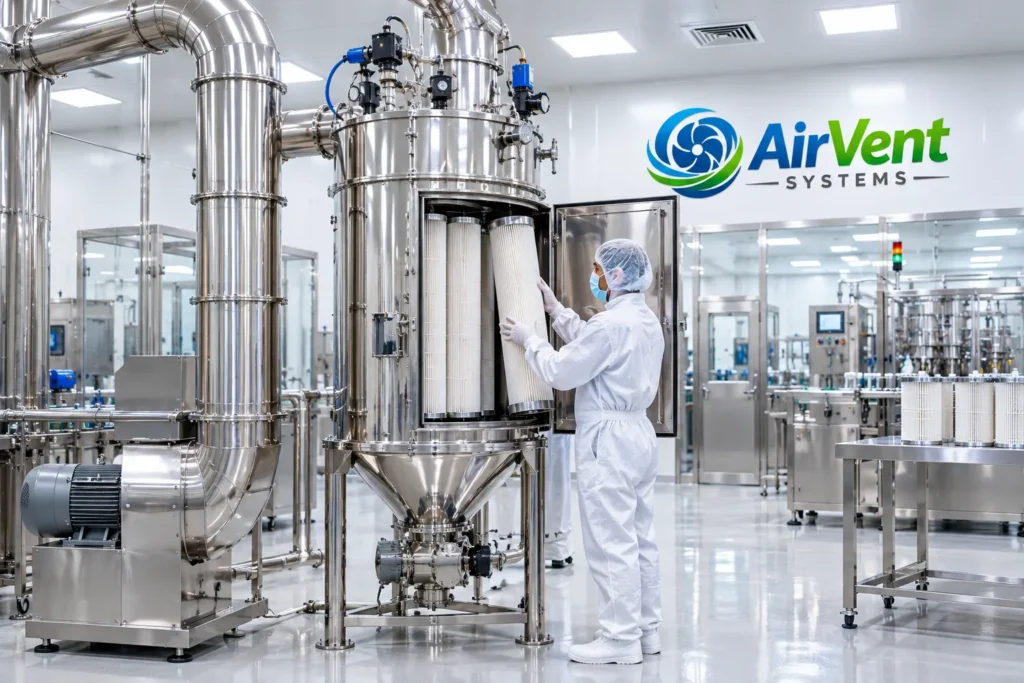
A dust collector machine for pharmaceutical industry has significantly tighter requirements than a standard industrial unit. FDA and GMP compliance, dust containment to prevent cross-contamination between products, HEPA-grade filtration to capture API particles below 1 micron, smooth internal surfaces without crevices where product can accumulate, and easy cleandown access between batches are all mandatory design features. Stainless steel construction in SS 304 or SS 316, validated filter media, and containment-discharge systems that prevent dust re-entrainment during bag change are the standard for any reputable industrial dust collector manufacturer serving pharma customers.
Dust Collector Machine for Shop
A dust collector machine for shop, whether a woodworking shop, metalworking shop, or fabrication shop, is typically a portable or small centralized unit in the 1 to 10 HP range. For woodworking shops, cyclone pre-separators feeding a bag filter are the standard combination: the cyclone captures heavy shavings and chips before they load the filter, extending filter service life significantly.
Dust Collector Machine for Road
A dust collector machine for road typically refers to mobile road sweeper dust suppression systems or road construction site dust control units. These applications require robust, weather-resistant construction, diesel-engine or generator-powered operation where mains power is unavailable, and filter media resistant to moisture and outdoor temperature variation.
Dust Collector Machine for Home
A dust collector machine for home refers primarily to small domestic or hobby workshop units for home woodworkers, DIY metalworkers, and small craft operations. These are compact, single-phase, low-HP units with integral collection bags. They are consumer products rather than industrial equipment and are outside the scope of what an industrial dust collector manufacturer typically supplies, though several manufacturers offer entry-level units in this range.
Industrial Dust Collector Manufacturer in Pune: The Local Advantage
Pune hosts multiple established industrial dust collector manufacturers, including firms in Bhosari MIDC, Punawale, and Hadapsar MIDC, serving Maharashtra’s industrial sector. For buyers based in Pune, Maharashtra, choosing a local industrial dust collector manufacturer over a distant one, and the broader western India industrial belt, working with a local industrial dust collector manufacturer delivers four practical advantages that a manufacturer in Delhi, Coimbatore, or Chennai cannot match.
Faster site surveys for accurate system design. An industrial dust collector is a system, not just a unit. The pick-up hood design, duct routing, duct velocity, and total system resistance all affect performance. A Pune-based industrial dust collector manufacturer can send an engineer to your site within 24 hours to survey, measure, and design accurately. A manufacturer from another state designs from drawings alone, and drawings rarely capture actual site conditions.
Quicker commissioning and startup support. First-time startup of a dust collection system always involves adjustment: balancing airflow across multiple pickup points, setting cleaning cycle timers, verifying capture velocities at hoods. A local industrial dust collector manufacturer engineer can be present for commissioning. A distant supplier ships the unit and hopes for the best.
Local spare parts and service. Pulse jet valves, filter bags, rotary valves, and fan bearings are the consumables and wearing parts of any dust collector system. A Pune-based industrial dust collector manufacturer who stocks spare parts locally means your system is down for hours, not days, when a component needs replacement.
MPCB compliance documentation. Maharashtra Pollution Control Board requires specific technical documentation alongside dust collector installations in consent applications. A Pune-based industrial dust collector manufacturer with active MPCB consent experience can provide appropriate test data, performance guarantees, and documentation formats that align with MPCB requirements. Our Air Pollution Control Equipment range is designed specifically for MPCB-compliant installations.
How to Choose the Right Industrial Dust Collector for Your Process
This section answers the questions every buyer should work through before contacting any industrial dust collector manufacturer. Buyers who work through these questions arrive at a conversation where the manufacturer can give them a precise recommendation rather than a catalogue guess.
What is the nature of your dust?
- Particle size: coarse (above 50 microns), fine (5 to 50 microns), or very fine (below 5 microns)
- Dust density: light fibrous material behaves differently from heavy metal swarf
- Combustibility: wood dust, certain metal dusts, and many organic powders are explosive and require specific design features including explosion venting and earthing
- Hygroscopic tendency: dust that absorbs moisture and becomes sticky will blind bag filters very quickly unless pre-heating or special filter coatings are applied
- Temperature: dust from foundry pouring, kiln exhaust, or high-temperature grinding arrives at the collector at elevated temperature that affects filter media selection
What is your required airflow?
This is calculated from the number and type of pickup hoods and the required capture velocity at each hood. For a grinding booth application, any industrial dust collector manufacturer should calculate, the minimum capture velocity at the face of the hood is typically 1.0 to 1.5 m/s. From capture velocity and hood area, airflow per hood is calculated, and total system airflow is the sum of all operating hoods.
What are your emission requirements?
If your collector discharges to atmosphere through a stack, CPCB or MPCB stack emission limits apply. These specify a maximum particulate concentration at the stack outlet, typically 50 to 150 mg/Nm3 for most Red Category industries. Not all dust collector types achieve these limits equally. A cyclone alone cannot. A properly designed bag filter or cartridge system reliably can.
What is your available space?
Bag filters require more floor space than cartridge collectors for the same airflow. If space is constrained, a cartridge collector may be the better choice even at a higher unit cost. For our guide on how blowers and fans that pair with these collectors are selected, read our article on Centrifugal Blower Manufacturer in Pune and Maharashtra, since the fan is an integral part of every dust collection system’s performance.
Material of Construction: MS, SS 304, SS 316 and FRP
| Material | Temperature Limit | Corrosion Resistance | Best Application |
| Mild Steel (MS) | Up to 200 degrees C | Low | Woodworking, foundry, cement, general factory |
| Stainless Steel 304 | Up to 300 degrees C | Moderate to high | Pharmaceutical, food processing, mild acid |
| Stainless Steel 316 | Up to 300 degrees C | High | Chemical plants (consult your industrial dust collector manufacturer for grade selection), strong acid fumes, coastal |
| FRP (Fibre Reinforced Plastic) | Up to 80 degrees C | Very high | Corrosive acid fumes, electroplating |
| Galvanised Steel | Up to 150 degrees C | Moderate | Light commercial and shop applications |
For pharmaceutical dust collector machines, SS 316 with electropolished internal surfaces and GMP-compliant construction is the standard. Any industrial dust collector manufacturer quoting MS construction for a pharmaceutical application without explicit customer request is making a material specification error.
CPCB and MPCB Compliance: What Every Maharashtra Plant Needs to Know
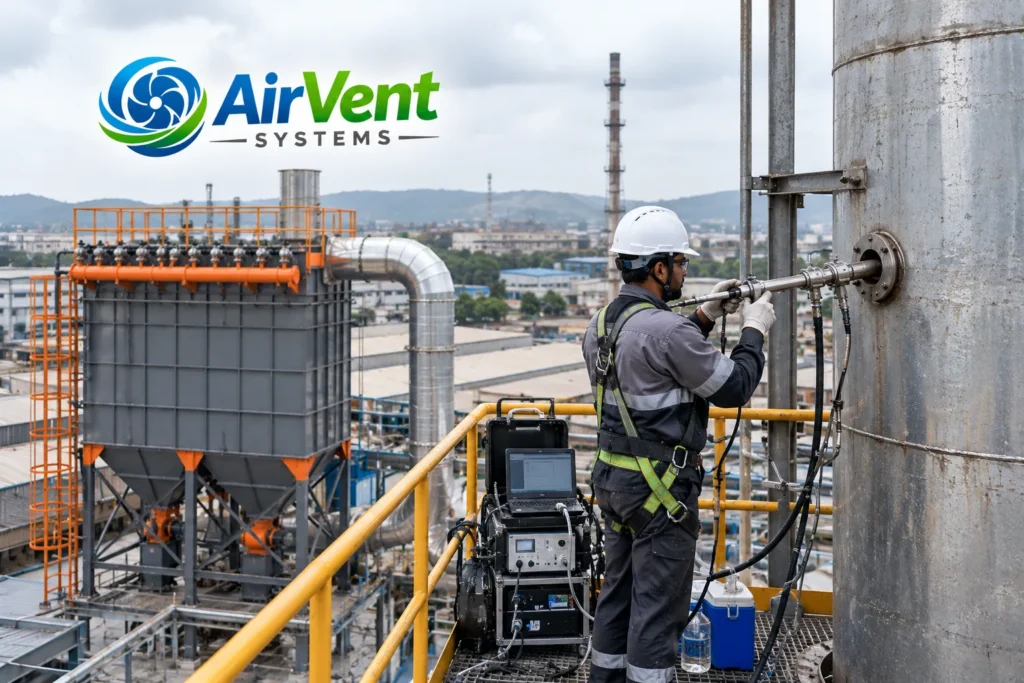
This section is almost entirely absent from every competing industrial dust collector manufacturer content’s content and yet is one of the most critical factors in industrial dust collector selection for Maharashtra-based plants.
The Central Pollution Control Board (CPCB) sets national emission standards for particulate matter at stack outlets, and the Maharashtra Pollution Control Board enforces these through consent conditions at individual plant level.
Key CPCB norms relevant to dust collector selection:
- Most Red Category industries must achieve stack particulate emissions below 150 mg/Nm3, and many new installations are consented to 50 mg/Nm3
- A cyclone dust collector alone cannot reliably achieve these limits for fine particulate
- A pulse jet bag filter or cartridge collector, correctly sized and maintained, comfortably achieves sub-50 mg/Nm3 when filter integrity is maintained
- Stack emission testing is required periodically and results must be reported to MPCB under consent conditions
- Explosive dust applications (wood, certain food powders, metal dusts) require additional design features: explosion venting panels, rotary isolation valves at the collector inlet and outlet, earthing, and in some cases deflagration suppression systems
What to request from your industrial dust collector manufacturer for MPCB compliance:
- Performance guarantee in writing at your stated inlet concentration and airflow
- Confirmation of filter media rating and efficiency at your specific particle size
- Stack emission test data from a similar installation
- Compliance with applicable CPCB Schedule for your industry category
Industrial Dust Collector Price in Pune and India: Realistic Ranges
Every competitor in this market avoids publishing pricing, which is precisely why so many buyers waste time getting quotes that vary by 300 percent for apparently similar equipment. Here are honest, experience-based ranges.
| Dust Collector Type and Size | Approximate Price Range (INR) |
| Portable dust collector, 1 to 3 HP | Rs. 25,000 to Rs. 80,000 |
| Cyclone dust collector, small to medium | Rs. 15,000 to Rs. 1,50,000 |
| Pulse jet bag filter, small (up to 5,000 m3/hr) | Rs. 75,000 to Rs. 3,50,000 |
| Pulse jet bag filter, medium (5,000 to 20,000 m3/hr) | Rs. 3,50,000 to Rs. 10,00,000 |
| Pulse jet bag filter, large (above 20,000 m3/hr) | Rs. 10,00,000 to Rs. 40,00,000+ |
| Cartridge dust collector, small to medium | Rs. 1,00,000 to Rs. 6,00,000 |
| Pharma-grade SS 304/316 cartridge collector | Rs. 2,50,000 to Rs. 12,00,000 |
| Centralized system with ducting and blower | Rs. 5,00,000 to Rs. 50,00,000+ depending on factory size |
| FRP construction, any type | Add 30 to 50 percent over MS equivalent |
These are indicative ranges only. When evaluating any industrial dust collector manufacturer quote, actual price depends on required airflow, dust type, filter media grade, material of construction, whether a rotary valve, screw conveyor, and starter panel are included, and the specific CPCB compliance level targeted.
What to Verify Before Placing an Order
- Confirm that the manufacturer asked about your dust properties
Any industrial dust collector manufacturer who quotes without knowing your dust properties particle size, bulk density, combustibility, and moisture content is catalogue-matching rather than engineering.
- Verify the filter-to-air ratio (Air-to-Cloth Ratio)
This ratio, measured in m3/hr per m2 of filter area, determines whether your filter is adequately sized for your dust loading. Too high a ratio causes excessive pressure drop and short filter life. Ask for the air-to-cloth ratio at your stated airflow and confirm it falls within the recommended range for your dust type.
- Confirm compressed air requirement for pulse jet systems
Pulse jet bag filters require a constant supply of clean, dry compressed air at 5 to 7 bar for the cleaning pulses. If your facility does not have a compressor or has insufficient capacity, this must be planned upfront. An industrial dust collector manufacturer who does not raise this in the specification stage is leaving a critical utility dependency unaddressed.
- Ask about filter bag or cartridge media specification
The filter media chosen by your industrial dust collector manufacturer must match your dust: standard polyester for general factory dust, membrane-coated PTFE for fine pharmaceutical powders, fiberglass for high-temperature applications, and antistatic media for combustible dusts. A manufacturer who specifies “standard filter bag” without a media grade is not specifying a system for your dust.
- Confirm after-sales support and spare filter availability
Ask specifically whether replacement filter bags or cartridges are stocked in Pune, and what the lead time is. Any industrial dust collector manufacturer should advise that a dust collector running on degraded filters is a compliance failure waiting to happen. For more guidance on what warning signs indicate a dust collection system that needs attention, read our guide on 5 Signs Your Dust Collection System Needs Maintenance.
Common Mistakes That Cost Plants Dearly
- Specifying airflow in HP without calculating actual CFM requirement. A 5 HP dust collector can move 1,000 CFM or 3,000 CFM depending on fan selection. HP tells you nothing about actual collection capacity.
- Using a cyclone alone and assuming it meets CPCB. It does not. A cyclone is a pre-separator, not a compliance-grade collector.
- Underestimating dust loading and undersizing the filter area. Undersized filter area causes rapid pressure buildup, short filter bag life, and continuous performance degradation from day one.
- Not planning for compressed air supply in pulse jet systems. Plants frequently discover this utility gap after the collector is installed, resulting in installation delays and additional cost.
- Using standard MS construction for pharmaceutical dust. This is not a minor compromise. It is a GMP violation and a quality risk.
- Buying based on lowest quote without confirmed filter media specification. The filter media is the most performance-critical component in any dust collector. A cheaper quote that includes a lower-grade filter medium is not actually cheaper in performance terms.
For more context on how ID fans and centrifugal blowers that any industrial dust collector manufacturer supplies alongside the collector are correctly selected and maintained, read our guide on Common Causes of ID Fan Failure and How to Prevent Them, since the blower is as critical as the collector itself to overall system performance.
Maintenance Checklist for Industrial Dust Collectors
- Daily: Check differential pressure gauge reading across the filter and compare to normal operating range. A rising trend indicates filter loading or cleaning system malfunction.
- Weekly: Inspect dust discharge from the hopper and confirm the rotary valve or screw conveyor is functioning. A blocked discharge path causes dust to re-entrain into the clean air plenum.
- Monthly: Inspect pulse jet valve operation and solenoid coils. Inspect filter bags or cartridges visually for tears or blinding. Check fan bearing temperature and vibration against baseline.
- Quarterly: Clean pulse jet nozzles and confirm pulse timing settings. Inspect casing for corrosion or dust buildup in dead zones. Check all gaskets and access door seals.
- Annually: Full filter bag inspection and replacement if required. Motor insulation resistance test. Full duct inspection for buildup particularly at duct elbows and low-velocity zones.
Frequently Asked Questions
What is an industrial dust collector manufacturer?
An industrial dust collector manufacturer designs, fabricates, and supplies systems that capture airborne dust and particulate from industrial processes, protecting workers and ensuring compliance with CPCB and MPCB stack emission standards.
What is the best industrial dust collector manufacturer in Pune?
The best industrial dust collector manufacturer in Pune, and the best industrial dust collector manufacturer across India, is one that conducts a site survey before designing, specifies filter media matched to your specific dust properties, provides performance guarantees at your actual airflow and dust loading, and maintains local spare parts for fast breakdown response. Airvent Systems, your trusted industrial dust collector manufacturer backed by Ravi Air Tech established since 2005, meets these criteria with over 17 years of field-proven dust collection system experience across Maharashtra.
What is a dust collector machine for factory use?
A dust collector machine for factory use is typically a centralized pulse jet bag filter system serving multiple pickup points across a production floor through a ducting network, sized to maintain the required capture velocity at every dust generation point throughout the factory.
What is the difference between a dust collector machine for pharmaceutical industry and a standard industrial unit?
A pharmaceutical dust collector uses SS 304 or SS 316 construction, HEPA-grade or membrane filter media to capture API particles below 1 micron, smooth GMP-compliant internal surfaces, and contained-discharge systems to prevent cross-contamination. Standard industrial units use MS construction with polyester filter bags suitable for general factory dust.
What is the price of an industrial dust collector in Pune?
Industrial dust collector prices in Pune range from approximately Rs. 25,000 for a small portable unit to Rs. 40,00,000 or more for a large centralized pulse jet system with full ducting, blower, and control panel, with actual pricing depending on airflow, dust type, material of construction, and CPCB compliance requirement.
Can a cyclone dust collector be used alone for CPCB compliance?
No. A cyclone dust collector alone does not achieve the particulate emission limits required by CPCB for most Red Category industries. It should be used as a pre-cleaning stage upstream of a bag filter or cartridge collector, which together achieve compliant stack emission levels.
What is a dust collector machine for shop use?
A dust collector machine for shop use is a portable or small centralized unit in the 1 to 10 HP range, designed for woodworking shops, metal fabrication shops, and small manufacturing operations where a large fixed installation is not practical.
Final Thoughts
An industrial dust collector manufacturer is only as valuable as the engineering conversation it has before the order is placed. Every industrial dust collector manufacturer as the engineering conversation it is willing to have before the order is placed. The difference between a dust collection system that performs reliably, maintains MPCB compliance, and serves your plant for a decade, and one that struggles with blinding filters, inadequate capture, and repeated maintenance calls, is almost always decided in the specification stage between buyer and industrial dust collector manufacturer, not the fabrication stage.
Pune’s industrial dust collector manufacturer ecosystem is among the most active in western India and competitive, with multiple capable suppliers serving Maharashtra’s industrial base. Within that ecosystem, the distinction comes down to who asks the right questions, specifies filter media correctly, designs the ducting as part of the system rather than an afterthought, and stands behind the installation with local spare parts and service.
At Airvent Systems, as your industrial dust collector manufacturer, we manufacture pulse jet bag filters, cartridge dust collectors, cyclone separators, and complete centralized dust collection systems from our Bhosari MIDC, Pune facility, designed for your specific dust, sized for your actual airflow, and backed by local after-sales service across Maharashtra. Learn more About Airvent Systems, explore our complete Products range, or share your dust collector requirement with our engineering team today.
Looking for a trusted industrial dust collector manufacturer in Pune, Maharashtra or across India?
Get a Free Application-Specific Quote from Airvent Systems Today