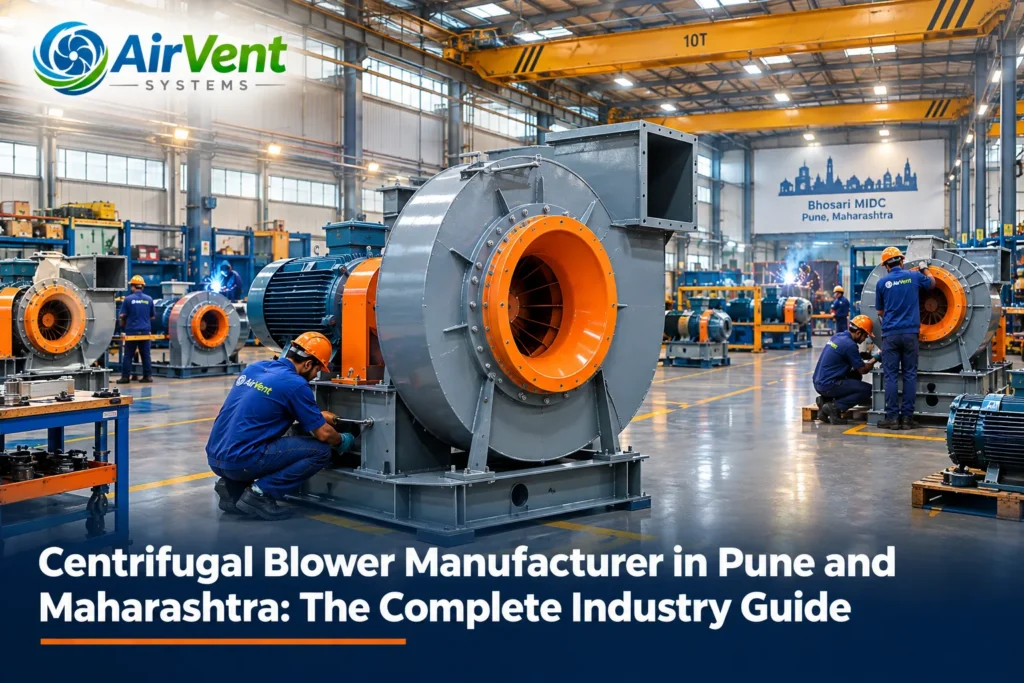
Centrifugal blower manufacturer is the search term that brings engineers, plant managers, and procurement teams to this page from across Pune, Maharashtra, India and beyond, and yet most results they find either list supplier directories or publish shallow product descriptions that never answer the real questions: which blade design suits my application, which material of construction handles my process conditions, and how do I verify a manufacturer before placing an order worth lakhs of rupees. This guide on centrifugal blower manufacturer selection answers all of that directly, drawing on manufacturing experience from our facility in Bhosari MIDC, Pune, and backed by the engineering depth of our parent company Ravi Air Tech, established in Pune in 2005 with over 17 years of centrifugal blower manufacturing experience serving Maharashtra and India.
Whether you are searching for a centrifugal blower manufacturer in Pune, or want to understand what makes one centrifugal blower manufacturer better than another, Mumbai, India, Delhi, Gujarat, Ahmedabad, or Hyderabad, the selection criteria and quality benchmarks covered here apply universally.
Table of Contents
- What Is a Centrifugal Blower Manufacturer and Why Pune Leads This Industry
- How a Centrifugal Blower Works: Working Principle Explained
- Types of Centrifugal Blowers by Blade Design
- Centrifugal Blower Fan: Key Specifications You Must Know
- Industries Served by Centrifugal Blower Manufacturers in Maharashtra
- Centrifugal Blower Manufacturer in Pune vs Mumbai, Delhi, Gujarat, Ahmedabad and Hyderabad
- Material of Construction: MS, SS 304, SS 316 and FRP
- What to Verify Before Placing an Order with a Centrifugal Blower Manufacturer
- Centrifugal Blower Price in India: Honest Ranges
- Common Mistakes When Buying from a Centrifugal Blower Manufacturer
- Maintenance Tips That Extend Centrifugal Blower Life
- Frequently Asked Questions
- Final Thoughts
What Is a Centrifugal Blower Manufacturer and Why Pune Leads This Industry
A centrifugal blower manufacturer is a company that designs, fabricates, tests, and supplies centrifugal blowers: rotating mechanical devices that move air or gas by drawing it into the center of a spinning impeller and throwing it outward at a 90-degree angle using centrifugal force, building significant static pressure before discharging the airstream through a single outlet.
Pune leads centrifugal blower manufacturer activity in Maharashtra for a specific set of practical reasons. The city’s MIDC industrial zones, spanning Bhosari, Chakan, Talwade, Talegaon, Pimpri-Chinchwad and Ranjangaon, host the dense concentration of automotive, pharmaceutical, foundry, chemical, and food processing industries that are the primary buyers of centrifugal blowers. This proximity between manufacturer and buyer drives engineering precision, since Pune-based manufacturers receive direct field feedback from installations nearby, refining their designs faster than manufacturers operating at a distance.
Additionally, Pune’s engineering talent base, its raw material supply chains, and its export-oriented industrial culture have produced a cluster of centrifugal blower manufacturers in Pune that is genuinely competitive on quality, price, and technical capability against manufacturers anywhere in India.
At Airvent Systems, supported by Ravi Air Tech, we manufacture centrifugal blowers from our Bhosari MIDC facility and serve industries across Maharashtra, India and export markets. Learn more About Airvent Systems and our engineering approach.
How a Centrifugal Blower Works: Working Principle Explained
Understanding how a centrifugal blower works is the foundation for selecting the right one. Every centrifugal blower manufacturer builds around the same core physics, even though design details differ.
Step-by-step working principle:
- Air intake: Air or gas enters through the inlet at the center of the rotating impeller, a point called the eye of the impeller
- Impeller rotation: The impeller spins at high speed, creating a low-pressure zone at the center that continuously draws fresh air in
- Centrifugal acceleration: Rotating blades fling the air outward toward the periphery, converting rotational energy into velocity
- Pressure conversion: As high-velocity air travels along the curved blades and into the scroll-shaped housing, velocity converts into static pressure
- Discharge: Pressurized air exits through the discharge outlet into the connected ducting or process system
This 90-degree change in airflow direction is the defining characteristic of a centrifugal blower and precisely what separates it from an axial fan. That direction change, combined with the impeller’s centrifugal force, generates the high static pressure that makes centrifugal blowers indispensable for ducted systems, filtration, conveying, and combustion applications.
For a detailed comparison of when to choose centrifugal over axial, read our article on Centrifugal Blower vs Axial Fan: Which One Does Your Process Need?
Types of Centrifugal Blowers by Blade Design
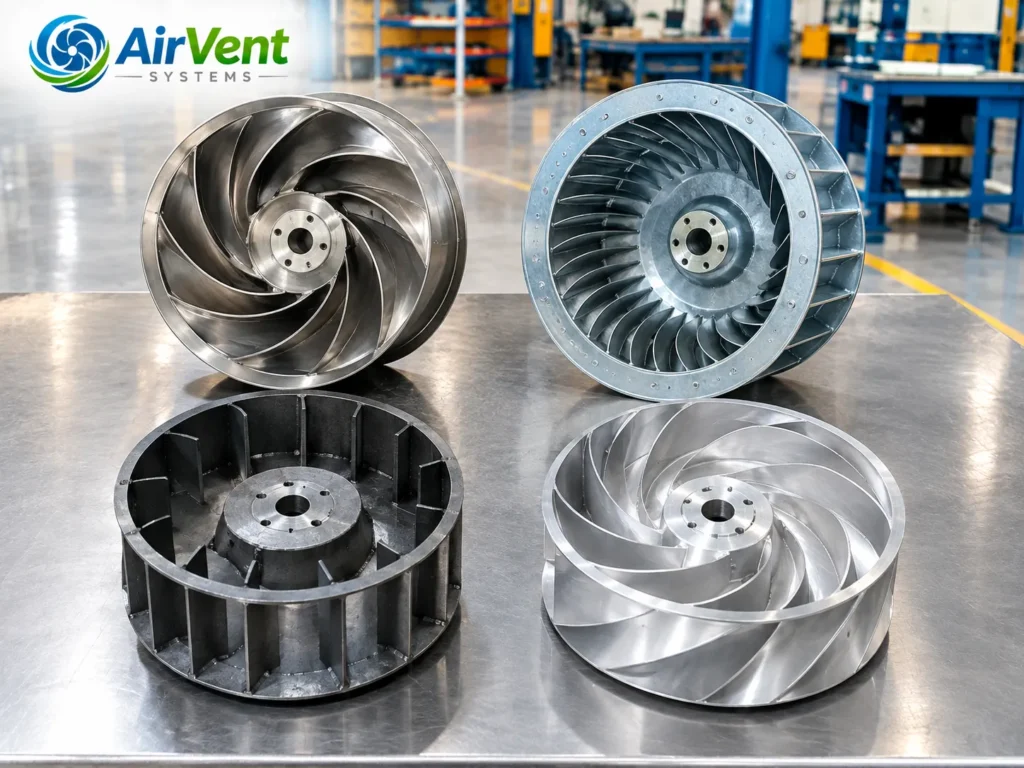
The blade design of the impeller is the single most critical decision in centrifugal blower selection, and it is the area where most buyers receive the least guidance from suppliers. Here is a complete breakdown.
Backward Curved Blade Centrifugal Blower
Blades curve away from the direction of rotation. This design delivers the highest aerodynamic efficiency among centrifugal blower types and has a self-limiting power curve, meaning the motor will not overload even if system resistance drops unexpectedly.
Best suited for: HVAC systems, general factory ventilation, process air supply, and applications where energy consumption is a key operating cost
Limitation: Moderate tolerance for dust buildup on blade surfaces. Not recommended for heavy-dust industrial applications where regular cleaning cannot be scheduled
Forward Curved Blade Centrifugal Blower
Blades curve in the direction of rotation, allowing a smaller, more compact impeller to move a given volume of air at lower rotational speed and lower noise.
Best suited for: Low-pressure ventilation, commercial kitchen exhaust, small process air applications where noise and compact dimensions are priorities
Limitation: Does not have a self-limiting power curve, meaning the motor can overload if system resistance falls below the design point. Requires careful system design
Radial Blade Centrifugal Blower
Blades extend straight outward from the hub at 90 degrees. This design sacrifices some aerodynamic efficiency but provides exceptional resistance to dust and material buildup on blade surfaces, and strong structural integrity under abrasive conditions.
Best suited for: Cement dust handling, foundry exhaust, wood chips, grain and bulk powder conveying, any application where the airstream carries abrasive or sticky particulate
Limitation: Lower efficiency than backward curved, so running costs are higher in clean-air applications. For dusty process applications, this is the correct choice and the efficiency penalty is justified
Aerofoil Blade Centrifugal Blower
Blades are shaped like an aircraft wing cross-section, delivering peak aerodynamic efficiency of all centrifugal blower designs. The complex blade profile requires precision manufacturing and tight quality control.
Best suited for: Clean air HVAC, large-scale ventilation systems, and applications where maximum energy efficiency is the primary design objective
Limitation: Very low tolerance for dust buildup. A thin layer of dust on aerofoil blades disrupts the airfoil profile and causes rapid efficiency loss. Not suitable for any process with particulate in the airstream
Centrifugal Blower Blade Types Compared
| Blade Type | Efficiency | Dust Tolerance | Self-Limiting Power | Noise Level | Best For |
|---|---|---|---|---|---|
| Backward curved | High | Moderate | Yes | Low to moderate | HVAC, ventilation, process air |
| Forward curved | Moderate | Low | No | Low | Low-pressure, compact, kitchen exhaust |
| Radial | Moderate | Very high | Yes | Moderate | Cement, foundry, grain, abrasive dust |
| Aerofoil | Very high | Very low | Yes | Low | Clean air HVAC, large ventilation |
Centrifugal Blower Fan: Key Specifications You Must Know
A centrifugal blower fan is specified by a combination of parameters, and understanding each one allows you to evaluate manufacturer quotes accurately rather than simply comparing prices.
Airflow (CFM or m3/hr): The volume of air the blower moves per unit time at your operating conditions. This is always stated at a specific static pressure and temperature. A CFM figure without a stated pressure is meaningless.
Static pressure (mm WG or Pa): The pressure the blower must develop to push air through your system resistance, including ducting, filters, bends, and process equipment. This is the most frequently underspecified parameter and the most common cause of a blower that “doesn’t perform” after installation.
Operating temperature (degrees C): The temperature of the air or gas being handled. This affects air density, material selection, and bearing specification. A blower sized for ambient air will underperform on hot gas if the thermal expansion effect on air density is not accounted for.
Motor rating (HP or kW): The power input to the blower. HP alone does not determine performance. A 10 HP blower can be built for 200 mm WG or 1,200 mm WG depending on impeller design.
Speed (RPM): Impeller rotational speed, which directly determines airflow, pressure, and noise. Higher speed means more airflow and pressure, but also more noise and bearing load.
Material of construction: MS, SS 304, SS 316, or FRP, determined by the corrosive or abrasive nature of the airstream.
Drive type: Direct drive (impeller mounted on motor shaft) or belt drive (impeller on separate shaft, driven by belt and pulleys). Belt drive allows speed adjustment; direct drive eliminates belt maintenance.
Industries Served by Centrifugal Blower Manufacturers in Maharashtra
An experienced centrifugal blower manufacturer in Maharashtra and Pune designs differently depending on the industry. Here is how the technology gets applied across the state’s key industrial sectors.
- Cement and steel plants: Radial-blade centrifugal blowers for combustion air supply, dust collection feed, and kiln exhaust handling. Also read our detailed guide on Types of Industrial Dust Collectors to understand how blowers and filtration systems connect.
- Pharmaceutical units (Hinjewadi, Talawade, Navi Mumbai): Backward curved or aerofoil centrifugal blowers in SS 316 construction for cleanroom ventilation, process air, and API drying systems
- Foundries (Bhosari, Ranjangaon, Kolhapur): Heavy duty radial-blade centrifugal blowers for fume extraction and dust-laden air handling from cupola and induction furnaces
- Chemical plants (Tarapur, Navi Mumbai, Nashik): FRP or SS 316 centrifugal blowers for corrosive acid fume extraction
- Automotive and fabrication (Chakan, Talegaon, Aurangabad): Backward curved centrifugal blowers for paint booth ventilation, drying ovens, and shop-floor air movement
- Food processing: SS 304 backward curved or aerofoil blowers for hygienic drying, cooling and packaging line ventilation
- Textile mills (Solapur, Ichalkaranji): General ventilation blowers for heat removal and fiber handling
- Boilers and furnaces:FD fans and ID fans, which are centrifugal blower designs specifically engineered for combustion air supply and flue gas extraction
- Wastewater treatment: Roots-type blowers and centrifugal blowers for aeration basin air supply
You can explore our complete Products range including all centrifugal blower configurations we manufacture.
Centrifugal Blower Manufacturer in Pune vs Mumbai, Delhi, Gujarat, Ahmedabad and Hyderabad

From the Google search data you see in the screenshots above, buyers across all major Indian industrial cities search for centrifugal blower manufacturers. Here is an honest assessment of what a Pune-based manufacturer offers compared to each alternative geography.
| City | Proximity to Maharashtra Industry | Site Visit Speed | Spare Parts | MPCB Knowledge | Typical Lead Time |
|---|---|---|---|---|---|
| Pune | Direct MIDC access | Same/next day | Local stock | Direct experience | 2 to 4 weeks |
| Mumbai | Close, some MIDC zones | 1 to 2 days | Moderate | Moderate | 3 to 5 weeks |
| Delhi / NCR | Distant | 3 to 5 days | Limited locally | Generic | 4 to 6 weeks |
| Gujarat / Ahmedabad | Moderate distance | 2 to 3 days | Limited locally | Generic | 3 to 5 weeks |
| Hyderabad | Distant | 3 to 5 days | Limited locally | Generic | 4 to 6 weeks |
For Maharashtra-based plants, working with a centrifugal blower manufacturer in Pune rather than sourcing from a centrifugal blower manufacturer in Delhi or Gujarat is not simply a regional preference. It is a practical advantage that translates directly into faster commissioning, quicker spare parts during breakdowns, and a supplier who understands the specific dust loading, humidity, and operating conditions typical of Maharashtra’s MIDC zones.
Material of Construction: MS, SS 304, SS 316 and FRP
Choosing the correct material of construction is as important as choosing the correct blade type. An incorrect material choice leads to corrosion-driven failure or premature replacement, regardless of how well the impeller is designed.
Mild Steel (MS)
The standard construction material for the majority of centrifugal blowers in general-duty applications.
- Temperature rating: Up to 200 degrees C
- Corrosion resistance: Low. Suitable for clean air, ambient humidity, and mildly dusty conditions
- Cost: Lowest of all options
- Best for: General factory ventilation, HVAC, standard dust collection, combustion air in clean-fuel systems
Stainless Steel 304
Food-grade and pharmaceutical-grade construction for mildly corrosive or hygiene-sensitive environments.
- Temperature rating: Up to 300 degrees C
- Corrosion resistance: Moderate to high. Resists most mild acids, alkaline cleaning agents, and high humidity
- Cost: 40 to 60 percent higher than equivalent MS
- Best for: Food processing, pharmaceutical drying, dairy processing, cleanroom ventilation
Stainless Steel 316
Chemical-grade construction adding molybdenum for resistance to chlorides and stronger acid environments.
- Temperature rating: Up to 300 degrees C
- Corrosion resistance: High. Resists chlorides, sulphuric acid at moderate concentrations, and coastal salt air
- Cost: 60 to 90 percent higher than equivalent MS
- Best for: Chemical plants, electroplating, coastal installations, pickling line fume extraction, pharmaceutical API processes
FRP (Fibre Reinforced Plastic)
Non-metallic composite construction, completely corrosion-immune for most acid and alkali gas streams, but limited in temperature tolerance.
- Temperature rating: Up to 80 degrees C
- Corrosion resistance: Very high. Handles HCl, HF, H2SO4, HNO3 at concentrations that destroy stainless steel
- Cost: 30 to 50 percent higher than equivalent MS, lower than SS 316 for corrosive applications
- Best for: Chemical fume extraction, acid gas scrubber fans, electrochemical plant exhaust
What to Verify Before Placing an Order with a Centrifugal Blower Manufacturer
With over 50,000 kW of industrial air blower installations across India, the Pune centrifugal blower manufacturing ecosystem is mature and competitive, but that also means quality varies significantly between suppliers. These are the verification steps that every buyer should apply when evaluating any centrifugal blower manufacturer in India.
- Confirm application-specific sizing, not just HP matching
Ask the manufacturer to confirm the impeller diameter, speed, and calculated static pressure at your required airflow. Any centrifugal blower manufacturer who quotes only on HP without confirming these three parameters is catalogue-matching, not engineering.
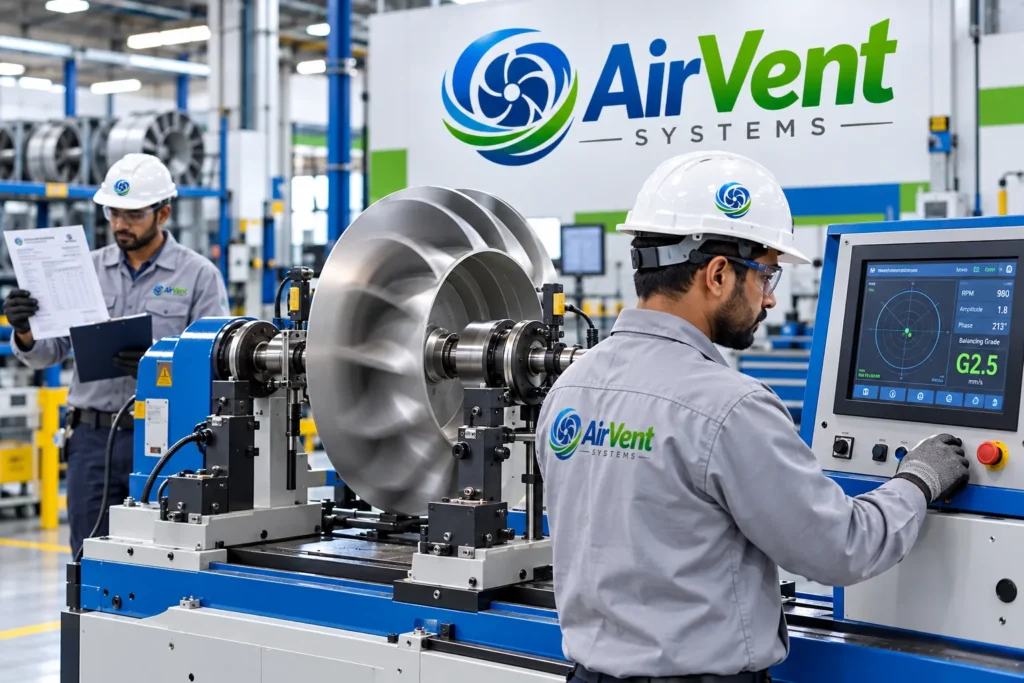
- Ask for the impeller balancing grade
Impellers must be dynamically balanced before assembly. Ask specifically for the balancing grade: G2.5 is the tighter standard for high-speed blowers; G6.3 is acceptable for lower-speed units. A manufacturer who cannot state their balancing grade has not considered it as a quality parameter.
- Request a performance curve at your operating point
A performance curve shows blower output across a range of static pressures, and your operating point should sit on the stable, right-descending portion of that curve. Avoid operating near the surge region (the left, unstable portion of the curve).
- Verify material grade with a mill certificate
If you have specified SS 304, SS 316, or FRP, request the material test certificate from any centrifugal blower manufacturer (MTC) for the actual grade used. This is standard industrial procurement practice. Misrepresented material grades are one of the most common quality failures in the Indian centrifugal blower market.
- Confirm testing before dispatch
Ask any centrifugal blower manufacturer whether the completed blower is performance-tested before dispatch, and whether you can receive actual measured CFM and static pressure data. A blower that leaves the factory untested may not meet specification once installed.
- Check spare parts availability in Pune or Maharashtra
Ask specifically whether bearings, shaft seals, and impeller components are stocked locally. A breakdown-to-repair time measured in days rather than weeks depends on local parts availability.
For guidance on how centrifugal blower selection connects to your complete air handling system, read our article on How to Choose the Right Industrial Blower for Your Application.
Centrifugal Blower Price in India: Honest Ranges
Pricing is the most searched and least published topic in the centrifugal blower market. Here are honest, experience-based ranges reflecting current manufacturing costs in India.
| Centrifugal Blower Type and Size | Approximate Price Range (INR) |
|---|---|
| Backward curved, 0.5 to 2 HP, MS | Rs. 10,000 to Rs. 32,000 |
| Backward curved, 2 to 10 HP, MS | Rs. 32,000 to Rs. 1,50,000 |
| Backward curved, 10 to 30 HP, MS | Rs. 1,50,000 to Rs. 4,50,000 |
| Backward curved, 10 to 30 HP, SS 304 | Rs. 2,80,000 to Rs. 7,50,000 |
| Radial blade, 5 to 30 HP, MS | Rs. 55,000 to Rs. 4,00,000 |
| Radial blade, 5 to 30 HP, hard-faced | Rs. 1,00,000 to Rs. 6,00,000 |
| Aerofoil blade, 10 to 50 HP, MS | Rs. 1,80,000 to Rs. 9,00,000 |
| FRP centrifugal blower, any size | Add 30 to 50 percent over MS equivalent |
| SS 316 construction, any size | Add 60 to 90 percent over MS equivalent |
| Complete system with ducting and starter | Add 40 to 80 percent over blower-only pricing |
These are indicative ranges only. When comparing quotes from any centrifugal blower manufacturer, actual centrifugal blower price depends on required static pressure, airflow, blade design, material, motor efficiency grade, and whether inlet guide vanes, VFD compatibility, or an acoustic enclosure are included. Always obtain a quote that specifies static pressure, airflow, and material grade explicitly.
Common Mistakes When Buying from a Centrifugal Blower Manufacturer
These mistakes appear repeatedly across plants in Pune, Maharashtra and across India. Every one of them is avoidable with the right pre-purchase process.
- Choosing by HP alone without confirming static pressure. A centrifugal blower fan sized incorrectly for your actual resistance will circulate air but not move it through your process, regardless of its motor size.
- Selecting an aerofoil or backward curved blade for a foundry or cement application. Dust buildup on these blade profiles causes rapid imbalance. Radial blades are the correct choice for abrasive environments.
- Accepting MS construction for a chemical or high-humidity application. Surface corrosion begins within months in the wrong material, and casing thinning accelerates beyond safe limits within two to three years.
- Not specifying motor efficiency grade. Specifying an IE1 motor instead of IE2 or IE3 costs more in electricity over two years than the entire price difference between grades.
- Skipping the site visit. Duct routing, available installation space, and actual process conditions frequently differ from what a drawing shows. A blower sized from a drawing contains assumptions; a blower sized after a site visit contains measurements.
- Comparing quotes without confirming identical specifications. A lower quote may reflect thinner casing walls, a lighter base frame, a lesser impeller balance grade, or an untested unit. The specification behind the price matters more than the price itself.
Maintenance Tips That Extend Centrifugal Blower Life
A centrifugal blower from a reputable manufacturer, correctly specified and properly maintained, should deliver reliable service for 8 to 12 years or more. These are the maintenance practices that deliver that result.
- Weekly visual check: Inspect for unusual sound, visible vibration, loose fasteners, or signs of dust accumulation on the impeller or in the inlet
- Monthly bearing check: Record bearing temperature and vibration velocity. An upward trend in either is a warning, not yet an emergency, but should be investigated at the next planned shutdown
- Calendar-based lubrication: Lubricate on a fixed schedule, not when noise appears. Audible bearing noise means damage has already occurred
- Impeller cleaning: In dusty applications, clean the impeller at a fixed interval to prevent uneven buildup that creates imbalance. Uneven dust on an impeller is one of the most common causes of progressive vibration increase in any centrifugal blower manufacturer installation
- Belt and coupling inspection: Check belt tension and pulley alignment monthly on belt-drive units. A loose belt reduces efficiency and overloads the motor
- Dynamic balancing after any impeller work: A weld repair or blade replacement changes mass distribution. Skip balancing after impeller work and vibration will increase immediately
For a detailed breakdown of what goes wrong when maintenance is missed, our article on Common Causes of ID Fan Failure and How to Prevent Them covers the most critical failure patterns for centrifugal equipment under continuous industrial duty. Our guide on 5 Signs Your Dust Collection System Needs Maintenance covers complementary warning signs on the downstream filtration side of your system.
Frequently Asked Questions
What is a centrifugal blower manufacturer?
A centrifugal blower manufacturer designs, fabricates, tests, and supplies centrifugal blowers engineered to move air or gas through industrial process systems using centrifugal force, serving sectors from HVAC and dust collection to pneumatic conveying and combustion air supply.
Which is the best centrifugal blower manufacturer in Pune?
The best centrifugal blower manufacturer in Pune is one that provides application-specific sizing. A reliable centrifugal blower manufacturer will also based on actual static pressure and airflow, specifies the correct blade design and material of construction for your conditions, dynamically balances every impeller, performance-tests before dispatch, and provides reliable after-sales support with local spare parts. Airvent Systems, backed by Ravi Air Tech established in Pune since 2005, meets all these criteria with over 17 years of field-proven centrifugal blower manufacturing experience.
What is the difference between a centrifugal blower manufacturer in Pune and one in Gujarat or Delhi?
The core product may be similar, but a Pune-based centrifugal blower manufacturer offers faster site visits for accurate field sizing, quicker spare parts availability from local stock, and direct knowledge of Maharashtra MPCB compliance requirements, all of which translate into shorter downtime and faster commissioning for Maharashtra-based buyers.
What blade design should I specify for a foundry application?
Radial blades are the correct choice for foundry applications. Radial blades resist dust and material buildup on blade surfaces, which in a foundry environment includes abrasive metal particulate that would rapidly erode backward curved or aerofoil blades. Any centrifugal blower manufacturer recommending a non-radial blade for foundry duty without a specific technical justification should be questioned.
What is the price of a centrifugal blower in Pune?
Centrifugal blower prices in Pune range from approximately Rs. 10,000 for a small 0.5 HP MS unit to Rs. 9,00,000 or more for a large 50 HP aerofoil-blade unit, with SS 304, SS 316, and FRP construction adding 40 to 90 percent over equivalent MS pricing.
How do I verify a centrifugal blower manufacturer’s quality?
Ask for the impeller balancing grade (G2.5 or G6.3), a performance curve at your operating point, material test certificates for any SS or FRP construction, confirmation of performance testing before dispatch, and references from similar applications in your industry.
What is the centrifugal blower fan price for a 10 HP unit in India?
A standard-duty 10 HP centrifugal blower in MS construction typically costs between Rs. 90,000 and Rs. 2,00,000 in India, depending on blade design, static pressure requirement, and whether a starter, VFD, or acoustic enclosure is included.
Final Thoughts
Choosing a centrifugal blower manufacturer in Pune, Maharashtra, or anywhere across India, is a technical decision. The right centrifugal blower manufacturer, or anywhere across India is a technical and commercial decision that affects your plant for the next decade. A correctly specified, correctly built centrifugal blower from a manufacturer who understands your process will run efficiently and reliably for years. A misspecified or under-engineered unit will show you that gap in rising vibration, overheating, reduced airflow, and early bearing failure within months of installation.
Pune’s centrifugal blower manufacturer cluster is genuinely strong, offering engineering depth that rivals any centrifugal blower manufacturer cluster in India, offering a combination of engineering depth, competitive pricing, and local service support that is difficult to match from manufacturers in Delhi, Gujarat, or other distant states for Maharashtra-based buyers. The key is choosing the right centrifugal blower manufacturer within that cluster based on verified engineering capability, not the lowest quote.
At Airvent Systems, backed by the manufacturing expertise of Ravi Air Tech, we manufacture centrifugal blowers across all blade designs and material grades from our Bhosari MIDC, Pune facility, performance-tested before dispatch and backed by local after-sales support. Learn more About Airvent Systems and explore our complete Products range, or share your application details with our engineering team today.
Looking for a trusted centrifugal blower manufacturer in Pune, Maharashtra or across India?Get a Free Application-Specific Quote from Airvent Systems Today