
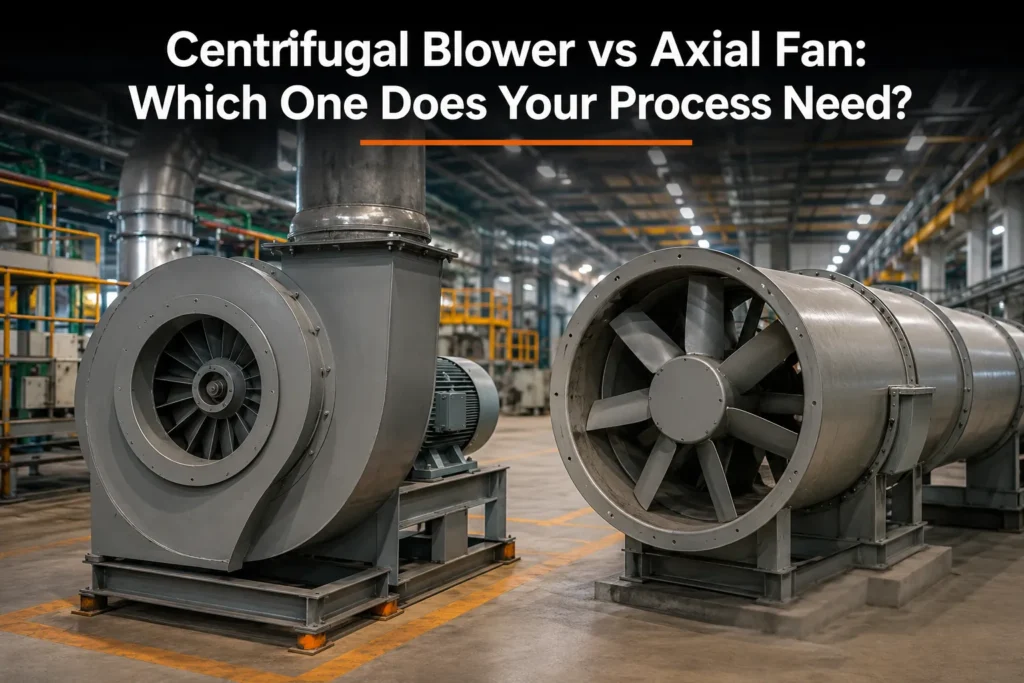
Centrifugal blower vs axial fan is a question I’ve answered on more shop floors than I can count, and every single time, I notice the same thing people assume it’s a small technical detail, when really, it’s one of the most important decisions in the entire ventilation or process design. I remember standing beside a plant engineer in an MIDC unit near Chakan a few years ago, watching him stare up at an axial fan that simply wasn’t pulling its weight, wondering out loud why the airflow “just wasn’t reaching where it needed to.” It reminded me, oddly enough, of walking into a quiet temple courtyard and noticing that the air itself feels different depending on how the space is built some spaces move air gently across a wide area, others push it with focused, deliberate force toward one point. That’s really the heart of the centrifugal blower vs axial fan decision, and once you understand it that way, the rest becomes much easier to follow.
So let’s walk through this together, properly, the way I would if we were standing in front of your ducting layout right now.
What Is a Centrifugal Blower, and How Is It Different From an Axial Fan?
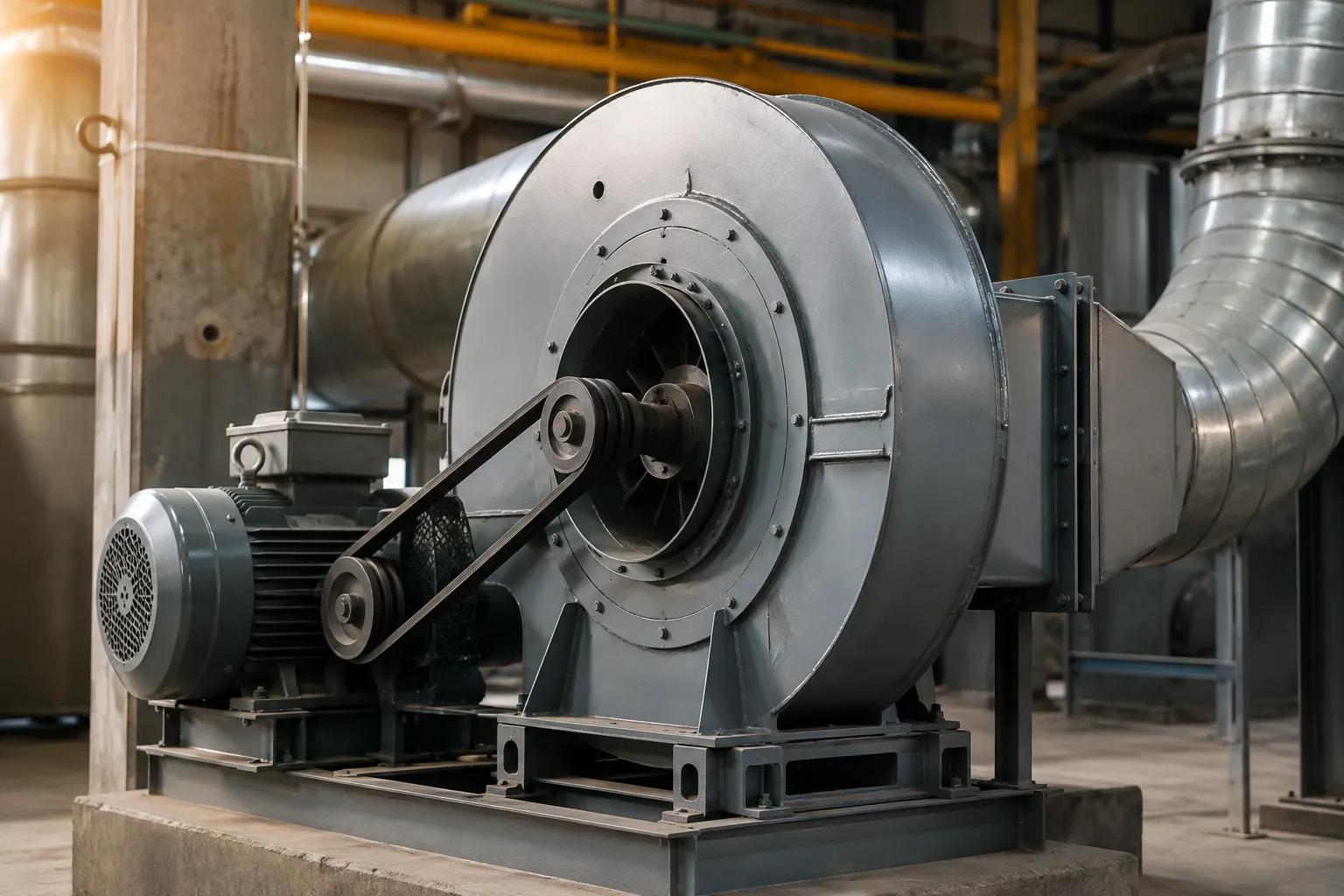
A centrifugal blower moves air by drawing it in through the center of a rotating impeller and throwing it outward at a 90-degree angle using centrifugal force, before channeling it out through a single discharge outlet. An axial fan, on the other hand, moves air in a straight line, parallel to the fan’s shaft much like a ceiling fan or an aircraft propeller pushes air directly forward.
In fact, that direction of airflow is really the single biggest difference between the two, and almost everything else pressure capability, noise, space requirement flows from that one distinction.
How a Centrifugal Blower Works
- Air enters axially through the eye of the impeller
- The impeller flings the air outward using centrifugal force
- Air is collected in a scroll-shaped housing and directed out through one discharge point
- This design allows the blower to build up high static pressure
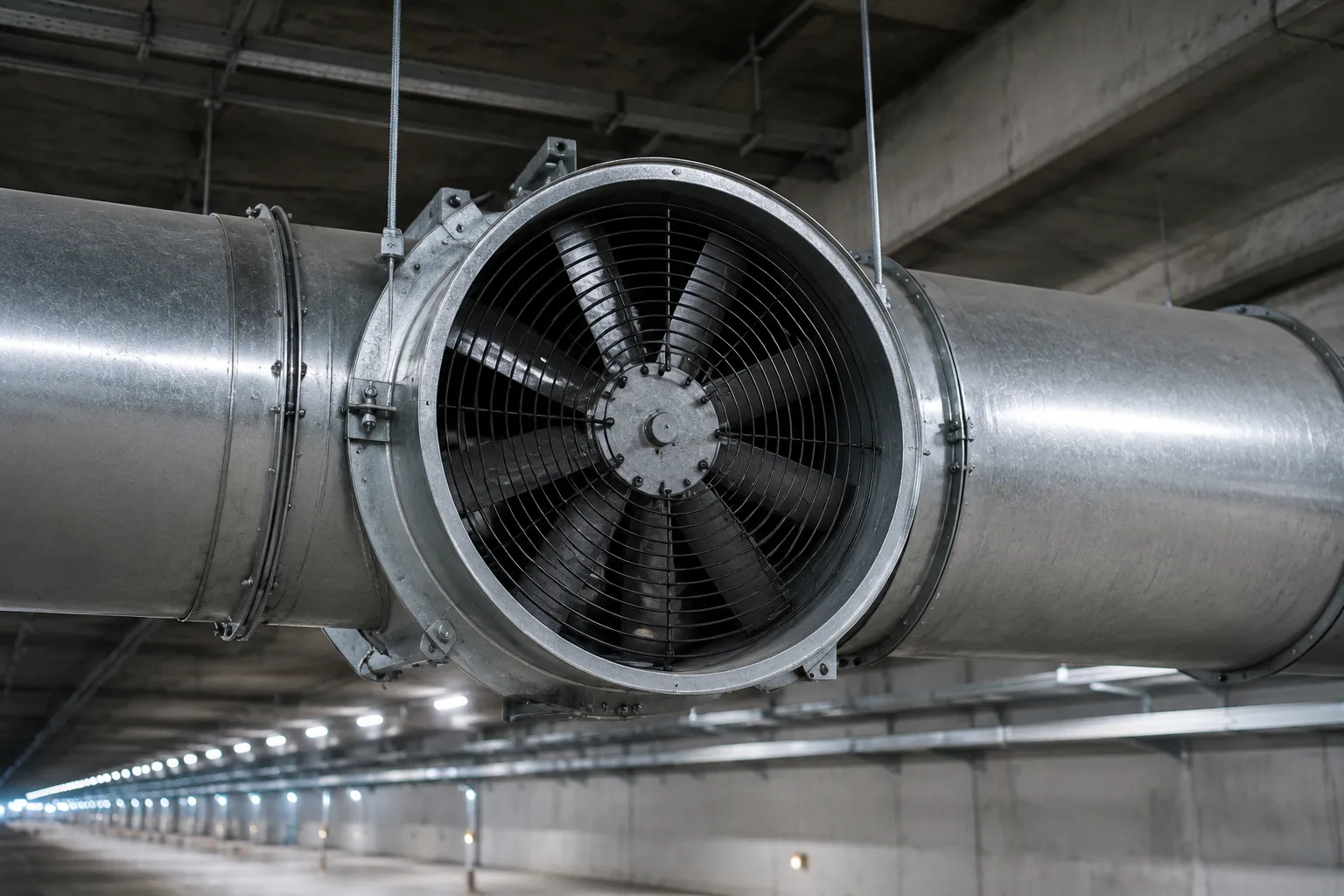
How an Axial Fan Works
- Air moves straight through the fan, entering and exiting along the same axis
- Blades are shaped like an aircraft propeller to push large volumes of air forward
- Best suited for low-resistance, high-volume airflow applications
Centrifugal Blower vs Axial Fan: Side-by-Side Comparison
| Feature | Centrifugal Blower | Axial Fan |
| Airflow direction | 90-degree turn (radial) | Straight through (axial) |
| Static pressure capability | High | Low to moderate |
| Air volume (CFM) | Moderate | High |
| Best suited for | Ducted systems, high resistance | Open spaces, low resistance |
| Noise level | Generally quieter at high pressure | Can be noisier at high volume |
| Space requirement | Larger footprint | Compact, in-line installation |
| Typical applications | Pneumatic conveying, combustion air, dust collection | General ventilation, cooling towers, exhaust systems |
| Efficiency at high pressure | High | Drops significantly |
Where a Centrifugal Blower Is the Right Choice
Over the years, I’ve found centrifugal blowers to be the dependable choice whenever the air has to travel through resistance long ducting, filters, bends, or a dust collector. Here’s where I recommend them most often:
- Pneumatic conveying systems moving material through long ducting runs
- Combustion air supply for boilers and furnaces, where consistent pressure matters
Dust collection and fume extraction systems, especially when paired with baghouse or cartridge filters we cover this in detail in our article on Types of Industrial Dust Collectors
- Process cooling where air must be pushed through tight, resistance-heavy paths
Therefore, if your system has any real resistance in the ductwork filters, long pipe runs, multiple bends a centrifugal blower will consistently outperform an axial fan, even if the axial fan looks like the cheaper option on paper.
Where an Axial Fan Is the Right Choice
That said, I don’t want to make it sound like axial fans are somehow the lesser option that wouldn’t be honest, and it wouldn’t serve you well either. Axial fans genuinely excel in their own space:
- General factory or warehouse ventilation, where you simply need to move a large volume of air with minimal resistance
- Cooling tower and radiator applications, pulling air straight through with no ducting
- Roof-mounted exhaust systems removing heat or fumes directly upward
- Tube axial fan applications in tunnels, parking structures, and large open sheds
More importantly, if your application doesn’t involve pushing air through a filter, a long duct, or a dense process, an axial fan will move far more air for far less power than a centrifugal blower trying to do the same job.
Common Mistake I See: Choosing Based on CFM Alone
I’ll be direct with you, because this mistake costs plants real money. A lot of buyers compare a centrifugal blower and an axial fan purely on CFM rating and go with whichever number looks bigger. This is, frankly, one of the most costly assumptions I see in the field. CFM alone tells you nothing about whether the fan can actually push that air through your specific resistance. An axial fan rated for a high CFM will lose most of that airflow the moment it meets real ducting resistance, while a correctly sized centrifugal blower will maintain performance because it’s built for exactly that condition.
This is precisely why we always ask for your duct layout, filter type, and total resistance before recommending equipment something we also talk about in our guide on How to Choose the Right Industrial Blower for Your Application.
Quick Decision Checklist

Ask yourself these questions honestly before deciding:
- Does the air need to travel through ducting, filters, or bends? → Centrifugal blower
- Is this an open space needing bulk air movement? → Axial fan
- Do you need high static pressure (above 100mm WG)? → Centrifugal blower
- Is noise and space at a premium, with low resistance? → Axial fan
- Is this feeding into a dust collector or scrubber system? → Centrifugal blower, almost always
A Word on FD/ID Fans, Since the Confusion Often Overlaps
Many plant engineers I speak with also confuse this decision with FD (forced draft) and ID (induced draft) fan selection, since both are technically centrifugal designs used in combustion systems. If that’s part of what you’re evaluating too, it’s worth reading our detailed breakdown in FD Fan vs ID Fan: Understanding the Difference, since the same centrifugal-vs-axial logic carries through into that decision as well.
Cost and Maintenance: What Nobody Tells You Upfront
Here’s something I wish more suppliers were upfront about, because it changes the real cost picture entirely. On paper, an axial fan usually looks like the cheaper option simpler construction, fewer components, lower purchase price. And in a low-resistance application, that’s genuinely true; you’ll get years of trouble-free service at a lower cost. However, the moment an axial fan is forced to work against resistance it wasn’t designed for, its efficiency collapses, power draw climbs, and the motor runs hotter than it should, which quietly shortens its working life. I’ve replaced more than a few axial fans that failed early simply because they were doing a centrifugal blower’s job.
A centrifugal blower, by comparison, costs more upfront and needs a slightly larger footprint, but it holds its efficiency and its motor life far better when resistance is part of the equation. So when you’re comparing quotes, don’t just look at the purchase price ask what the running cost and expected motor life will look like a year from now, under your actual operating conditions.
On the maintenance side, both types are relatively low-maintenance when correctly sized:
- Centrifugal blowers need periodic bearing lubrication, impeller balance checks, and belt or coupling inspection
- Axial fans need blade cleaning, bearing checks, and motor alignment verification, especially in dusty environments where blade imbalance can develop over time
Either way, routine inspection matters more than the technology itself a well-maintained fan of either type will consistently outperform a neglected one, regardless of how well it was originally sized.
Compliance and Efficiency Considerations
If your facility falls under emission or energy-efficiency norms tracked by the Bureau of Energy Efficiency (BEE), fan selection also affects your energy consumption reporting. A correctly matched blower or fan rather than an oversized one running inefficiently against resistance it wasn’t designed for genuinely reduces long-term power draw, which matters both for your compliance reporting and your electricity bill.
Frequently Asked Questions
What is the main difference between a centrifugal blower and an axial fan?
A centrifugal blower moves air at a 90-degree angle using centrifugal force and handles high resistance well, while an axial fan moves air in a straight line and is better suited for high-volume, low-resistance applications.
Which is better for dust collection systems, centrifugal blower or axial fan?
A centrifugal blower is almost always the better choice for dust collection systems because it can maintain airflow against the resistance created by filters and ducting.
Can an axial fan handle high static pressure?
No, axial fans are not designed for high static pressure applications; their efficiency drops significantly as resistance increases, unlike centrifugal blowers.
Is a centrifugal blower more energy efficient than an axial fan?
It depends on the application a centrifugal blower is more efficient in high-resistance systems, while an axial fan is more efficient for open, low-resistance airflow.
Do centrifugal blowers make more noise than axial fans?
Generally, centrifugal blowers run quieter at high pressure, while axial fans can become noisier when pushed to move large air volumes at high speed.
Final Thoughts
If you take one thing away from this, let it be this: the centrifugal blower vs axial fan decision isn’t about which technology is superior it’s about which one respects the actual conditions your air has to move through. I’ve watched plants save lakhs in energy costs simply by switching to the correctly matched equipment, and I’ve also watched perfectly good axial fans get blamed for underperformance when the real problem was that they were never suited for that resistance in the first place.
At Airvent Systems, we manufacture both centrifugal blowers and axial fans, and more importantly, we help you figure out which one your specific process actually needs before you spend a single rupee. You can explore our full range on our Centrifugal Blowers page, or reach out directly and share your application details with our team.
Not sure which one fits your process? Talk to Our Engineering Team for a Free Recommendation →