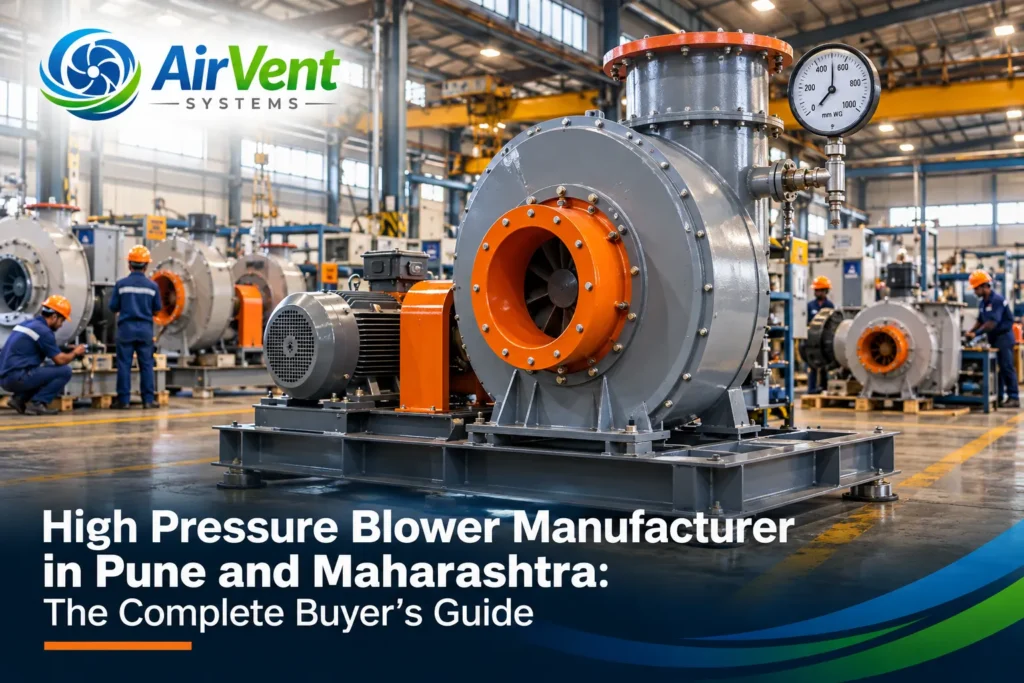
High pressure blower manufacturer is the search that arrives when a standard industrial blower has already failed your process, when your system needs static pressure that no general-purpose fan can deliver, or when your plant is being set up for the first time and your engineer has specified a high pressure blower on the drawing but nobody has explained what that actually means and why it costs more than a regular centrifugal unit. This guide on high pressure blower manufacturer selection answers every one of those questions, drawing on manufacturing experience from our Bhosari MIDC, Pune facility and backed by the engineering depth of our parent company Ravi Air Tech, established in Pune since 2005 with over 17 years of high pressure and centrifugal blower manufacturing experience across Maharashtra and India.
Whether you are looking for a high pressure blower manufacturer in Pune, or evaluating any high pressure blower manufacturer in India, searching for the best high pressure blower manufacturer in India, or evaluating options across cities like Mumbai, Delhi, Ahmedabad, and Hyderabad, the technical framework in this guide applies to every sourcing decision.
At Airvent Systems, supported by Ravi Air Tech, we manufacture high pressure blowers for industries across Maharashtra and India. Learn more About Airvent Systems and our manufacturing approach, or explore our complete Products range.
What Is a High Pressure Blower Manufacturer and Why the Right One Matters
A high pressure blower manufacturer is a company that designs. Every reputable high pressure blower manufacturer must engineer, fabricates, tests, and supplies blowers specifically engineered to develop static pressure significantly above what a standard centrifugal or axial fan can achieve. While a general-purpose industrial blower operates in the 50 to 300 mm WG range, a high pressure blower is designed to deliver 300 mm WG to 2,000 mm WG and beyond, depending on the type and application.
This elevated pressure output is precisely what makes high pressure blowers essential in applications where air must be pushed through dense resistance: long pneumatic conveying pipelines carrying powder or grain, deep aeration tanks in wastewater plants, combustion air systems for boilers and furnaces, and industrial cleaning operations requiring high-velocity air jets. In every one of these applications, a standard blower will simply stall against the resistance and fail to deliver airflow. Only a correctly designed high pressure blower maintains performance under these conditions.
Choosing the wrong high pressure blower manufacturer matters significantly more than choosing the wrong standard blower supplier. A high pressure blower manufacturer in Pune or India that underspecifies more than it might in other equipment categories, because the gap between a correctly designed unit and an incorrectly specified one is not a subtle performance degradation. It is a complete operational failure. A high pressure blower that cannot develop its rated static pressure against your actual system resistance is, functionally, a blower that does not work. This is why every detail of this guide matters before you place your order.
How a High Pressure Blower Works: The Engineering Behind High Static Pressure
Understanding the working principle of a high pressure blower, and the engineering decisions your high pressure blower manufacturer makes to achieve it, explains immediately why it costs more than a standard blower and why the pressure rating must be matched to your system resistance precisely.
Working principle, step by step:
- Air intake: Air enters the blower inlet at atmospheric pressure
- Impeller acceleration: The impeller, rotating at significantly higher speed than a standard blower (typically 2,800 to 3,600 RPM for single-stage units, and higher for multi-stage), flings air outward at high velocity using centrifugal force
- Pressure conversion: The scroll housing converts kinetic energy into static pressure. Higher impeller tip speed equals higher pressure development
- Multi-stage pressure building (for very high pressure): In multi-stage designs, two or more impellers in series each add pressure to the same airstream, multiplying total output pressure without proportionally increasing impeller diameter
- Discharge: The pressurized air exits through the discharge outlet at the required pressure to push through your specific system resistance
The critical design relationship is this: pressure output is proportional to the square of impeller tip speed, while power consumption is proportional to the cube. This means that getting from 500 mm WG to 1,000 mm WG is not simply a matter of doubling the motor. It requires either a larger impeller, a higher rotational speed, or a multi-stage design, each of which has engineering and cost implications that a competent high pressure blower manufacturer will discuss with you before quoting.
For context on how this compares to the centrifugal blowers used in ventilation and general process applications, our article on Centrifugal Blower Manufacturer in Pune and Maharashtra covers the standard pressure range and selection criteria in detail.
Types of High Pressure Blowers: Which One Suits Your Application
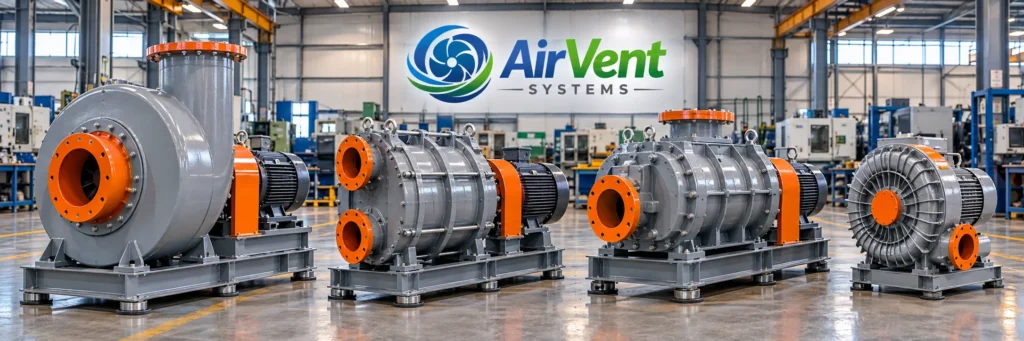
Not all high pressure blowers are the same technology. Any experienced high pressure blower manufacturer will guide you through this choice before discussing any other specification. Choosing the correct type is the first decision any high pressure blower manufacturer should help you make before any other specification detail is discussed.
Single-Stage High Pressure Centrifugal Blower
The most common high pressure blower type in Indian industry. A single impeller running at elevated speed develops pressures from 300 mm WG to approximately 1,000 mm WG in most standard industrial configurations.
Best for: Furnace combustion air, boiler forced draft, industrial drying, high-pressure fume extraction, and pneumatic conveying of light materials over moderate distances
Pressure range: 300 to 1,000 mm WG typical
Key advantage: Simpler construction, lower maintenance, wide availability of spares in Pune and Maharashtra
Multi-Stage High Pressure Centrifugal Blower
Two or more impeller stages mounted on the same shaft in series. Each stage adds pressure to the same airstream. This design reaches pressures that a single stage cannot achieve without an impeller diameter that becomes impractical.
Best for: Dense-phase pneumatic conveying over long distances, deep tank aeration, high-resistance filtration systems, and high-pressure combustion air for large boilers
Pressure range: 800 mm WG to 2,500 mm WG and beyond
Key advantage: Achieves very high pressure with manageable impeller size and motor current
Roots (Twin-Lobe Positive Displacement) Blower
Counter-rotating twin lobes trap and displace a fixed volume of air with each rotation, generating high pressure with a constant flow rate regardless of system pressure changes. This positive-displacement working principle is fundamentally different from centrifugal types.
Best for: Wastewater aeration requiring consistent airflow under variable back-pressure, cement and fly ash pneumatic conveying, and applications where flow constancy matters more than efficiency
Pressure range: Up to 1,000 mm WG
Key advantage: Constant flow regardless of pressure variation. Major disadvantage: inherently noisier than centrifugal designs
Side Channel (Ring) Blower
A compact, lightweight design using a single impeller operating in a ring-shaped channel, recirculating air through the blade set multiple times before discharge. Achieves surprisingly high pressure from a very small footprint.
Best for: Small high pressure applications: vacuum packaging, aquaculture aeration, printing presses, laboratory fume hoods, and medical equipment
Pressure range: 200 to 600 mm WG typically
Key advantage: Very compact, no oil lubrication required, virtually silent, minimal maintenance
High Pressure Blower vs Standard Industrial Blower: Key Differences
| Feature | Standard Industrial Blower | High Pressure Blower |
| Typical static pressure | 50 to 300 mm WG | 300 to 2,500 mm WG |
| Impeller speed | 960 to 1,450 RPM | 1,450 to 3,600 RPM |
| Casing wall thickness | Standard | Heavier, reinforced |
| Bearing specification | Standard industrial | Heavy-duty, higher load rating |
| Noise level | Moderate | Higher at peak pressure |
| Motor HP for same CFM | Lower | Significantly higher |
| Applications | Ventilation, dust collection | Conveying, aeration, combustion |
| Shaft sealing requirement | Standard | Critical, higher leakage risk |
| Price premium over standard | Baseline | 40 to 150 percent depending on pressure |
| Design complexity | Standard | Higher: impeller balance critical |
High Pressure Blower Applications Across Maharashtra Industries
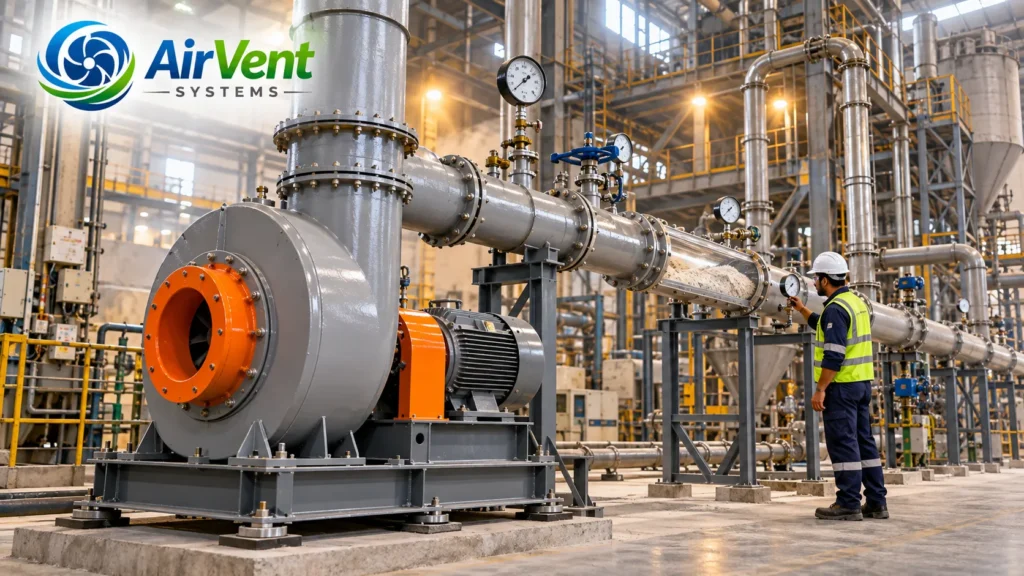
An experienced high pressure blower manufacturer in Pune serves many sectors, each requiring a different pressure range, material, and design configuration.
- Cement plants (Pune, Nashik, Aurangabad): High pressure centrifugal blowers for pneumatic conveying of cement and fly ash through long pipeline runs, and combustion air for clinker coolers. Also read our guide on Types of Industrial Dust Collectors to understand how high pressure blowers connect to filtration systems downstream
- Boiler forced draft systems: Single-stage or multi-stage high pressure blowers as FD fans supplying combustion air against furnace back-pressure. Our detailed guide on FD Fan and ID Fan Manufacturer in India covers the specific FD fan variant of high pressure centrifugal blowers in combustion systems
- Foundries (Bhosari, Ranjangaon, Kolhapur): High pressure air for cupola furnace combustion, with radial-blade high pressure blowers specified for dust-laden hot air conditions
- Wastewater treatment (Pune, Navi Mumbai): Roots blowers and high pressure centrifugal blowers for submerged aeration, where discharge pressure must overcome the head of water above the diffuser
- Pharmaceutical and chemical plants: High pressure blowers for vacuum filtration, reactor aeration, and transfer of powders in closed-loop pneumatic conveying
- Pneumatic conveying systems: Dense-phase and dilute-phase conveying of food grain, pharmaceutical powders, fly ash, and plastic pellets through long pipe runs, where system resistance can exceed 800 mm WG
- Industrial cleaning and air knives: High pressure blowers supplying air to knife-shaped nozzles for cleaning conveyor belts, removing moisture from bottles, and drying sheets in printing and packaging lines
- Automotive plants (Chakan, Talegaon): High pressure blowers for blow-off stations, paint booth pressurisation and cooling tunnel air supply
High Pressure Blower Manufacturer in Pune: What the Local Ecosystem Offers
Pune has a substantial cluster of high pressure blower manufacturers, ranging from established engineering companies with multi-decade track records to newer fabricators assembling units with minimal in-house design capability. Understanding what the Pune ecosystem offers helps you choose within it more effectively.
The genuine advantage of working with a high pressure blower manufacturer in Pune for Maharashtra-based buyers comes down to four practical realities.
Same-day or next-day site visits. High pressure blower sizing requires accurate knowledge of your duct layout, the actual resistance in your system, and your process conditions. A Pune-based manufacturer can send an engineer to your facility in Bhosari, Chakan, Talwade, or Ranjangaon within 24 hours. A manufacturer in Delhi, Ahmedabad, or Hyderabad cannot.
Local spare parts availability. A high pressure blower running a pneumatic conveying system or an aeration basin cannot wait 5 to 7 days for a bearing or shaft seal from another state. A Pune-based high pressure blower manufacturer with proper spares inventory can have your plant running again in hours, not days.
MPCB compliance knowledge. The Maharashtra Pollution Control Board enforces specific consent conditions on industrial equipment installations. A Pune high pressure blower manufacturer with active installations across MIDC zones understands these requirements from direct experience. Our Air Pollution Control Equipment range covers systems that often work alongside high pressure blowers in MPCB-regulated installations.
Competitive pricing without distributor margins. Working directly with a manufacturer in Pune eliminates one reseller margin layer and typically results in faster, more technically detailed communication during the quotation stage.
Among Pune’s established high pressure blower manufacturer operations, Breezeair Technology in Talawade and Air Control Systems in Chikhali represent the typical local supplier profile: Pune-based fabricators with centrifugal and high pressure blower ranges. At Airvent Systems, backed by Ravi Air Tech established in 2005, we bring over 17 years of high pressure blower manufacturing experience to every application, with a specific emphasis on engineered solutions rather than catalogue-size matching.
Material of Construction for High Pressure Blowers: MS, SS, FRP and Cast Iron
High pressure blowers handled by any high pressure blower manufacturer span a wider range of process conditions than standard ventilation blowers, and material selection is more critical because the consequences of getting it wrong at elevated pressure are accelerated. Casing corrosion at high pressure causes faster wall thinning than at low pressure, and an impeller material failure at 1,000 mm WG releases more energy than one at 100 mm WG.
Mild Steel (MS)
Standard construction for clean air and moderately dusty applications.
- Temperature limit: Up to 250 degrees C with appropriate design
- Best for: Combustion air, general pneumatic conveying of dry non-corrosive material, aeration of clean water
- Not suitable for: Corrosive gas streams, high-humidity acid-bearing environments, food-grade applications
Cast Iron (CI)
Traditional material for Roots blowers and some centrifugal high pressure designs. Excellent dimensional stability, good wear resistance.
- Temperature limit: Up to 200 degrees C
- Best for: Roots blowers for wastewater aeration, conveying systems with moderate abrasion
- Not suitable for: Corrosive environments, any application where impact resistance matters
Stainless Steel 304
For food-grade, pharmaceutical, and mildly corrosive applications.
- Temperature limit: Up to 300 degrees C
- Best for: Food powder conveying, pharmaceutical transfer, dairy plant aeration
- Cost premium: 50 to 70 percent over equivalent MS
Stainless Steel 316
For chemical environments, coastal installations, and acid gas applications.
- Temperature limit: Up to 300 degrees C
- Best for: Chemical plant conveying, chloride-bearing environments, strong acid fume
- Cost premium: 70 to 100 percent over equivalent MS
FRP (Fibre Reinforced Plastic)
For highly corrosive acid and alkali gas streams that attack even stainless steel.
- Temperature limit: Up to 80 degrees C
- Best for: Acid fume exhaust, electroplating, pickling line air systems
- Cost premium: 30 to 50 percent over MS, lower than SS 316 for equivalent corrosion resistance
Material Selection Quick Reference
| Process Condition | Recommended Material |
| Clean air, ambient temperature | Mild Steel (MS) |
| Abrasive dry powder conveying | MS with hard-faced impeller |
| High temperature, 150 to 250 degrees C | Alloy Steel or heat-treated MS |
| Food or pharma conveying | SS 304 |
| Chemical or coastal environment | SS 316 |
| Strong acid or alkali fumes | FRP |
| Wastewater aeration | Cast Iron or MS epoxy-coated |
Technical Specifications You Must Confirm Before Ordering
This is the section that separates buyers who choose the right high pressure blower manufacturer from those who do not from buyers who get a blower that looks right on paper and fails in service. Any high pressure blower manufacturer in Pune or India should ask for all of these before providing a firm quotation.
Required airflow (m3/hr or CFM at operating conditions): Always state at the actual operating temperature and altitude. Airflow at 20 degrees C is different from airflow at 120 degrees C because hot air is less dense, and the blower must move more volume to deliver the same mass flow.
Required static pressure (mm WG or kPa): This is the system resistance your blower must overcome. Do not guess this number. Measure or calculate it from your actual duct layout, pipe length, bends, valves, filtration resistance, and process back-pressure. An underspecified static pressure is the single most common cause of a high pressure blower that stalls in service.
Operating temperature of the gas being handled: Affects impeller tip clearances, material selection, and shaft seal design.
Gas composition: Clean air, dusty air, corrosive fumes, humid air, or a mixture. Each combination drives a different material and impeller design choice.
Altitude above sea level: Air density decreases at altitude. At 600 metres above sea level, which applies to parts of Pune district, air density is approximately 7 percent lower than at sea level, meaning a blower sized for sea level will deliver 7 percent less mass flow at the same pressure setting.
Duty cycle: Continuous 24/7 operation, intermittent, or standby. This determines motor insulation class, bearing specification, and whether a variable frequency drive should be considered.
Inlet conditions: Whether the blower draws from open atmosphere or from a closed system, and whether any moisture separator, filter, or damper sits at the inlet.
For a broader framework on how blower selection fits into your overall air system, our guide on How to Choose the Right Industrial Blower for Your Application covers the complete selection decision across all blower types.
High Pressure Blower Price in Pune and India: Realistic Ranges
Published prices for high pressure blowers on IndiaMART and TradeIndia range from Rs. 15,000 to Rs. 47,500 for small units, but these figures tell only part of the story. For industrial-grade, engineered high pressure blowers, the pricing picture is significantly broader and depends on pressure rating, material, and whether a complete system is being supplied.
| High Pressure Blower Type and Size (per high pressure blower manufacturer standard) | Approximate Price Range (INR) |
| Side channel ring blower, 0.5 to 2 HP | Rs. 12,000 to Rs. 45,000 |
| Single-stage centrifugal, 2 to 5 HP, MS, up to 500 mm WG | Rs. 30,000 to Rs. 90,000 |
| Single-stage centrifugal, 5 to 15 HP, MS, up to 800 mm WG | Rs. 90,000 to Rs. 2,80,000 |
| Single-stage centrifugal, 15 to 50 HP, MS, up to 1,000 mm WG | Rs. 2,80,000 to Rs. 8,00,000 |
| Multi-stage centrifugal, 10 to 50 HP | Rs. 3,50,000 to Rs. 15,00,000 |
| Roots blower, 5 to 30 HP, cast iron | Rs. 1,80,000 to Rs. 8,00,000 |
| SS 304 construction, any type | Add 50 to 70 percent over MS equivalent |
| SS 316 construction, any type | Add 70 to 100 percent over MS equivalent |
| FRP construction, any type | Add 30 to 50 percent over MS equivalent |
| Complete system with starter panel and silencer | Add 40 to 80 percent over blower-only pricing |
These are indicative ranges only. When comparing quotes from any high pressure blower manufacturer, actual price depends on the specific static pressure requirement, airflow, material grade, impeller design, noise attenuation requirement, and whether a VFD, acoustic enclosure, or inlet filter is included in scope. Never accept a quote that states only HP and price without confirming static pressure and airflow specifications.
Best High Pressure Blower Manufacturer in Pune and India: How to Verify Quality Before Ordering
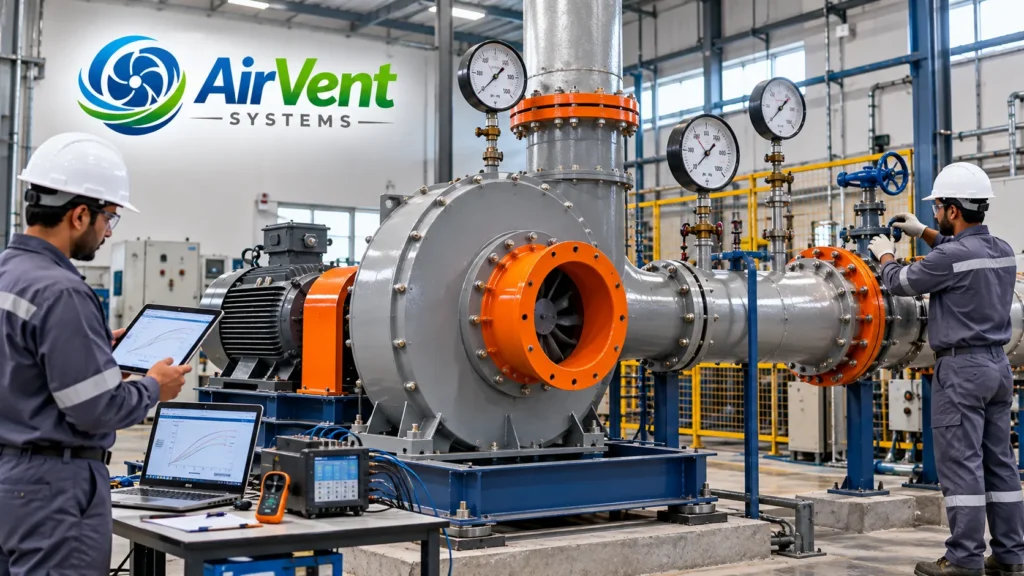
The search for the best high pressure blower manufacturer is a search every buyer goes through, and it is genuinely a search for the most verifiable manufacturer, because quality in this product category is not visible to the eye. Here is exactly how to verify it before committing.
- Ask for a system resistance calculation, not just a blower curve
A competent high pressure blower manufacturer in Pune or anywhere in India will calculate your total system resistance from your duct layout and process back-pressure before recommending a blower size. A manufacturer who skips this step and quotes based on your stated pressure requirement alone, without cross-checking against your system, is assuming your own calculation is correct. That assumption fails regularly in the field.
- Request the impeller balancing grade and test certificate
High pressure blowers run at significantly higher speeds than standard centrifugal blowers. At these speeds, even minor impeller imbalance creates large bearing loads and vibration. Ask specifically for G2.5 dynamic balance grade. This is the standard for high-speed rotating equipment and any credible high pressure blower manufacturer will reference it without hesitation.
- Confirm shaft seal design for your pressure rating
As static pressure increases, the tendency for air to leak back along the shaft increases proportionally. At 500 mm WG and above, shaft sealing design becomes critical to both performance and bearing longevity. Ask your manufacturer specifically how the shaft seal is designed for your pressure rating.
- Request a noise level estimate
High pressure blowers are inherently noisier than standard centrifugal units. If your installation is near occupied areas or if your facility has occupational noise compliance requirements under Indian factory regulations, ask for a noise level estimate at your operating point and discuss silencer options upfront.
- Verify after-sales support and local spare parts
Ask explicitly: can you supply bearings, shaft seals, and impeller components from stock within 48 hours in Pune? A high pressure blower powering an aeration system or a conveying line cannot wait a week for spares from another city.
For guidance on what goes wrong when maintenance is missed on high-pressure centrifugal equipment, our article on Common Causes of ID Fan Failure and How to Prevent Them covers the failure patterns most directly relevant to high-speed centrifugal designs under continuous duty.
Common Mistakes That Cause High Pressure Blowers to Underperform
These mistakes repeat consistently across plants in Pune and Maharashtra when working with any high pressure blower manufacturer, and every one, and every one of them is preventable with the right pre-purchase process.
- Specifying pressure in HP instead of mm WG. A 10 HP high pressure blower can be built for 400 mm WG or 1,200 mm WG depending on impeller design. HP alone tells you nothing about actual pressure output.
- Underestimating system resistance. The most common reason a new high pressure blower fails to move material through a conveying line is that the pipe run is longer than estimated, there are more bends than counted, or the filter resistance was not included in the system resistance calculation. Always add a 15 to 20 percent safety margin to your calculated system resistance.
- Selecting a side channel ring blower for heavy industrial duty. Ring blowers are excellent for light, low-dust applications. They are not designed for continuous heavy dust loading or elevated temperatures above 60 degrees C. A heavy duty industrial application that exceeds these conditions will destroy a ring blower rapidly.
- Ignoring altitude correction. Pune district sits at 500 to 700 metres above sea level. Air density at this altitude is approximately 6 to 7 percent lower than at sea level. A blower sized from standard sea-level tables without altitude correction will underperform at your actual installation site.
- Comparing quotes without confirming identical specifications. Two quotes for a 10 HP high pressure blower may differ by Rs. 60,000. The difference is almost always explained by different static pressure ratings, different casing wall thickness, different impeller material, or different balancing standards. The cheaper quote may not be cheaper once it fails to perform.
- Skipping acoustic assessment. Noise from high pressure blowers at 800 mm WG and above often exceeds occupational exposure limits without attenuation. Installing an acoustic enclosure or silencer after the fact typically costs more than specifying it upfront.
Maintenance Checklist to Extend High Pressure Blower Life
A correctly specified and well-maintained high pressure blower from a reliable high pressure blower manufacturer should deliver reliable continuous service for 8 to 12 years. These are the maintenance practices that make that service life achievable.
- Weekly: Listen for change in noise character, check for any visible oil or grease leakage at bearing housings, verify motor current reading against baseline
- Monthly: Record bearing temperature at both ends, record vibration velocity at bearing housings and compare to baseline trend, inspect inlet filter if fitted
- Quarterly: Check coupling or belt alignment, inspect shaft seal for wear or air leakage, verify impeller for dust buildup particularly in conveying applications
- Annually or at each planned shutdown: Full impeller inspection and cleaning, dynamic balancing check if vibration trend has risen, bearing replacement on a time-based schedule for continuous-duty units, motor insulation resistance test
The single most important maintenance principle for high pressure blowers is this: never wait for a problem to become obvious before acting on a trend. A vibration reading that has increased by 30 percent over three months is a warning that intervention is needed now, not a symptom to monitor until the bearing fails. By the time a high pressure blower fails catastrophically, the repair cost is always higher than the intervention cost would have been at the trend stage.
Our guide on 5 Signs Your Dust Collection System Needs Maintenance covers the complementary warning signs on the downstream filtration and system side that often appear before the blower itself shows distress.
Frequently Asked Questions
What is a high pressure blower manufacturer?
A high pressure blower manufacturer designs, fabricates, and tests blowers engineered to develop static pressure above 300 mm WG, used in applications including pneumatic conveying, aeration, combustion air supply, and industrial drying where standard centrifugal blowers cannot maintain airflow against the system resistance.
Which is the best high pressure blower manufacturer in Pune?
The best high pressure blower manufacturer in Pune is one that calculates your system resistance before recommending a blower size, specifies the correct type and material of construction for your process conditions, dynamically balances impellers to G2.5 grade, performance-tests before dispatch, and maintains local spare parts in Pune for fast breakdown response. Airvent Systems, backed by Ravi Air Tech established in Bhosari MIDC since 2005, meets all these criteria with over 17 years of high pressure blower manufacturing experience.
What is the difference between a high pressure blower and a standard industrial blower?
A standard industrial blower operates in the 50 to 300 mm WG range and is designed for ventilation, dust collection, and general air movement. A high pressure blower is designed for 300 mm WG and above, using heavier casing construction, higher impeller speeds, more robust bearings, and critical shaft sealing to sustain performance against high system resistance.
What types of high pressure blowers are available?
The main types are single-stage high pressure centrifugal blowers, multi-stage high pressure centrifugal blowers, Roots twin-lobe positive displacement blowers, and side channel ring blowers, each suited to different pressure ranges, applications, and duty requirements.
What is the price of a high pressure blower in Pune?
High pressure blower prices in Pune range from approximately Rs. 12,000 for a small side channel ring blower to Rs. 15,00,000 or more for a large multi-stage centrifugal unit in SS construction, with actual pricing depending on static pressure requirement, airflow, type, material, and whether a complete system is included.
Why choose a high pressure blower manufacturer in Pune over one in Delhi or Ahmedabad?
For Maharashtra-based buyers, a Pune-based high pressure blower manufacturer offers same-day or next-day site visits for accurate sizing, local spare parts availability for fast breakdown response, and direct knowledge of MPCB compliance requirements, all of which reduce downtime and project risk compared to a distant supplier.
What information do I need to provide to get an accurate high pressure blower quote?
Provide required airflow in m3/hr or CFM, required static pressure in mm WG, operating temperature, gas composition, duty cycle, altitude above sea level, and whether any inlet or outlet accessories are needed. A high pressure blower manufacturer who quotes without asking for most of these parameters is providing a catalogue estimate, not an engineered solution.
Final Thoughts
A high pressure blower manufacturer is only as good as the engineering conversation that happens before the order is placed. The difference between a plant that commissions a new conveying system or aeration installation and runs it reliably for a decade, and a plant that replaces its blower twice in three years, almost always comes down to whether the system resistance was correctly calculated, whether the blower type was matched to the application, and whether the manufacturer asked the right questions before quoting.
Pune’s high pressure blower manufacturer ecosystem is genuinely strong, and a Pune-based high pressure blower manufacturer brings advantages, with multiple competent manufacturers serving Maharashtra’s industrial base. The challenge for any Maharashtra buyer is not finding a high pressure blower manufacturer in Pune. The challenge is identifying the right high pressure blower manufacturer within that ecosystem. The challenge is identifying the one whose engineering process, quality standards, and after-sales commitment match the demands of your specific application. Every high pressure blower manufacturer in Pune should be evaluated on these criteria before you commit to an order.
As your trusted high pressure blower manufacturer, at Airvent Systems, backed by the manufacturing expertise of Ravi Air Tech, we manufacture high pressure centrifugal blowers, multi-stage blowers, and complete high pressure air systems from our Bhosari MIDC, Pune facility, performance-tested before dispatch and supported by local after-sales service across Maharashtra. Learn more About Airvent Systems, explore our complete Products range, or share your application details with our engineering team today.
Looking for a trusted high pressure blower manufacturer in Pune, Maharashtra or across India?
Get a Free Application-Specific Quote from Airvent Systems Today